Julia Arévalo’s White Wool Cape: A 1983 Family Gift Beside the Parliamentary Record
Research and writing: DDUJA KNIT · 한국어로 읽기
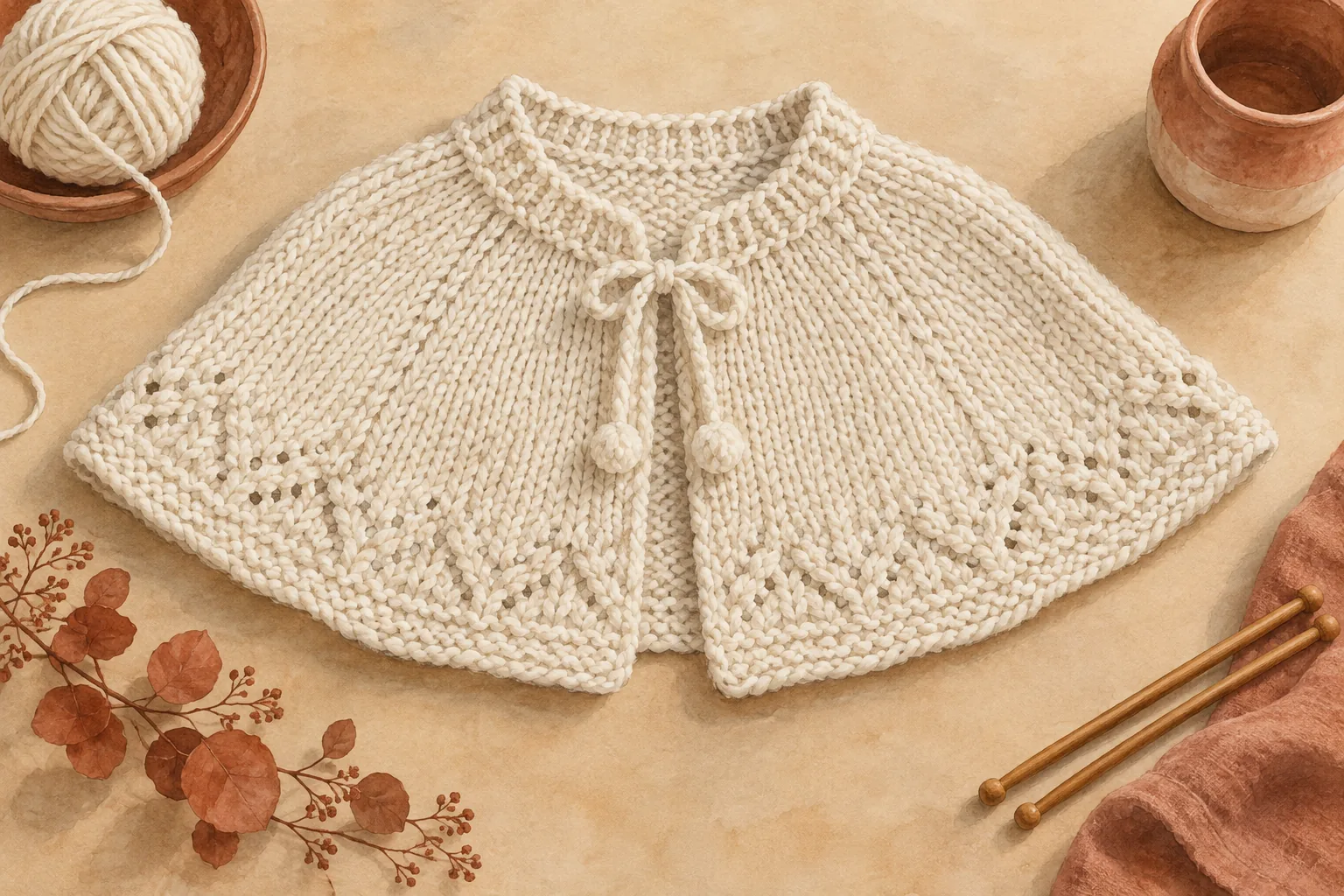
A white wool cape made for a granddaughter survives in a Uruguayan museum record under the name of Julia Arévalo de Roche, a woman also documented in parliamentary history. The object card gives a year, 1983, a diameter of 110 cm and the technique tejido a aguja. It does not give a stitch count or a pattern. Parliamentary library records, meanwhile, show her name in the contents of a magazine from the 1940s. Reading these together is useful only if we preserve the distance between a public record and a family garment. The five images here are clearly marked AI concept illustrations, not photographs of the surviving object.
One garment, a name and a measurement
Uruguay’s museum portal describes the garment as a capa o mañanita, a short winter wrap worn over the shoulders. It categorizes the object as civilian dress, records white wool as its material, and specifies needle knitting as the technique. The listed diameter is 110 cm and the date is 1983. The record does not explain exactly how that diameter was measured or supply an inner circumference, an opening measurement or a schematic. Nor is the garment presented as the museum’s own property: the entry names the Roche family collection and gives no inventory number. A museum’s online presentation and physical ownership are not the same fact. Calling this a knitted wool garment is supported; deriving a modern cape pattern from the single measurement is not.
What “needle knitted” proves—and what it cannot
The technical phrase in the card matters because knitting is not interchangeable with weaving or embroidery. It is still only one line of description. No needle size, yarn thickness, gauge, starting point, increases, decreases, seam, edge treatment or stitch motif is identified. A 110 cm diameter cannot be converted to a cast-on count without both a gauge and a measured construction. The ribbon and surface texture in our AI paintings are visual inventions, not evidence about the original. A viewer can follow the link to the museum photograph and observe a silhouette, but the invisible reverse and interior structure would require more documentation. A responsible reconstruction would need detailed views of both sides, a measurement diagram, direct object study and a tested sample.
A lower-house entry, then a Senate term
The museum description places Arévalo in the lower house in 1943–47 and the Senate in 1947–51. A biography on the parliamentary library site names her among the first four women to enter Uruguay’s parliament: Arévalo and Magdalena Antonelli Moreno entered the Chamber of Deputies, while Sofía Álvarez Vignoli and Isabel Pinto entered the Senate. This distinction prevents the common mistake of moving Arévalo’s later Senate service back to her initial 1943 entry. A claim about who was “first” across all Latin America would need a different comparative inquiry, so this article does not repeat that superlative. Neither a parliamentary date nor a magazine title proves that Arévalo intended the 1983 cape as a political emblem. The garment was recorded as a gift to a granddaughter.
What a table of contents can tell us
The parliamentary library’s Nosotras catalogue record lists Arévalo de Roche as a director and gives a Montevideo imprint dated 1945–48 while also listing later issues in the library’s holdings. Separate issue records reveal appearances across time. The March 1946 contents list her editorial and an item on women’s civil rights. The July 1946 contents attach her name to a title concerning hunger and cold. The May 1947 contents list a contribution and an interview about legal protection for rural women. The June 1947 contents contain another title under her name. These are bibliographic records of titles and pages, not the articles’ full text. We cannot quote her argument from them or connect a title about cold in 1946 to the cape made decades later. They locate her public editorial activity; the object card locates a private act of making.
A gift recorded without a recipient’s name
The museum says Arévalo knitted the cape for one of her granddaughters. The card does not name that person or give a day, occasion or place of presentation. It also says she knitted throughout her life, drawing in part on a later 2001 biographical account by Cristina Canoura. That passage is a later author’s description repeated by the museum, not a diary of the 1983 making process or direct testimony from the granddaughter. The surviving wool garment is a rare way in which everyday handwork enters the historical record. It does not, by itself, disclose the maker’s feelings or the complete history of a family. Her public work and her knitting can be held in the same biography without making either merely a metaphor for the other.
A three-column checklist for the next historical knit
When reading an old knitted object as carefully as a pattern, make three columns. The first contains what the institution actually records: maker, date, white wool, needle knitting, 110 cm diameter and a gift for a granddaughter in this case. The second contains research questions: cast-on or starting point, shaping, stitch count, edge treatment and how the garment was oriented on the body. The third holds attractive stories unsupported by the present sources: the granddaughter’s identity, a production schedule, where the cape was worn or whether it encoded a political message. Five polished concept paintings do not fill those gaps. The lesson is practical: distinguish material from technique, document each measurement’s meaning and leave missing pattern data as a question.
Records consulted and image rights
- Uruguay museum portal, ‘Capa o mañanita tejida por Julia Arévalo’ — object card, 1983 date, wool, technique, measurement, family ownership and later biographical quotation.
- Parliamentary library, Sofía Álvarez Vignoli biography — the four women’s initial entry and house assignments.
- Parliamentary library, Nosotras serial record — Arévalo’s director credit, imprint and holdings.
- Nosotras, March 1946 issue contents — her name and listed pieces.
- Nosotras, July 1946 issue contents — her byline and title.
- Nosotras, May 1947 issue contents — contribution and interview listing.
- Nosotras, June 1947 issue contents — another listed article.
Actual historical-object photographs used: zero. AI-generated reference images used: five. The object photograph and magazine cover were not republished because their reuse terms could not be confirmed. Each illustration’s caption links the relevant original page and the AI file. No image is a faithful copy of the object or a tested knitting pattern.