
Meet the people, places and projects behind the world’s knitting traditions.
2026 · DDUJA KNIT JOURNAL
What Does “Knitting Hats” Leave Out? Public Making at Buenos Aires’s Costume Museum
Read Buenos Aires costume museum gatherings from 2016 to 2022 through six rights-checked photographs. Distinguish needle knitting from crochet, and planned donations from reported results.
Read the story2026 · DDUJA KNIT JOURNAL
What Can a Small Knit Tell Us? Reading Amsterdam Foundling Clothing Records
Amsterdam Museum foundling garments reveal what an old knit records—and what it cannot. Five original object records and six individually CC0-identified photographs separate a wool cap, cotton cardigan and pullover from a labelled pair…
Read the story2026 · DDUJA KNIT JOURNAL
Two Pairs of a King’s Stockings, One Knitted: Reading Seventeenth-Century Swedish Dress
Two pairs associated with Gustav II Adolf reveal different construction: silk loops, gauge and fastening holes around 1620; plain-woven linen cut on the bias and backstitched in the pair linked to 1632. Five rights-checked…
Read the story2026 · DDUJA KNIT JOURNAL
Was the Name on the Stocking or on Its Label? Reading American Knitting Records, 1782–1809
Can a 1790 New York stocking tell us who knitted it? Compare Cleveland, Colonial Williamsburg and Met records to see what technique, fiber, initials and accompanying documents can actually establish.
Read the story2026 · DDUJA KNIT JOURNAL
How Did a Printed Pattern Teach Its Reader? Butterick Knitting in 1891–92
A close reading of Butterick’s 1891–92 knitting serial and 1892 book shows how abbreviations, hand diagrams, stitch samples, edgings and stocking tables guided readers from printed instructions to making.
Read the story2026 · DDUJA KNIT JOURNAL
When a Face Opening Froze: Reading Edgeworth David’s Antarctic Knitted Balaclava
A preserved wool balaclava and David’s 1909 Antarctic diary show where face and neck edges met wind, breath and ice, while the historical pattern remains unknown.
Read the story2026 · DDUJA KNIT JOURNAL
When a Shawl’s Edge Changes: Reading Orenburg Down Knitting Through Museum Records
Read Orenburg down shawls through a museum collection: the Butovsky family’s 40-gram cobweb, changing fringed and pointed edges, and the named makers behind openwork tradition. Modern photographs are clearly separated from historical objects.
Read the story2026 · DDUJA KNIT JOURNAL
Where Does Knitting Meet the Body? Four Vienna Museum Garments, 1870–1940
Compare a wool mantle, silk waistcoat, 1930s underwear and 1940 dress in the Wien Museum to see how knitted garments cover, shape and open around the body.
Read the story2026 · DDUJA KNIT JOURNAL
Read the Heel Before the Motif: Four Egyptian-Attributed Knitted Socks from the Fatimid Period
Four Egyptian-attributed Fatimid-period cotton sock records reveal what a heel, a toe and a script-like band can—and cannot—tell us. Five licensed museum photographs and six primary records.
Read the story2026 · DDUJA KNIT JOURNAL
How Far Should a Sock Cover the Foot? Six Sarakatsani Knits from Thrace
Six Sarakatsani wool socks and foot coverings from Thrace reveal differences in length, ties and geometric layout. DUTH records and six CC BY 4.0 photographs also expose a useful distinction between knitted descriptions and…
Read the story2026 · DDUJA KNIT JOURNAL
Before the Pattern, Look at the Opening: Vienna’s 1817 and c.1830 Beaded Knitted Purses
Two beaded knitted purses in the Wien Museum, dated 1817 and about 1830, reveal how rings, ribbons, and openings matter beyond the pattern. Five licensed museum photographs and six source records distinguish confirmed knitting…
Read the story2026 · DDUJA KNIT JOURNAL
Philippine Abacá Knitted Lace Scarf: When Cordage Fiber Becomes Loops
Read a Philippine abacá knitted lace scarf dated c. 1910–23 through museum records, a 1913 craft periodical, and verified photographs of the fiber.
Read the story2026 · DDUJA KNIT JOURNAL
Whose Name Was Knitted In? Two Faces of an 1809 English Silk Pincushion
Read five CC0 photographic views of one 1809 English knitted silk pincushion, from its floral face and MARY WILLIAMSON inscription to its encircling band.
Read the story2026 · DDUJA KNIT JOURNAL
Instep or Leg? Mapping Openwork on Five Cotton Stockings at the Palais Galliera
Map openwork placement, top channels, ties, seams and marks across five nineteenth-century cotton-stocking records at the Palais Galliera.
Read the story2026 · DDUJA KNIT JOURNAL
Before Calling a Sock “Turkish”: Museum Labels and Local Knitting Records
Compare museum socks and patik linked to Türkiye with local Aksaray and Çorum accounts, using three real object photographs and two clearly marked AI illustrations.
Read the story2026 · DDUJA KNIT JOURNAL
Who Made the Stockings, and Who Kept Them? Five Danish National Museum Records
Five National Museum of Denmark stocking records and six licensed object photographs reveal home knitting, materials, collecting routes and the limits of a museum label.
Read the story2026 · DDUJA KNIT JOURNAL
The Fingertips Remain Free: Five Cotton Knitted Mitts and Gloves in a Dutch Museum
Five cotton knitted mitts and gloves in the Rijksmuseum reveal different thumbs, open fingertips, eyelets and edges, while their records distinguish Dutch from broader Western European origins.
Read the story2026 · DDUJA KNIT JOURNAL
Whose Record Holds a Sock’s Pattern? Knitting from the Livonian Coast
Five photographs of socks from the Livonian coast invite a careful reading of museum records, a field image and today’s pattern-making activity.
Read the story2026 · DDUJA KNIT JOURNAL
Why Begin a Sock at the Toe? Double-Stranded Knitting in Serbia’s Timok Region
Read Serbia's Timok double-stranded socks through its national heritage register, museum records and five licensed exhibition photographs, separating documented technique from what a photograph cannot prove.
Read the story2026 · DDUJA KNIT JOURNAL
Can a Sock’s Surface Tell Us How It Was Made? Five North Macedonian Museum Records and Five Separate Photographs
Five North Macedonian sock photographs are read alongside five separate British Museum records to distinguish knitting, embroidery, woven soles, and the limits of each source.
Read the story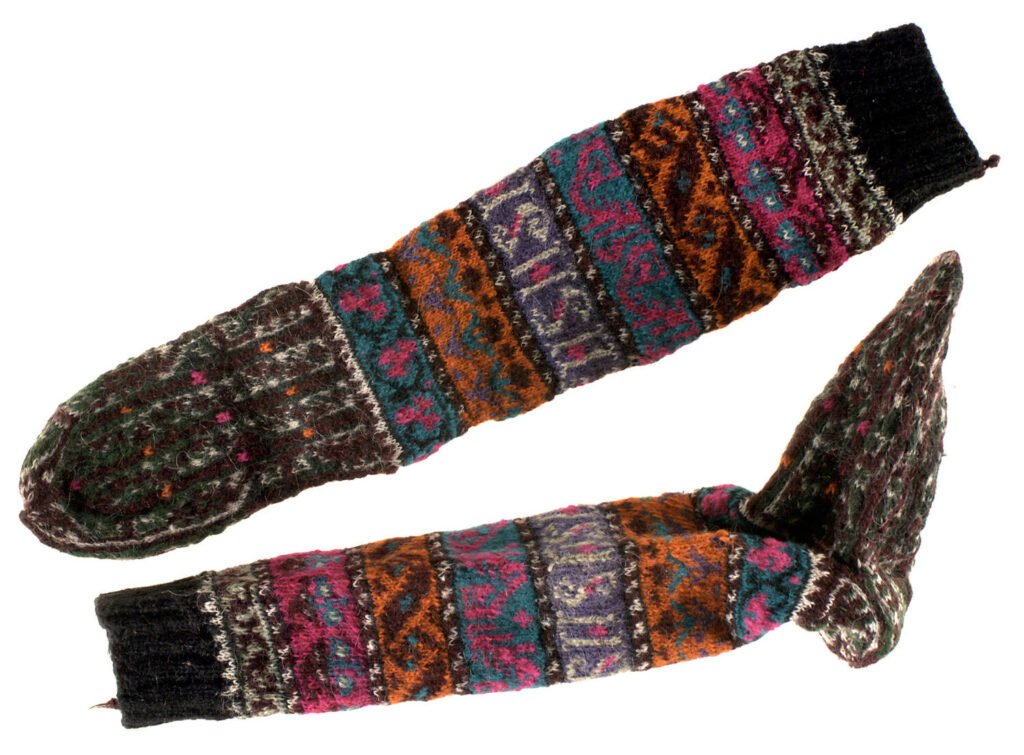
2026 · DDUJA KNIT JOURNAL
A British Researcher’s Antarctic Socks: What Stripes and Boots Can Prove
A museum record identifies George Rayner’s striped hand-knitted Antarctic socks, but the surviving boots and field portrait answer different questions. Seven primary records and five licensed images show what is documented—and what remains unknown.
Read the story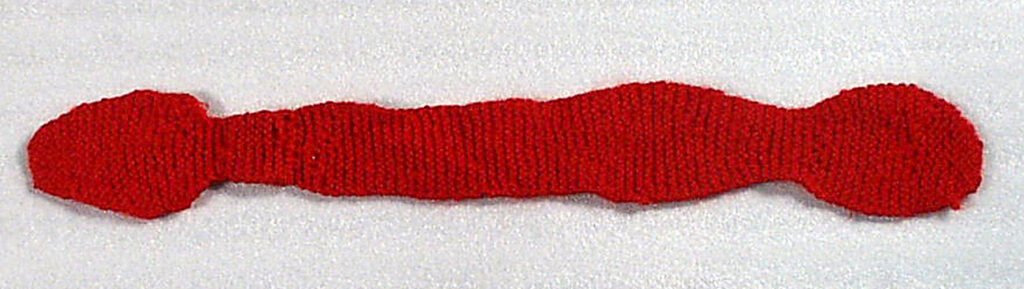
2026 · DDUJA KNIT JOURNAL
The Red Scarf That Wasn’t in the Suitcase: Knitting After a Family’s 1965 Migration from Argentina
A grandmother's red knitted scarf reached Marie Pregal after her family's 1965 move from Argentina to Australia. Five museum objects reveal what travelled and what followed.
Read the story2026 · DDUJA KNIT JOURNAL
Before the Name “Hunting Jacket”: Reading a Seventeenth-Century Silk Knit from Five Angles
Five views and a conservation report reveal how a seventeenth-century Italian silk jacket was pieced, patterned and seamed—and where its making remains uncertain.
Read the story2026 · DDUJA KNIT JOURNAL
Knitting for Dolls, Not People: Five Different Records from an Australian Museum
Five Australian museum records show how knitting appears in miniature domestic life, football fandom, family craft and occupational therapy—without assuming the same maker, technique or purpose.
Read the story2026 · DDUJA KNIT JOURNAL
Before Comparing Needle Lengths: Five Museum Records of Knitting Tools
Five museum records show why a needle’s length may describe a pin, a case, a trade display or a cotton bundle. Compare the objects, photographs and limits of what they prove.
Read the story2026 · DDUJA KNIT JOURNAL
Can a Mitten Be Read from a Machine Drawing? Five U.S. Patents by Isaac W. Lamb
Five U.S. patents by Isaac W. Lamb, dated 1863–1904, reveal different approaches to tubular knitting, mitten blanks and holding loops on inactive needles.
Read the story2026 · DDUJA KNIT JOURNAL
Five Finnish Museum Gloves and Mittens: Reading Cuffs, Thumbs and Decreases
Five Craft Museum of Finland glove and mitten records reveal distinct cuffs, thumb gussets, yarn and decreases, with clear limits on dates, techniques and visual comparisons.
Read the story2026 · DDUJA KNIT JOURNAL
The Name on the Box, the Team on the Knit: Auckland Museum’s 2000 Red Socks
A pair of red socks sits inside a card box. The record for object 2018.17.1 at Auckland War Memorial Museum Tāmaki Paenga Hira calls it ‘socks, pair’, machine knitted, red with ‘TEAM NEW ZEALAND’…
Read the story2026 · DDUJA KNIT JOURNAL
Four Knits Beside a Uniform: Reading Herbert Golder’s New Zealand Wartime Clothing
Four hand-knitted garments associated with New Zealand gunner Herbert Golder, photographed and documented by Auckland Museum, read beside his woven service tunic.
Read the story2026 · DDUJA KNIT JOURNAL
Knitted Doll Socks and an Uncertain Beret: Reading an Auckland Museum Wardrobe
Eight pairs of knitted doll socks and three berets with conflicting knitting and crochet labels reveal how to read an Auckland Museum wardrobe through original records and five licensed photographs.
Read the story2026 · DDUJA KNIT JOURNAL
A Cot Blanket from Circa 1945 New Zealand: Reading Its Victory Message and Knitted Ground Separately
Auckland Museum’s circa-1945 New Zealand cot blanket combines a knitted ground with embroidered victory messages. Five licensed photos and primary records reveal what the object can and cannot prove.
Read the story2026 · DDUJA KNIT JOURNAL
Nicky Winmar’s 1993 Knitted Football Jumper: Reading One Garment as Historical Evidence
Museums Victoria’s knitted wool jumper HT 31972 shows how Nicky Winmar’s 1993 garment became historical evidence. Five licensed museum views, the object record, and official testimony distinguish what the textile proves from later interpretation.
Read the story2026 · DDUJA KNIT JOURNAL
Mrs Harsant’s 1853 Hand-Knitted Shawl: Migration, Evidence and Five Museum Views
Auckland Museum’s 1853 Harsant shawl reveals a named migrant, a hand-knitted wool textile and the limits of royal tradition. Compare five rights-cleared views and six primary records.
Read the story2026 · DDUJA KNIT JOURNAL
Five Cusco Chullo Records: Place, Fibre, Knitting and Crochet
Five Smithsonian NMAI chullo records from Peru’s Cusco region distinguish place, fibre, knitting and crochet. Five separately licensed comparison photographs are clearly identified as different objects, while restricted museum images are not reproduced.
Read the story2026 · DDUJA KNIT JOURNAL
Monarch Knitting in Canada: Factory, Yarn, and Wartime Patterns
Fifteen primary and institutional records trace the Monarch Knitting Company from a St. Thomas factory incentive to home-knitting yarn and two wartime pattern books. Two licensed modern Buffalo photographs and three clearly marked AI…
Read the story2026 · DDUJA KNIT JOURNAL
What Anne Trotter’s 1840 Specimen Book Teaches About Knitting
Anne Trotter's 1840 Irish specimen book preserves four knitted exercises beside sewing and embroidery. Five credited museum photographs reveal both the work and its limits.
Read the story