Before the Name “Hunting Jacket”: Reading a Seventeenth-Century Silk Knit from Five Angles
The golden flowers on a green jacket catch the eye first. To understand how the garment was made, however, look next at the front opening, the edges of the cuffs, and the places where sleeves meet the body. The Cleveland Museum of Art calls its seventeenth-century Italian garment Knitted Hunting Jacket, accession 1931.62. “Hunting” is the museum’s title; it does not by itself identify a wearer or prove an occasion of use. Five photographs of the same object and the museum’s conservation statement offer a better starting point: what can we observe, and where does the evidence stop? [1]
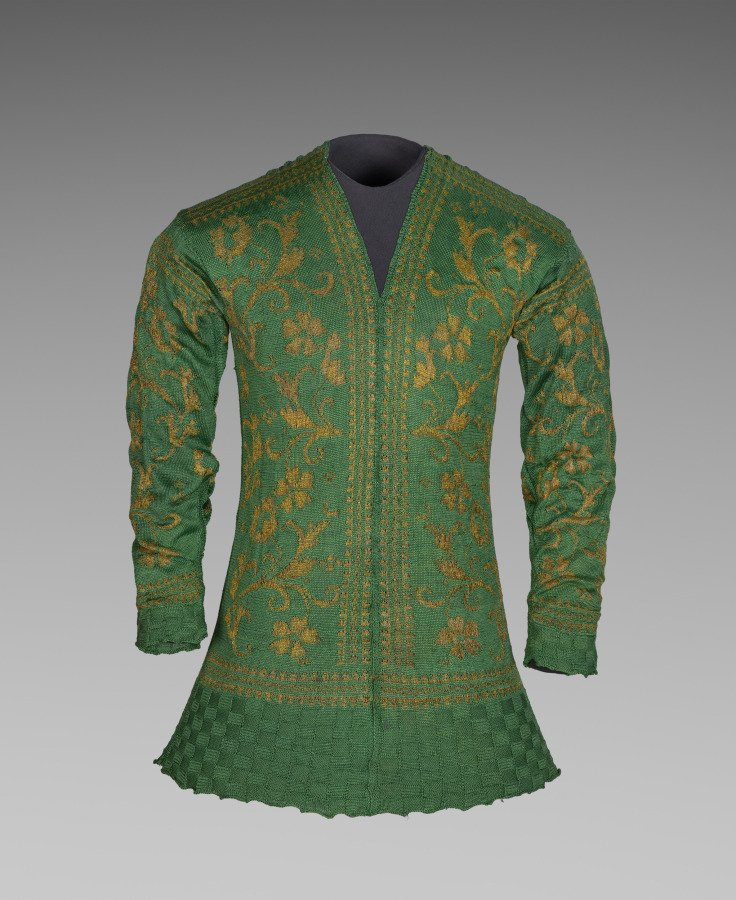
The front is more than its flowers
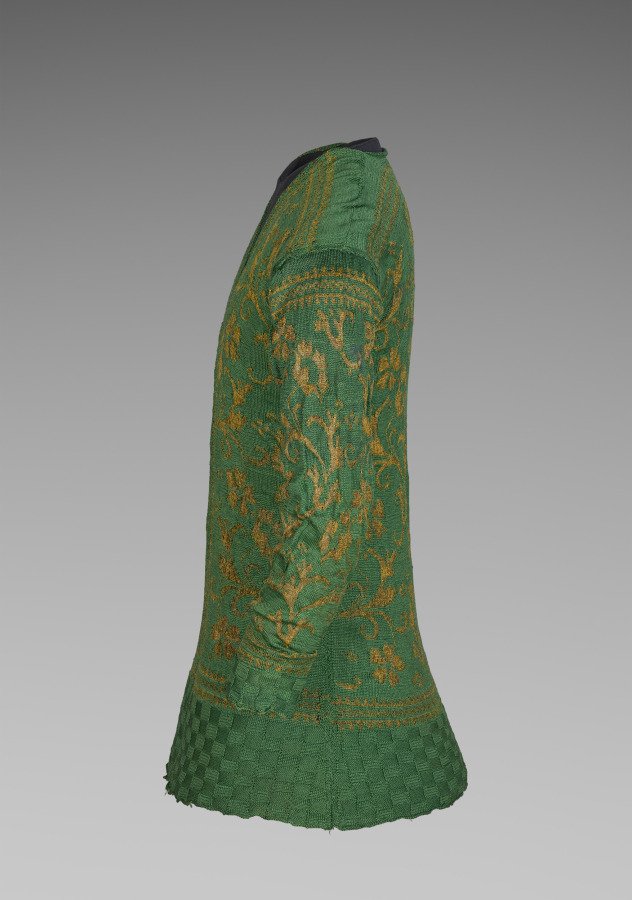
The museum records the material as knitted silk with gold thread and the overall dimensions as 67.5 × 121.5 cm. The open centre front and outstretched sleeves are readily visible. The gold floral design occupies the broad surfaces, yet the checked areas at the hem and cuffs tell a different part of the making story. According to the conservation statement, most of the garment is stockinette. At the hem and cuffs, knit and purl sections alternate in blocks of ten stitches by ten rows. That count comes from the institution’s examination, not from a pattern guessed from a photograph. [1]
One garment, five knitted pieces
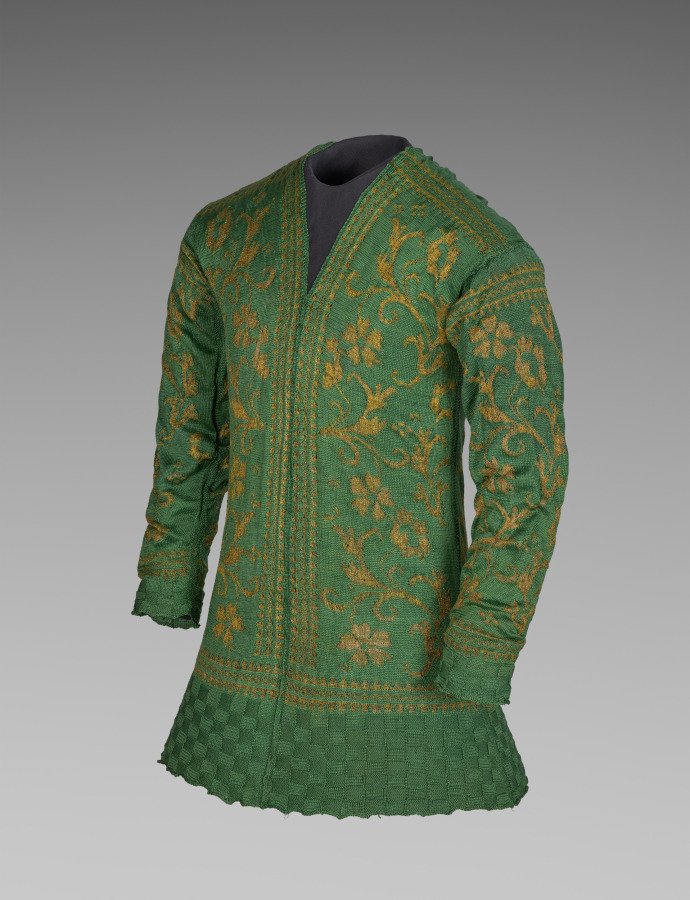
This was not knitted in a single continuous piece. The conservators identify five flat, shaped pieces: a back, left and right fronts, and two sleeves. The pieces were joined by whip stitching with the same green silk used in the garment. The number five here counts its component pieces, not its photographs. The museum also describes a four-stitch-wide treatment of alternating knit and purl rows along the front, side and back-neck edges. Those margins and seams matter to the garment’s shape as much as the decorative motifs do. Compare how a motif approaches a join and how the opening might have fallen on the body. The present display position does not reconstruct exactly how the jacket looked when worn. [1]
Metal thread and the long yarns inside
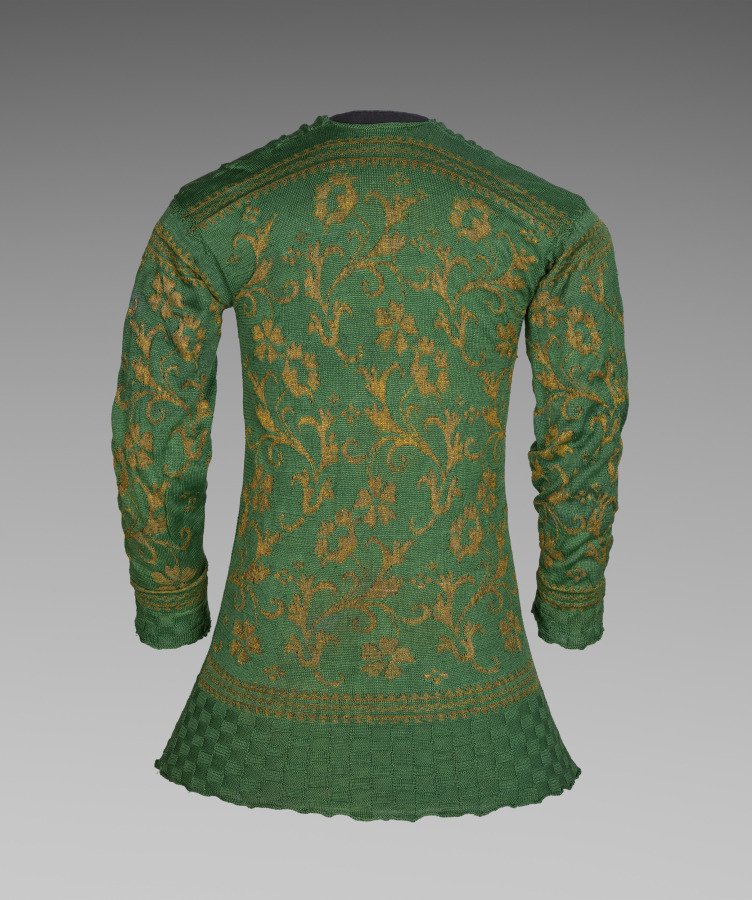
The green silk yarn is unplied and approximately 1 mm thick, the conservation statement says. The metallic yarn, around 0.5 mm thick, consists of a metal strip wound with deliberate spacing around a core of yellow silk. Calling the motif simply “gold-coloured yarn” obscures that layered construction. The museum gives an approximate gauge of 15 stitches and rows per inch. This is a measurement of the surviving object, not a promise that a modern yarn and needle combination will reproduce it. Where the decorative yarn is not forming a motif, it passes in long floats across what is now the interior of the jacket. The conservators note that these floats are not caught down at short intervals. They could snag during dressing or undressing, but that risk alone cannot tell us how often the garment was worn or whether it originally had a lining. [1]
Hand or frame? The point where the record pauses
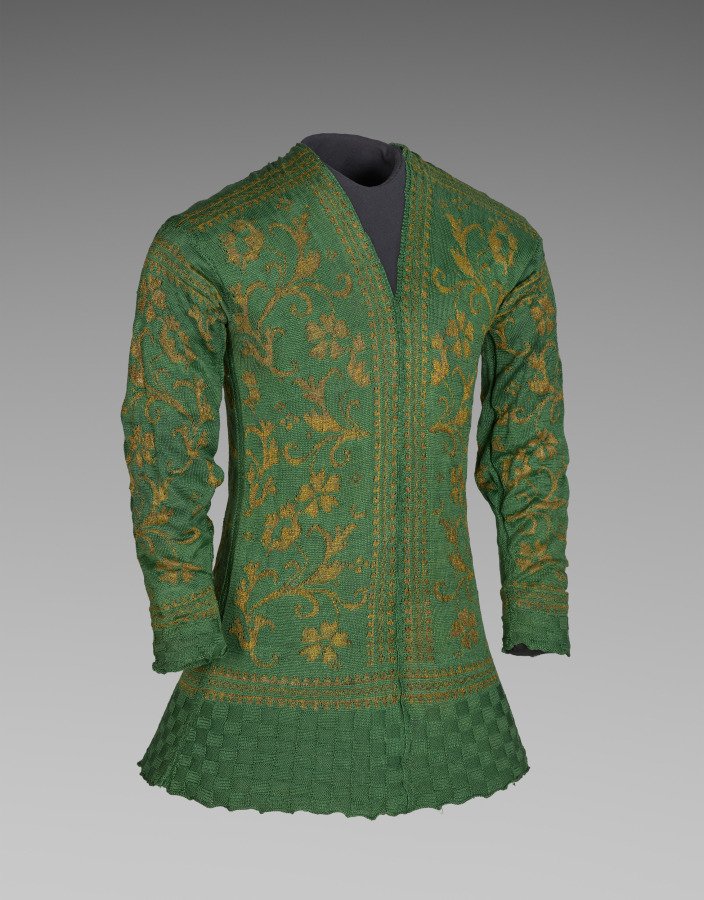
The jacket is unlined today. No buttons or ties survive at the front, and the museum reports no evidence that such closures were formerly attached. Absence is not proof that a lining or fastening was never planned. The conservation statement leaves open whether the jacket was meant to be unlined, was little worn, or had a planned lining that was never made. These are alternatives, not a settled biography. [1]
Its production method is another open question. Some scholars have read long, uncaught floats as a sign of frame knitting; others have questioned whether the period’s equipment could yet produce these purl effects and handle metallic yarn. The museum presents both positions and the historical chronology behind them. A photograph of this object does not resolve the debate or name the maker. The shaped panels, joins, base stitch and yarn paths are firmer observations than an attribution to either hand or machine. [1]
Other collections set limits, not a single answer
The Metropolitan Museum of Art’s late seventeenth-century European silk Sweater, 14.134.18, belongs to a comparable world of fine knitted silk, but its curators say that the role of such garments has never been fully explained. [2] National Trust jacket 934938.1, connected to Sir George Booth’s wardrobe, retains a lining and buttons. Its catalogue treats Italian manufacture as likely, not proven. [3] The presence of fastenings on that object does not prove that the Cleveland jacket once had them.
Glasgow Museums records a woman’s bodice or waistcoat, 29.126, dated about 1630–1650. It lists both England and Italy as possible places of manufacture and describes a stockinette body with differently worked borders and tailored shaping. [4] Those features permit comparison, not a claim that the two objects came from one workshop. London Museum waistcoat A27050 bears a tradition linking it to Charles I’s execution. The museum says tests of its stains did not establish whether they were blood. [5] The distinction between an association and a finding is part of reading a museum record. None of the comparison objects’ restricted photographs is reproduced here or passed off as another view of the Cleveland jacket.
Three questions for the next historic knit
When looking at another historic knitted garment, ask what pieces make up the body and where they join. Ask where an unused colour runs on the inside. Ask which closures or linings survive, and whether the collection record admits uncertainty about what is missing. The Cleveland jacket cannot answer every question about its own making or use. Its five views and unusually detailed conservation note do something just as valuable: they let us separate visible structure from a story supplied by imagination.
Sources and image rights
- The Cleveland Museum of Art, Knitted Hunting Jacket, 1931.62 — full conservation statement; object page; CMA Open Access/CC0 policy. Each of the five downloadable views was individually marked public domain. All five show this one object from different angles; no AI imagery is used.
- The Metropolitan Museum of Art, Sweater, 14.134.18.
- National Trust Collections, Jacket, 934938.1. Its © National Trust / Robert Thrift photograph is not reproduced.
- Glasgow Museums, bodice; jacket; waistcoat, 29.126. No Glasgow photograph is reproduced.
- London Museum, Undershirt, waistcoat, A27050. Its © London Museum digital photograph is not reproduced.