Who Made the Stockings, and Who Kept Them? Five Danish National Museum Records
Research and writing: DDUJA KNIT
Open a museum drawer and a pair of white stockings seems to ask a simple question: how was it knitted? Read the label and other questions appear. Who made it? Whose dress was it classified with? Did it arrive as a gift, a purchase or an inheritance? Five National Museum of Denmark records let us compare fabric and form while also noticing the choices involved in keeping an object.
These are not five examples from one Danish region or one decade. Some labels give only colour and material. One explicitly calls the cotton pair home-knitted. A photograph in the Danish collection describes stockings made by a German refugee. A shared museum does not prove a shared place of manufacture. Six photographs accompany the five records because the cotton pair has two views; it is still one pair.
Two white pairs, two different labels
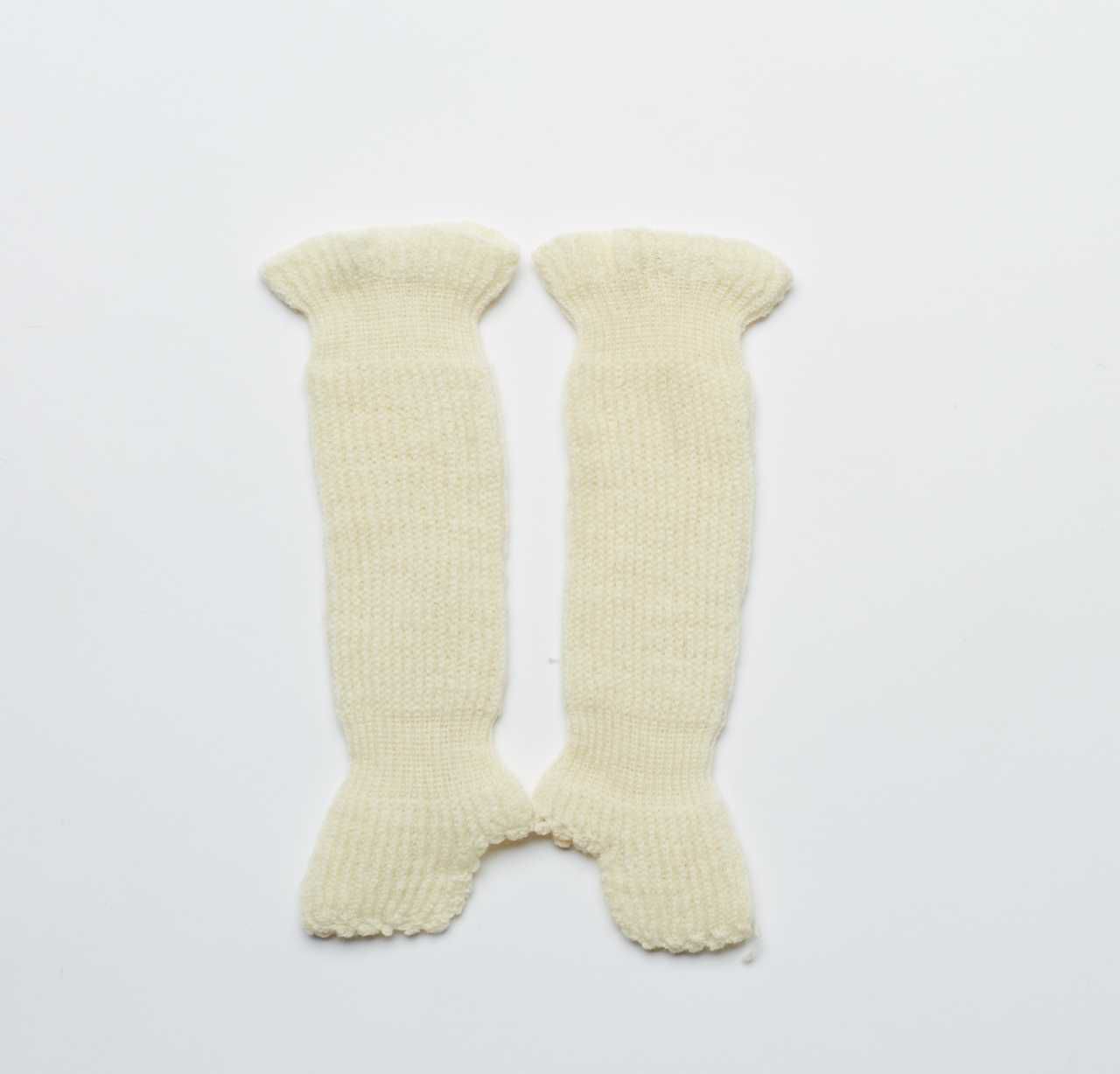
Record 468/1978 [1] names a pair of long white knitted stockings. Ordinary use and acquisition by gift are recorded. A maker and making date are not. The 1978 in its identifier must not be silently promoted into a year of manufacture; it belongs to the museum number.
A photograph encourages a close look at the length, the outline of the heel and the transition toward the toe. It cannot supply stitch count, needle size or a wearer’s measurements. Fibre, elasticity and subsequent care all matter if a modern knitter tries to make something with a similar silhouette. Looking carefully at an object is a beginning, not a verified pattern reconstruction.
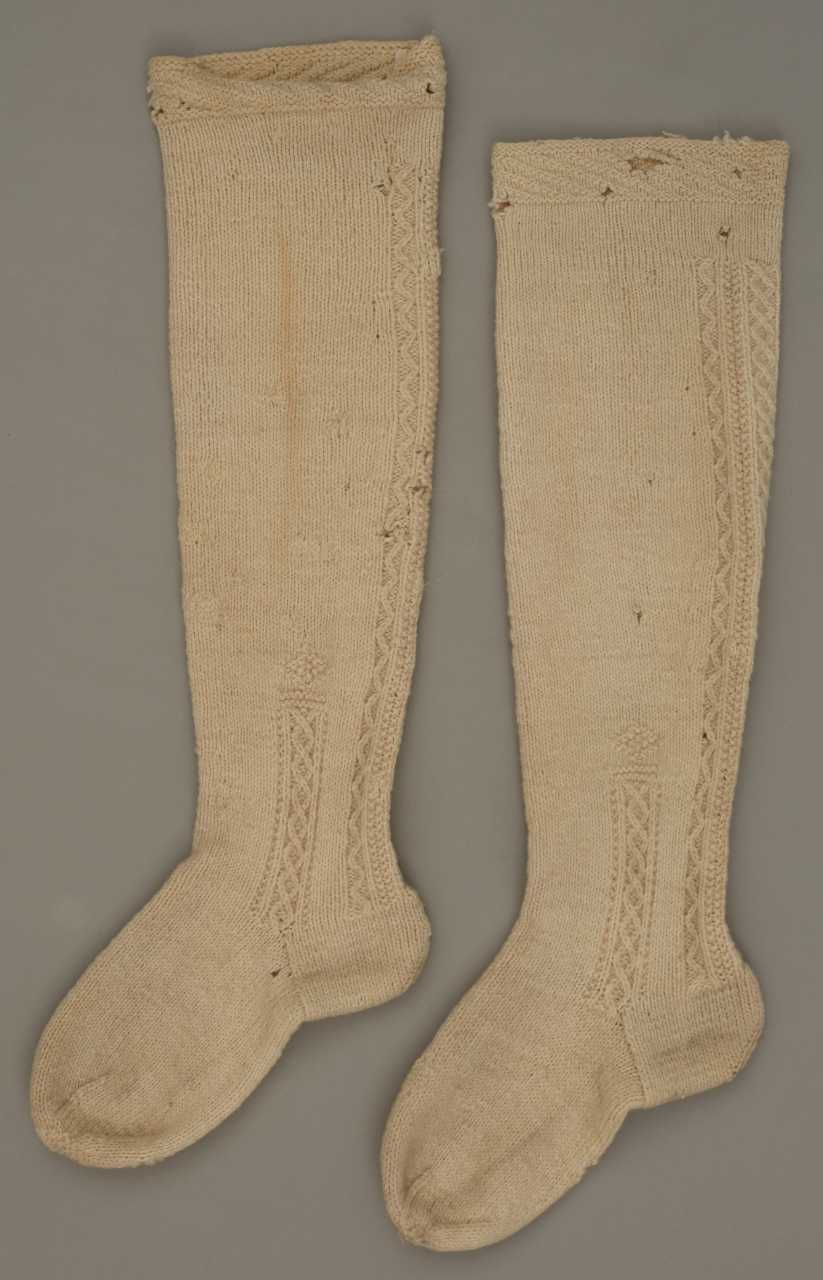
Record V.319 [2] identifies white wool knitted stockings and classifies them with men’s leg and foot dress. The museum again records ordinary use and a gift. Wool is an explicit material difference from the cotton pair below. Nothing in these short entries, however, proves that the two white pairs were made by the same person, in the same locality or in the same period.
When comparing a historic object with a contemporary pattern, material is an important first column. Wool and cotton need not stretch or behave after washing in the same way. Even an identical stitch count can produce a different finished size. This is practical advice for testing a modern swatch, not an assertion about an undocumented historical gauge.
A dress category is not a maker’s biography
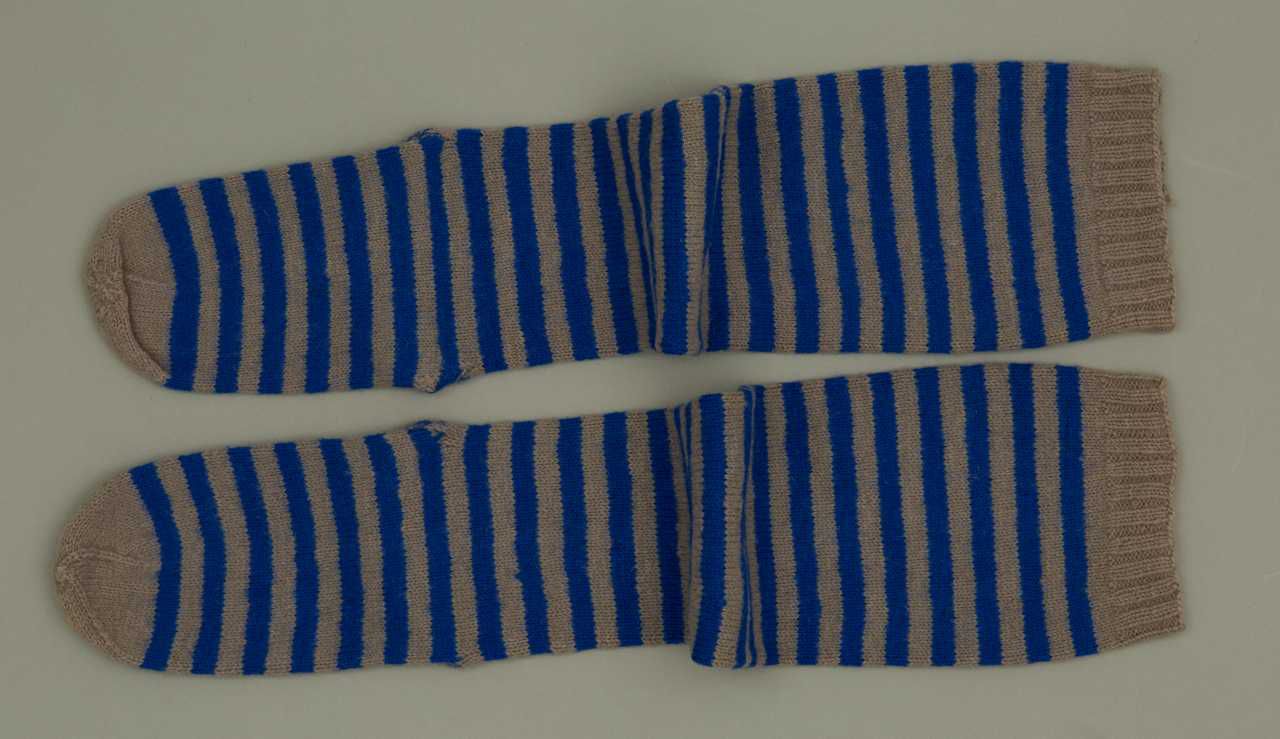
Record 1024/1945 [3] describes wool stockings, classifies them with women’s dress and records a purchase rather than a gift. Comparing that category with the men’s category above reveals how a museum makes its holdings searchable. It does not identify the person who knitted, wore or sold the pair. The brief title does not specify a knitting technique, so we do not call this pair hand-knitted simply because the object is a wool stocking.
One record gives a material, another highlights a collecting route. A catalogue entry is not a diary of everything a garment experienced. Keeping the missing fields visible makes the surviving evidence more useful than filling them with a plausible story.
What the word “home-knitted” changes
Record W.965.c [4] names a white cotton pair as hjemmestrikket, or home-knitted. The record also says it was inherited. Those details make it different from the wool examples in both material and collecting history. They still do not supply the knitter’s name or the family relationship behind the inheritance.
The collection provides two photographs of this pair. Different angles can help a reader inspect the overall outline, heel and toe, but they do not create two objects. We place the views together to avoid counting a pair twice when comparing museum records.
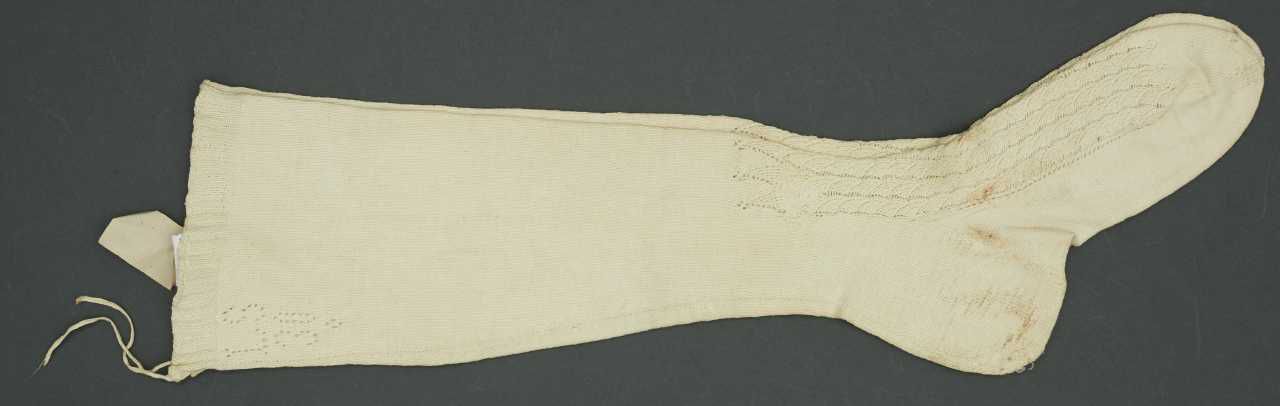
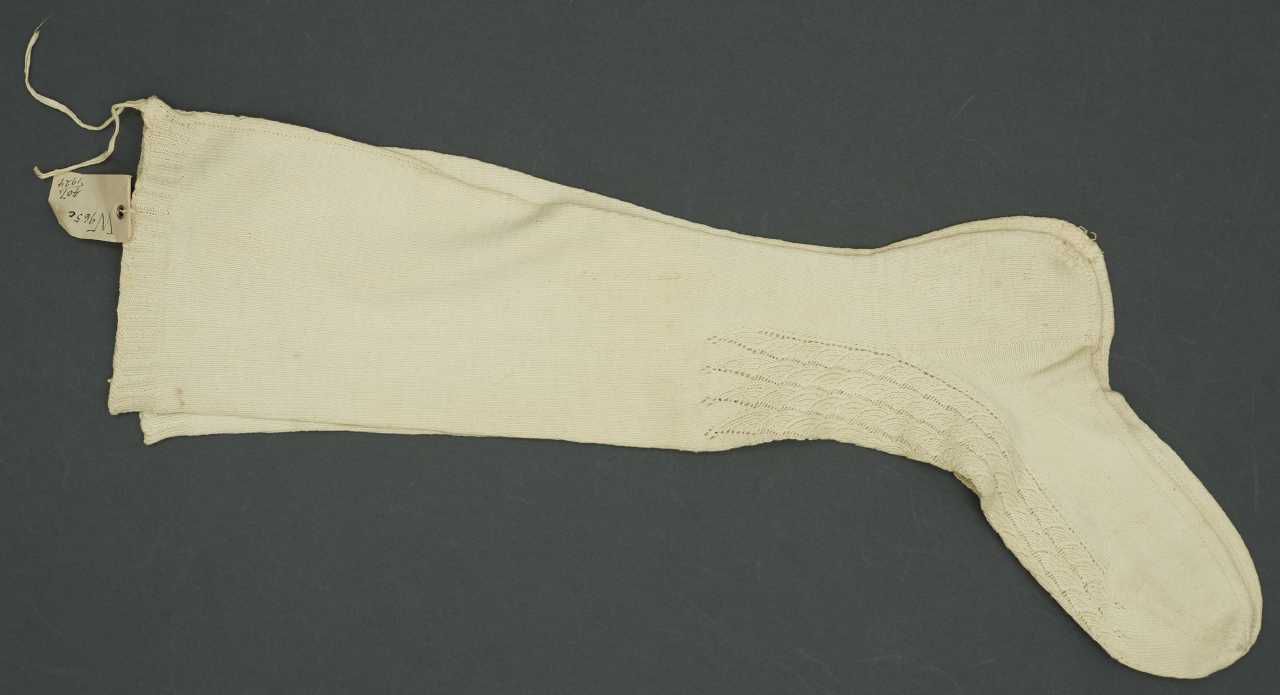
Cotton and home knitting are useful facts to carry into a modern maker’s notebook. They do not yield a gauge, a cast-on direction or a toe-closing sequence from the image. Those questions call for measurements and a test swatch if one is designing a new stocking. Respect for an old object includes refusing to present a photograph as a tested reproduction chart.
When sandbag material became stockings
The description attached to Freedom Museum image FHM-12411 [5] is more specific about the maker’s situation. It says a German refugee knitted these stockings from material taken from English sandbags in a refugee camp at the former German airfield near Rom in Jutland. It does not give a personal name or an exact making year. This collected object should not be treated as a representative pattern of Danish ethnic dress.
The shift in use is documented: material associated with sandbags became something to cover feet. The photograph does not explain how the material was prepared as yarn or the order in which the heel and toe were worked. Maker’s nationality, place of making and present collecting institution belong in separate fields if we want to understand the object’s movement.

The photographer is not the knitter
These entries preserve the names of photographers more clearly than the names of makers. Henrik Rønnow is credited for the three first object photographs, Maria Fortuna for both views of the cotton pair, and Elisabeth Halgreen for the refugee stockings image. Their documented role is photographic. Attaching their names to the making of the stockings would invent an attribution.
The next time you see a historic stocking, try four columns: recorded material, stated method, route into the collection, and what remains unknown. Observe the cuff, heel and toe in the picture; if the technical field is silent, leave that silence visible. For a garment you actually plan to knit, use measured gauge, the wearer’s dimensions and the behaviour of the chosen yarn. Museum stockings can sharpen the questions we ask without replacing a tested set of instructions.
These five records offer no single “Danish stocking” archetype. Wool and home-knitted cotton, gifts and a purchase and an inheritance, and a refugee’s reuse of material create different histories. Looking at how a sock was catalogued, as well as how it appears, changes what we can responsibly say about it.
Five museum records
- Nationalmuseet 468/1978
- Nationalmuseet V.319
- Nationalmuseet 1024/1945
- Nationalmuseet W.965.c
- Nationalmuseet FHM-12411
Records and image rights checked 27 October 2026. Five distinct records, six real-object image files and no AI images. Two views of the cotton pair refer to one object.