WORLD KNITTING JOURNAL · THE NETHERLANDS · OBJECTS & CULTURE
Five Dutch Fishermen’s Sweaters, Five Ways to Read a Coast
From a blue cable-knit in Scheveningen to black Volendam pullovers, museum records show why “the fisherman’s sweater” was never one fixed pattern.
Set the records for five photographed sweaters beside a sixth catalogue entry and the familiar phrase “Dutch fisherman’s sweater” starts to loosen. A blue Scheveningen pullover places cables above a broad, plain lower body. In Volendam, black sweaters use horizontal bands of knit and purl texture; some were worn by boys as well as adult fishers. A Spakenburg garment organizes its surface differently again. The place names matter, but they do not point to a single national chart. They are clues to how particular makers, wearers and museums described particular objects. [1][3][8]
How a knitted layer became outerwear
Modemuze describes the Dutch visserstrui as a woollen work or dress sweater worn by fishers and other ship crews from roughly 1860 to 1950. Its overview traces a change in use: knitted wool garments had earlier been worn close to the body as a borstrok, a woollen undershirt or vest, before knitted sweaters became more common as outerwear around the middle of the nineteenth century. The date range is a broad account of a garment type, not the age of every surviving sweater. [6]
The same overview suggests that Dutch versions may have been influenced by English fishermen’s ganseys. Modemuze presents this as a probability, not a proven single point of origin. Patterns and motifs travelled, then acquired local variations in Dutch villages and communities. Some garments carried meanings assigned by makers; others combined recognizable regional arrangements with individual choices. A motif’s presence on a sweater, by itself, cannot tell us what its maker intended. [6]
That distinction matters because later retellings often turn a practical garment into a codebook: one cable for a family, another for a harbor, each stitch a record of a drowned sailor. The collection descriptions used here support a more careful story. They document materials, construction, place, dates and recurring motifs. They do not establish a universal symbolic key. When the museum record is silent about a symbol’s meaning, this article leaves it open rather than supplying a picturesque explanation.

The makers behind the museum records
The catalogues identify institutions and accession numbers more readily than the people who knitted the garments. That is not a small omission to be patched with an invented name. Modemuze’s Katwijk record says patterns were passed from mother to daughter, while also noting room for a knitter’s personal taste within recurring local motifs. Its Scheveningen record makes a similar point: a customary layout could still be varied by individual knitters. These statements describe a transmission practice and a design space; they do not identify the maker of HM.1533 or HM.936. [1][2]
The objects therefore preserve evidence of skilled labour while leaving many makers anonymous. We can study the decisions that remain visible—where cables begin, how a textured band interrupts stocking stitch, whether the body is worked in the round—without claiming to know who made a specific sweater or what every motif meant to its maker. A museum number is useful because it lets readers return to the same object and check the evidence for themselves.
The records also show why “regional style” should not be mistaken for a rigid uniform. In Scheveningen, the museum describes a customary division between smooth knitting below and cables above, but explicitly says knitters varied it. In Katwijk, cables and garter ridges recur, yet the item record does not provide a chart or gauge. Volendam’s horizontal texture bands form another recognizable arrangement. Regional practice is best understood here as a shared vocabulary with room for choices—not as proof that every resident wore an identical garment.
Five objects, read closely
1. Scheveningen: the boundary is part of the design
HM.936, held by the Dutch Open Air Museum and catalogued as 1950, is described as a blue sajet sweater. Its lower body is plain for roughly half its length; cables occupy the upper section, with a zigzag band usually marking the transition. The arrangement is more informative than the label “cable sweater.” It directs attention to proportion: how much of the body remains smooth, where texture begins, and how the eye moves from one surface to the next. The record gives no stitch counts, gauge or complete construction instructions, so it cannot serve as a ready-to-knit pattern. [1]
2. Katwijk aan Zee: a documented local preference, an unpictured object
HM.1533, another Dutch Open Air Museum object, is catalogued as a woollen sajet fisherman’s sweater dated 1920–1950. The record describes cables and ridged garter-stitch borders, and says fishers in Katwijk began wearing this kind of sweater from about 1920. Its image reuse status was not clear in the material reviewed for this English edition, so we cite the catalogue but do not reproduce its photograph. The date range belongs to the object record; it should not be confused with a precise year when the local custom began. [2]
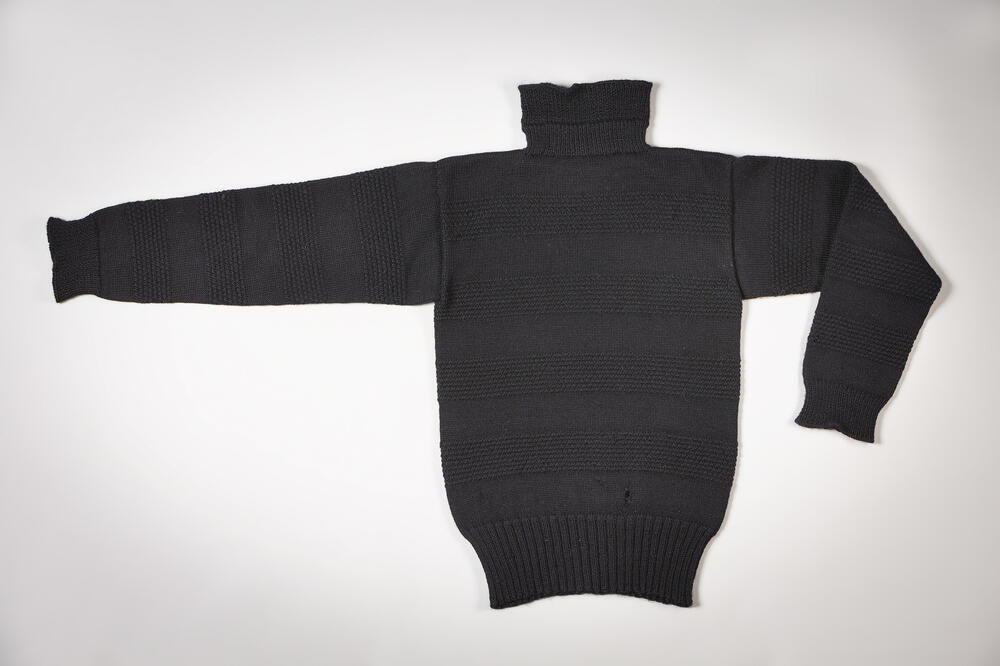
3. Volendam: an adult’s black sajet sweater
The Zuiderzee Museum’s record for Volendam sweater 011456 describes a black sajet garment. Its account places sweaters of this type around 1900 as clothing for Sundays or for time on land, with use as workwear appearing around 1920. It also says boys wore them from about age four. The record’s description of changing use is valuable because it resists a simple split between “work clothes” and “Sunday best”: a garment could move between settings as practice changed. It does not tell us that every Volendam household followed the same schedule. [3]
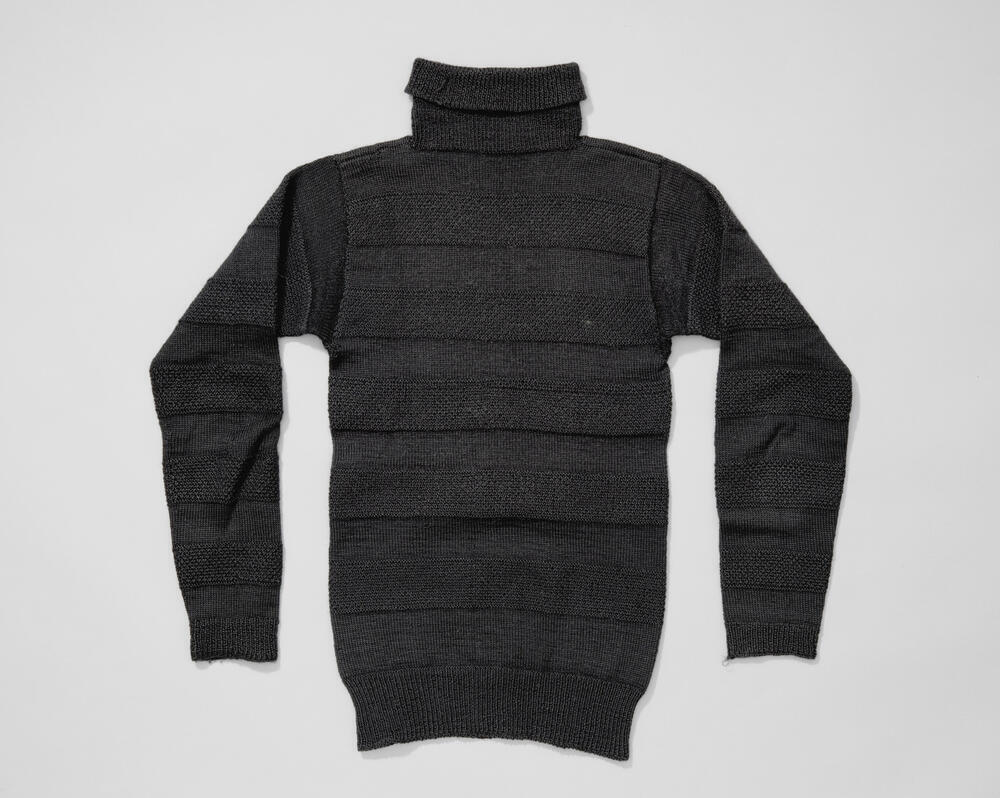
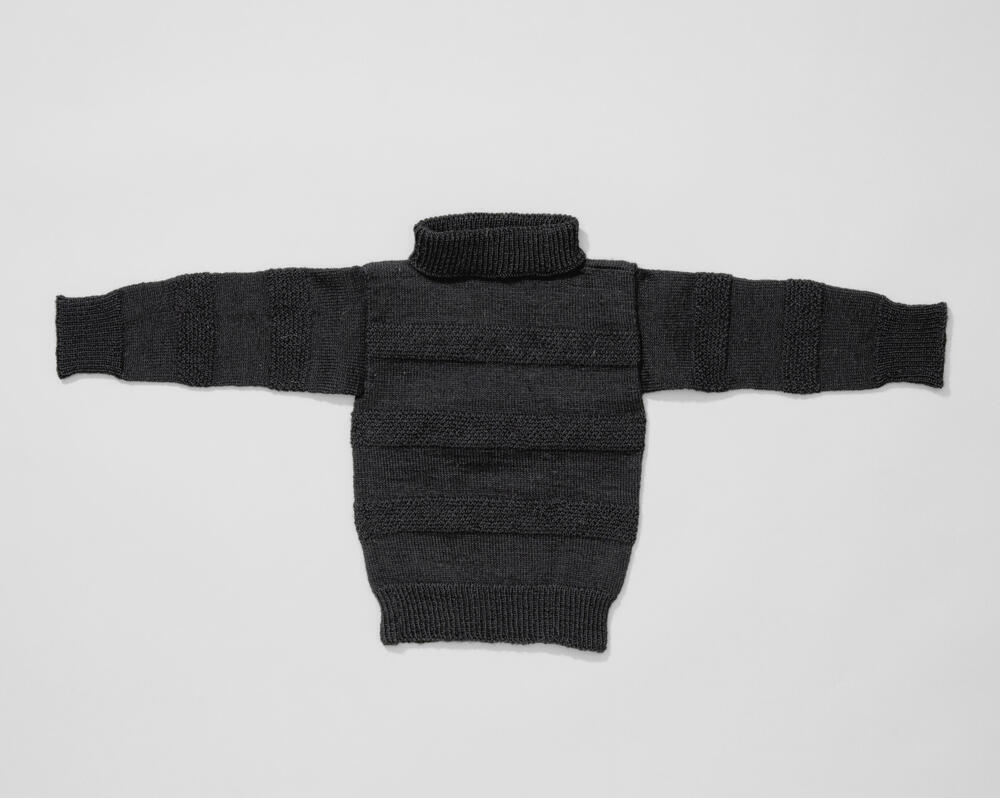
4. Volendam: two boys’ sweaters, not one garment photographed twice
The Dutch Open Air Museum records two separate boys’ sweaters: K.26-69, dated 1945–1969, and K.262-60, dated 1945–1960. Both records describe black sweaters with horizontal bands that alternate stocking stitch and knit–purl variations; the garments were traditionally worked in the round. The catalogue says black sweaters with knitted borders had become fashionable in Volendam from about 1920, initially as a repair or “smartening-up” job, and that boys wore them after their third year. These are two accessioned objects with different date ranges, not front and back views of a single sweater. [4][5]
5. Spakenburg: cables running vertically
The Zuiderzee Museum’s Spakenburg sweater 005333 is dated 1930 and catalogued as wool knitwear. Its alternating vertical fields of stocking stitch and cables offer a useful comparison with Scheveningen’s broad upper-and-lower division. A photograph lets us see texture and placement; the short museum entry does not provide the full pattern, the knitter’s identity or a symbolic explanation for each cable. The distinction between what an image shows and what a catalogue proves is essential when reconstructing historic clothing. [8]

A living design language, not a frozen code
The fisherman’s sweater did not stop changing when museums began collecting it. In a 2024 Modemuze article, researcher and Amsterdam Fashion Institute lecturer Maaike Feitsma describes a contemporary project with Hendrik Kramer, a sixth-generation fishing-family member from Urk and Amsterdam’s last commercial North Sea fisher, and his crew. Together with researchers and students from the Amsterdam University of Applied Sciences, they developed Metanoia, named after Kramer’s fishing boat. The project used traditional motifs alongside new community-designed patterns and produced the garment on a Shima Seiki 3D knitting machine. [7]
The project’s symbolism is documented in the article rather than guessed from a photograph: traditional sea and fish motifs form the base; Amsterdam’s three crosses appear above; a haddock refers to Urk’s coat of arms and the crew’s roots; a net and linked shapes express the idea of a shorter “fish to fork” supply chain. The article says the design was developed with the crew and students across heritage, fashion and computing. That is a different kind of authorship from the anonymous historical objects, but it shares an important feature with the museum records: a regional garment can carry a local voice without being reduced to one supposedly ancient chart. [7]
Reading the older sweaters alongside Metanoia does not make them equivalent. The modern project is explicitly collaborative and machine-produced; the older museum pieces are individual historical objects whose knitters are mostly unnamed. The comparison instead shows how a textile vocabulary can be revisited: a familiar silhouette and a language of cables, bands and local motifs can be adapted to new materials, tools and concerns.
A short timeline
- Mid-nineteenth century: Modemuze describes knitted wool garments moving from underlayers toward outerwear. [6]
- c. 1860–1950: broad period in which Dutch fishers and ship crews wore the visserstrui. [6]
- c. 1900: the Zuiderzee Museum account places Volendam’s black sajet sweater in Sunday or onshore use. [3]
- c. 1920: Katwijk’s catalogue dates local use from around this period; Volendam descriptions also place the rise of black sweaters with knitted borders around this time. [2][4]
- 1930: the Spakenburg object 005333 is dated in the Zuiderzee Museum record. [8]
- 1945–1969: the Dutch Open Air Museum’s recorded date ranges for two distinct Volendam boys’ sweaters. [4][5]
- 2024: Modemuze publishes Feitsma’s account of the collaborative Metanoia project. [7]
What the five sweaters can—and cannot—tell us
Compare the lower and upper body, the direction of the pattern, the texture between cables, the way a band changes the surface, and the object number attached to each photograph. These details make the garments legible without turning them into a puzzle with a single hidden answer. The museum records document places, materials, dates and techniques. They leave many makers unnamed, and they do not support a universal symbolic dictionary. That limit is not a gap to fill with folklore. It is part of the history we have.
Sources and image credits
Bracketed numbers in the article refer to the source records below. Each included photograph is captioned separately with its object number, holding institution and reuse terms. The article does not reproduce a knitting chart or claim that a museum photograph is a complete pattern.
- Modemuze / Nederlands Openluchtmuseum, “Visserstrui uit Scheveningen, circa 1950,” object HM.936.
- Modemuze / Nederlands Openluchtmuseum, “Visserstrui uit Katwijk aan Zee, 1920–1950,” object HM.1533.
- Modemuze / Zuiderzeemuseum, “Visserstrui,” object 011456.
- Modemuze / Nederlands Openluchtmuseum, “Visserstrui voor een jongen, Volendam, 1945–1969,” object K.26-69.
- Modemuze / Nederlands Openluchtmuseum, “Visserstrui voor een jongen, Volendam, 1945–1960,” object K.262-60.
- Modemuze editorial overview, “Visserstrui,” published 25 June 2024.
- Maaike Feitsma, “Modern fisherman’s sweater for Amsterdam’s last fisher,” Modemuze, 4 January 2024.
- Modemuze / Zuiderzeemuseum, “Trui,” object 005333, Spakenburg.