Khuc Cay: From Amigurumi Characters to Books and Written Patterns
DDUJA KNIT Journal · Vietnam-born designers · Amigurumi and publishing
Research and writing: DDUJA KNIT
Making a small crochet character and explaining how someone else can make it are different kinds of work. The second requires materials, sequence, photographs and words to agree. Khuc Cay offers a useful way into that distinction. Born in Vietnam and working in France, she develops characters through PDF patterns and books. This feature concentrates on authorship and individual listings rather than repeating our overview of Vietnamese industry and crochet culture.
Learning and writing · Two books · Egg animals · Aki · Alto · A reader’s notebook · Sources
Image note: All five images below are newly generated AI illustrations. The caption links lead to the designer’s authentic works and source photographs.
From learning crochet to writing a book
Khuc Cay’s own introduction gives her name as Hoang Thi Ngoc Anh and describes making characters through drawing and crochet in southwestern France. Eyrolles’ author biography records her birth in Vietnam in 1992 and move to France in 2014 after studying economics. [1] [3]
In a May 2020 account of teaching herself, she dates her sustained start in crochet to late December 2017, distinct from knitting encountered in childhood. She also dates her first book, Sweet Crochet Friends, to September 2019. This is an individual chronology, not a promise that another learner will become a professional author on the same schedule. [2]
The account connects imagining a character, crocheting, keeping records, photography and writing instructions. A finished photograph conceals much of that explanatory work. Knowing a stitch count does not necessarily tell a reader which side they are looking at or when pieces should be joined. Pattern authorship must bridge those gaps as well as produce an appealing object. [2]
Two books, two distinct publications
Tuva’s bibliographic listing describes Sweet Crochet Friends as a 128-page collection of 16 designs, ISBN 9786059192705, combining animals and dolls. We use it here as a milestone in the author’s publishing history. [4] The author published a separate notice concerning this title in 2026; consult that dated notice for her current statement. This feature makes no purchase recommendation or determination about the dispute mentioned there. [9]
Eyrolles lists Le minimonde de Khuc Cay – 16 amigurumis au crochet with a publication date of September 10, 2026: 66 pages, 186 × 186 mm, EAN 9782416022180. Its small-animal collection includes examples such as a donkey, elephant, otter and fox. [8]
The shared number sixteen does not make these the same collection, format or learning experience. When comparing books, start with language and bibliographic details, then inspect the contents and preview. The number of projects alone says little about whether the explanations suit you. Photograph size, familiar terminology and the kinds of shapes you want to make can matter more than a large project count.
Egg animals: size is only one condition
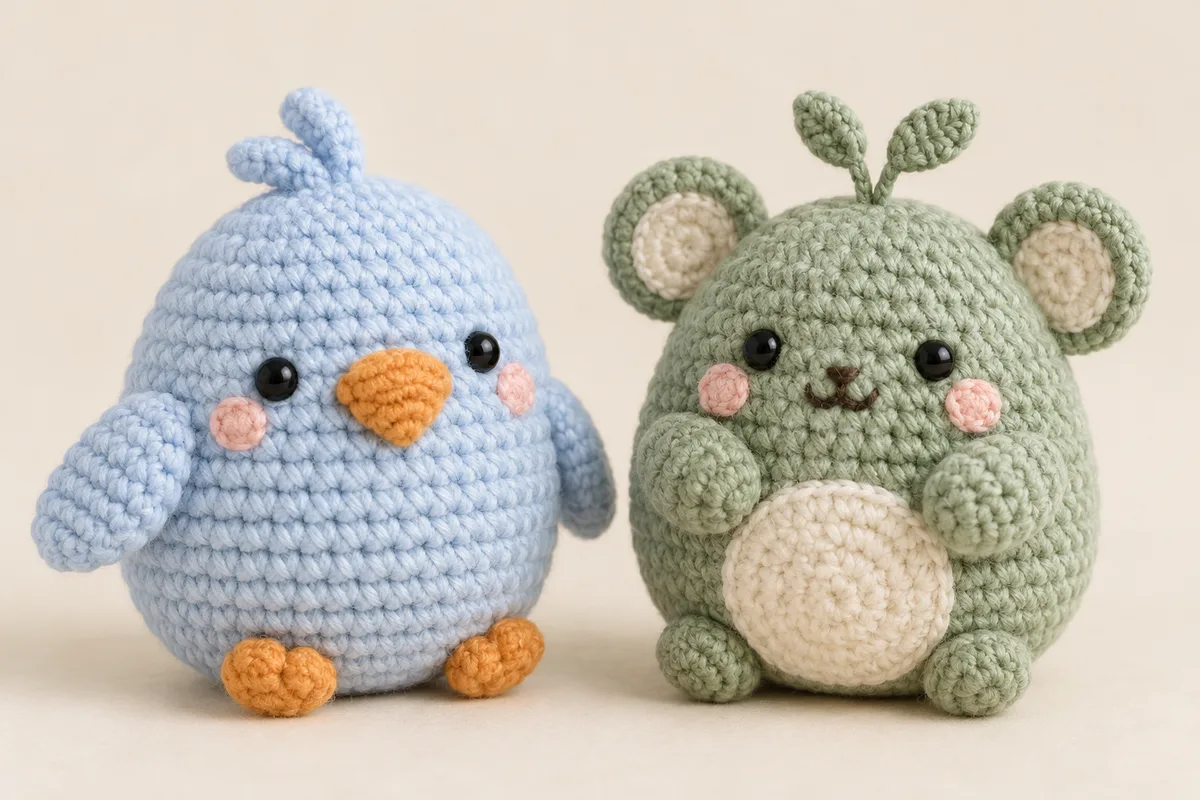
The official Adorable Baby Egg Animals listing covers hamster, koala, bear and panda PDF patterns in English and French. It labels the project beginner and no-sew, specifying Hobbii Honey Bunny or Snuggle Solid, a 3.75 mm hook and an approximately 10 cm result with those materials. [5]
Read the conditions beside the skill label, rather than treating “beginner” as the whole description. Yarn, tool, colour changes and finishing information help establish what you need to prepare. Our egg-shaped bird and imaginary creature are visual studies only. They neither depict the four official characters nor demonstrate the listing’s no-sew construction.
Before choosing a first small character, make your own skills list: working around a shape, increasing and decreasing, changing colours and finishing yarn ends. A short finished height does not guarantee a quick or effortless project. This is our preparation suggestion, not a reconstruction of the paid pattern’s actual sequence.
Aki the Shiba: know what the listing supplies
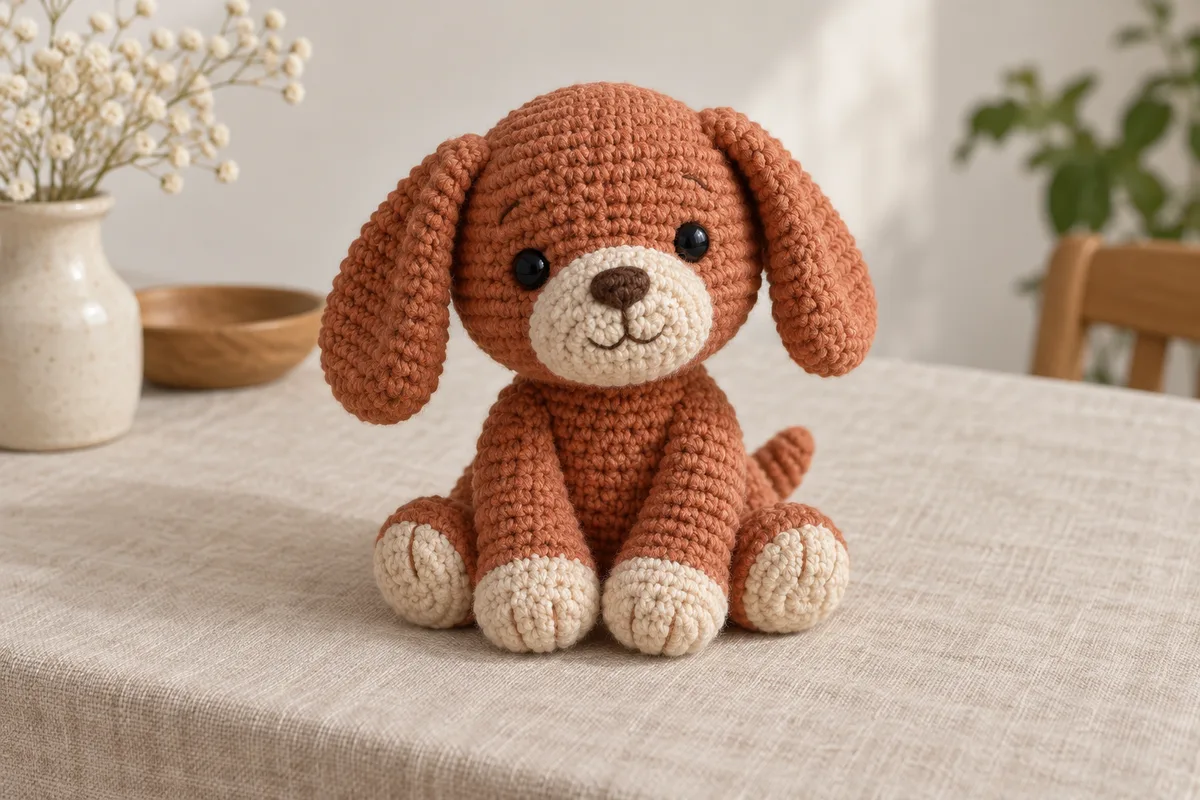
Aki the Shiba is offered as a PDF, not a finished toy. The listing specifies English with US terminology, French, Spanish and Vietnamese, an advanced-beginner-to-intermediate level, and clothing that cannot be removed. Its materials include sport yarn at 160 m per 50 g and a 2.25 mm hook. [6]
These details answer practical questions a photograph cannot settle. Check whether your reading language is included and whether you want an object or instructions. If removable clothing is important to your idea, a charming outfit in a picture is insufficient: read the construction description. Admiring a face and choosing a structure you want to make are related but separate decisions.
Alto the donkey: the same weight, a different yarn
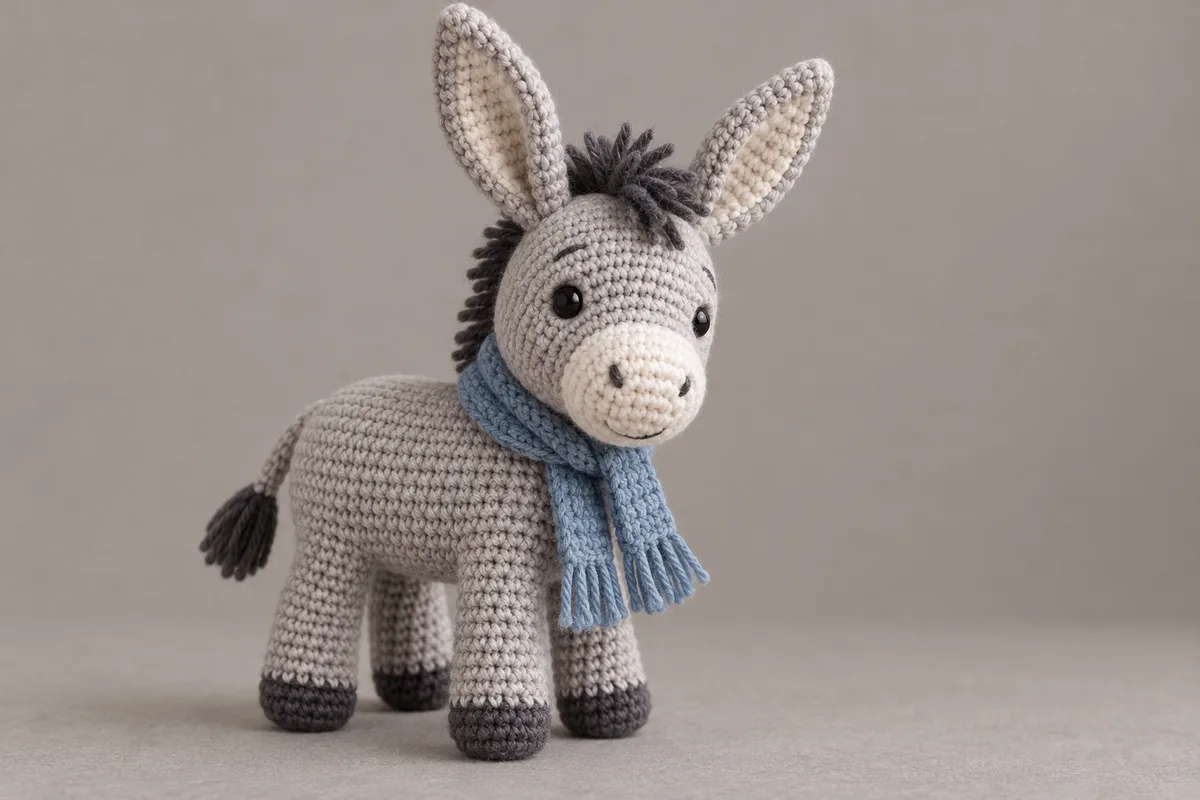
Alto the donkey is also listed as a PDF in English with US terms, French, Spanish and Vietnamese, at advanced-beginner-to-intermediate level with non-removable clothing. Here the specified DK yarn is 140 m per 50 g, with a 2.5 mm hook and an approximately 27 cm result using the stated materials. [7]
Putting Aki’s 160 m/50 g beside Alto’s 140 m/50 g makes a useful point: equal ball weight does not mean identical yarn. When substituting, record length, weight, fibre and tool rather than assuming the published height will remain unchanged. Category names are useful shorthand, but the concrete material specification gives a better starting point for comparison.
The four-legged stance and scarf in our AI donkey are not evidence of how Alto is made. Consult the authentic photographs and licensed pattern to learn how the actual character sits or stands and how its clothing is constructed. Separating a reference illustration from an attributed design prevents an attractive image from creating the wrong making expectations.
Build an index, not a replacement pattern
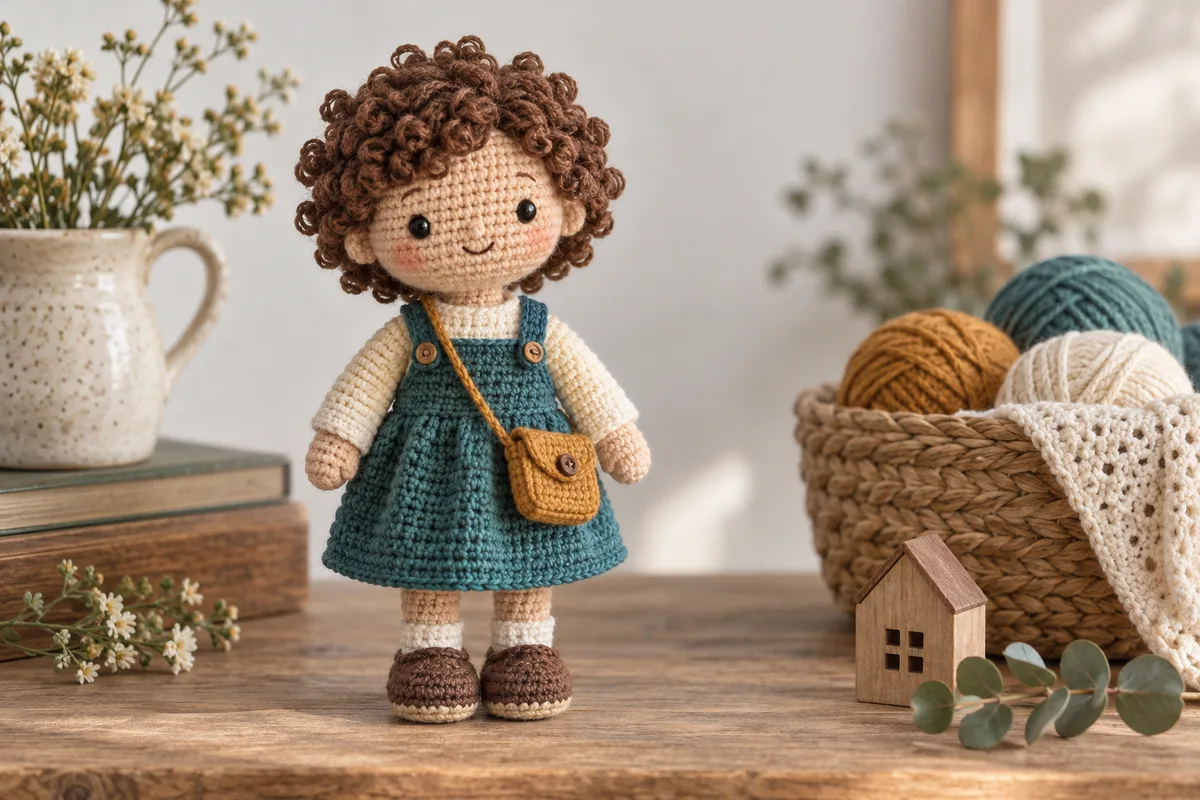
For a project you like, record its title, designer, official page, language, yarn length and weight, tool, stated level and the conditions attached to its finished size. That is an index to your chosen resource, not a document redistributing somebody else’s instructions. During your own making, keep separate notes on tension, substitutions and points that needed adjustment. Those observations make the next choice more informed.
Credit also needs precision. “A toy I made from a Khuc Cay pattern” means something different from “a toy I designed.” Our images likewise identify themselves as newly invented AI references. Keeping the author’s name attached to the actual design and providing a path to the original helps an appealing image become a starting point for careful learning.
Related reading: Vietnam’s knitwear industry and crochet designers. This feature moves from that country overview to the work of turning one character into instructions another person can read.
Sources and image note
- Khuc Cay · About me
- Khuc Cay · Mình đã tự học móc len như thế nào? (2020)
- Éditions Eyrolles · Khuc Cay
- Tuva Publishing · Sweet Crochet Friends
- Khuc Cay · Adorable Baby Egg Animals
- Khuc Cay · Aki the Shiba
- Khuc Cay · Alto the donkey
- Éditions Eyrolles · Le minimonde de Khuc Cay (2026)
- Khuc Cay · Notice concerning Sweet Crochet Friends (2026)
Checked October 14, 2026. Five new AI illustrations replace photographs for which reuse permission was not established. Authentic works can be seen through the caption links. The illustrations do not document the designer’s work, studio or patterns and cannot serve as making instructions. This article discusses an author and her public listings; it does not reproduce paid pattern rounds or charts.