Missoni in Print and in the Archive: Reading Colour Trials and Object Records
Research and writing: DDUJA KNIT
A familiar motif can feel entirely different after a change of colour. That may happen through the yarns used to form a fabric, or through printing on a knitted ground. To read Missoni’s colour, finished garments are only part of the evidence: trials and rejected possibilities matter too. This article focuses on printing and record-keeping. The founders and factory are discussed separately in our Rosita Missoni feature.
What the 1968–69 trials preserve
MA*GA’s MISSONOGRAFIA exhibition presented printing-test papers for designs made in 1968–69 and serial colour-variant samples on textiles. Curated by Emma Zanella and Luca Missoni, it ran from 22 January to 30 June 2023. This is an account of a past exhibition, not a current visiting recommendation.
The museum describes research into printed designs for knitted textiles from the early 1960s. Its screen-printing explanation separates a drawing into colour areas, associates those areas with screens, and recombines them through successive printing. Assigning different colours to the screens allows different versions of the same design. A stable outline therefore need not produce a stable colour effect. This explains the exhibition’s process; it does not identify the manufacturing method of every garment pictured here.
The account describes Ottavio experimenting with colour and Rosita selecting combinations for garments. Trials preserve decisions that a finished outfit can conceal. Rather than treating a palette as a single perfect inspiration, we can read it as comparison and selection. Establishing which trial led to which production garment would still require a documented connection between them.
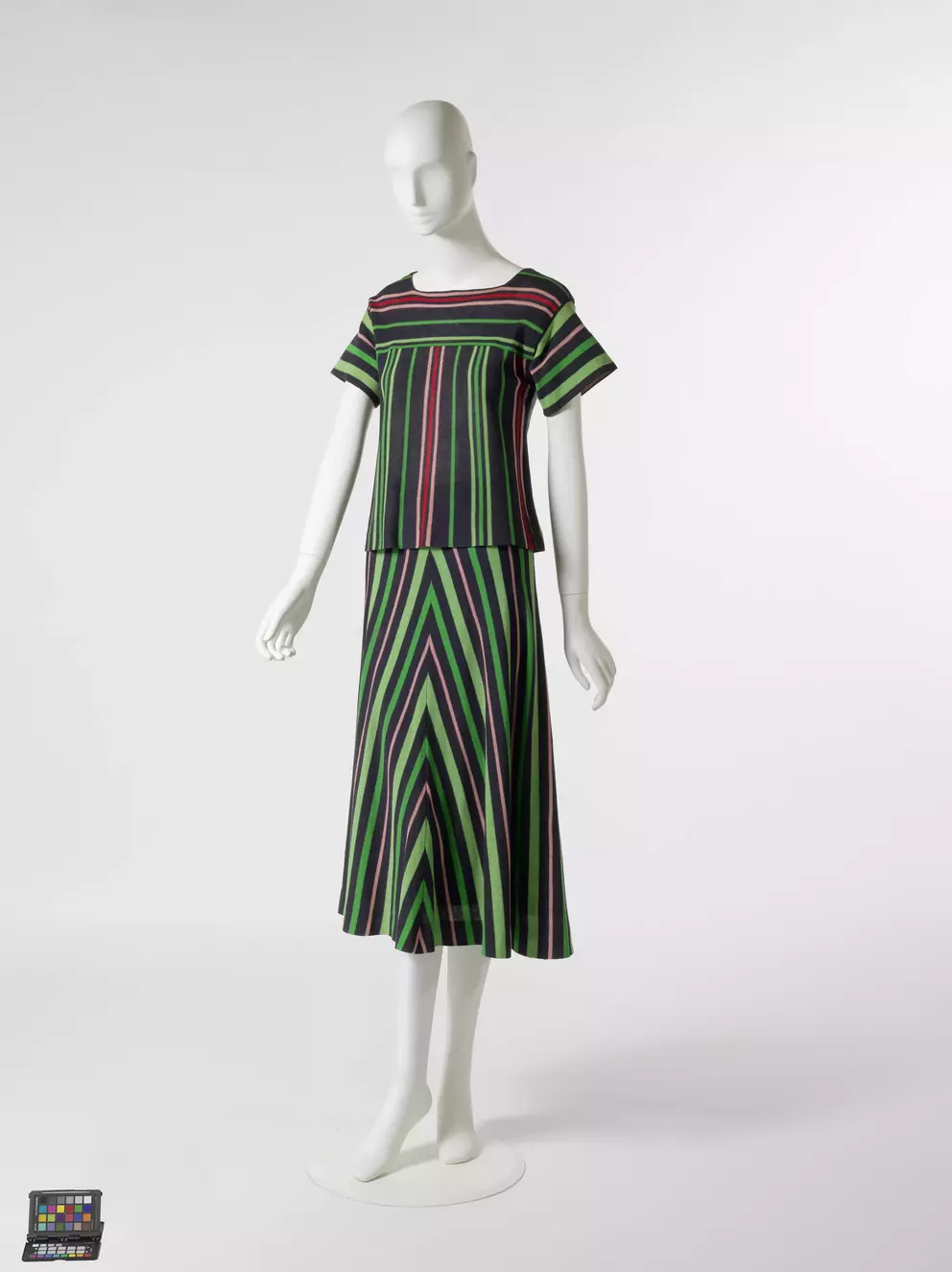
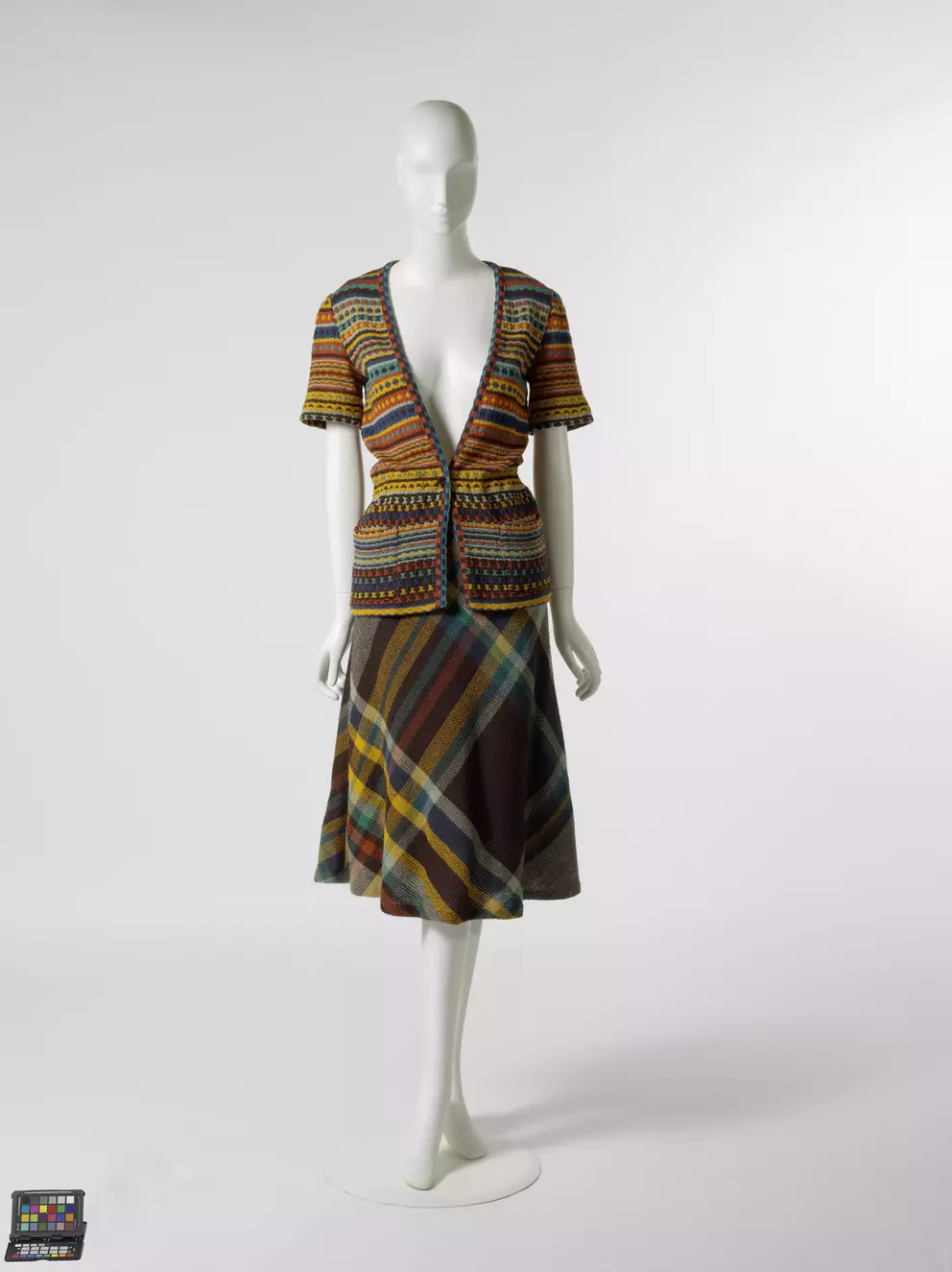
Ask whether a colour belongs to the yarn forming the loops or to a printed surface. A front-view photograph alone may not settle that question. Reverse views, edges and catalogue techniques help. The photographs below show actual Missoni garments, but they are not evidence of the 1968–69 printing trials. Actual trial-sheet photographs remain linked in the exhibition gallery.
From keeping garments to recording relationships
MA*GA’s June 2022 archive-opening notice connects the systematic archive with the 25th-anniversary retrospective in 1978. It describes chronological organisation of garments alongside editorials and sales photograph books. An outfit records a selected result; associated publications place it within a collection and its presentation. Different document types answer different questions.
The notice describes more than 100 archive garments arranged thematically for MISSONOLOGIA in 1994. Chronology makes change over time visible, while thematic organisation allows comparisons across dates. These are complementary approaches. Knowing both when an object was made and how it relates visually to other objects expands what can be retrieved from a collection.
Digitisation also has stages. The notice dates the growing need for a digital system to 2007. In 2012, much of the physical archive was reorganised and its contents digitised through participation in Europeana Fashion. Neither date should become an assertion that everything was publicly accessible online. Creating digital records, offering public access and permitting reuse are separate matters.
The approximately 20,000 pieces mentioned in the 2022 account concern the men’s and women’s collections at that time. It also describes accessories, fabric samples, publications, photographs, video, drawings and tapestries. We do not present that figure as a current total for every type of holding. The notice explains that seasonal collections continue to require archiving; a quoted quantity therefore needs its date.
Reading a museum record beyond the motif
Wien Museum’s M 22375 records a 1972 ensemble with a top measuring 55cm at the front and 50cm at the back, and a skirt length of 78cm. M 22372, dated 1971, lists wool alongside synthetic jersey and a synthetic button. Reducing both to “colourful wool knitwear” would discard material and construction information. A list of components also cannot be converted into invented fibre percentages.
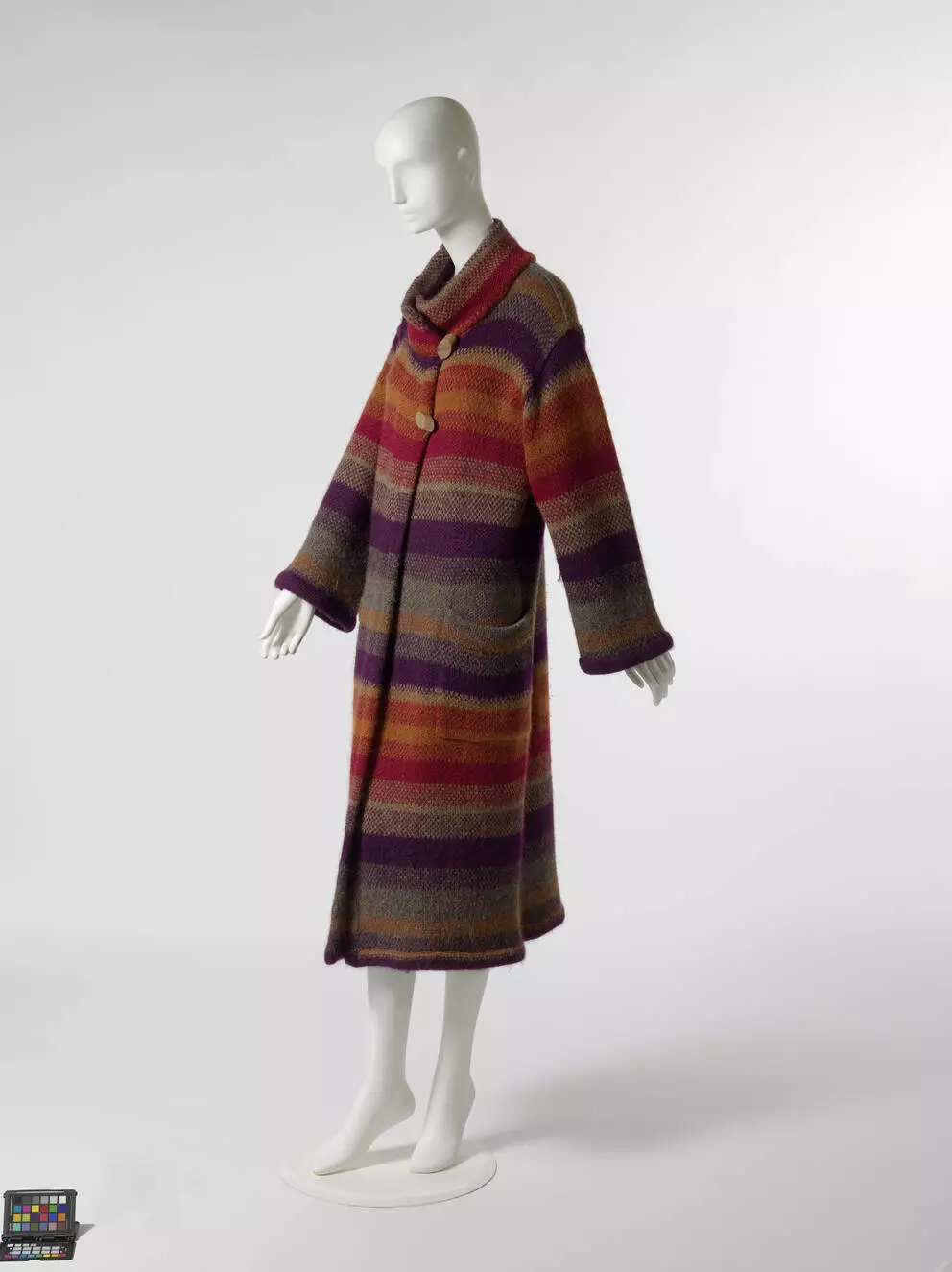
The 1979 coat M 22363 has a listed back length of 116cm and front length of 123cm. Wool, lining, mother-of-pearl buttons and shoulder pads appear in its materials. Different length figures are not automatically an error: the measurement location matters. These are finished-object dimensions, not cast-on counts or gauge instructions for reproducing the commercial design.
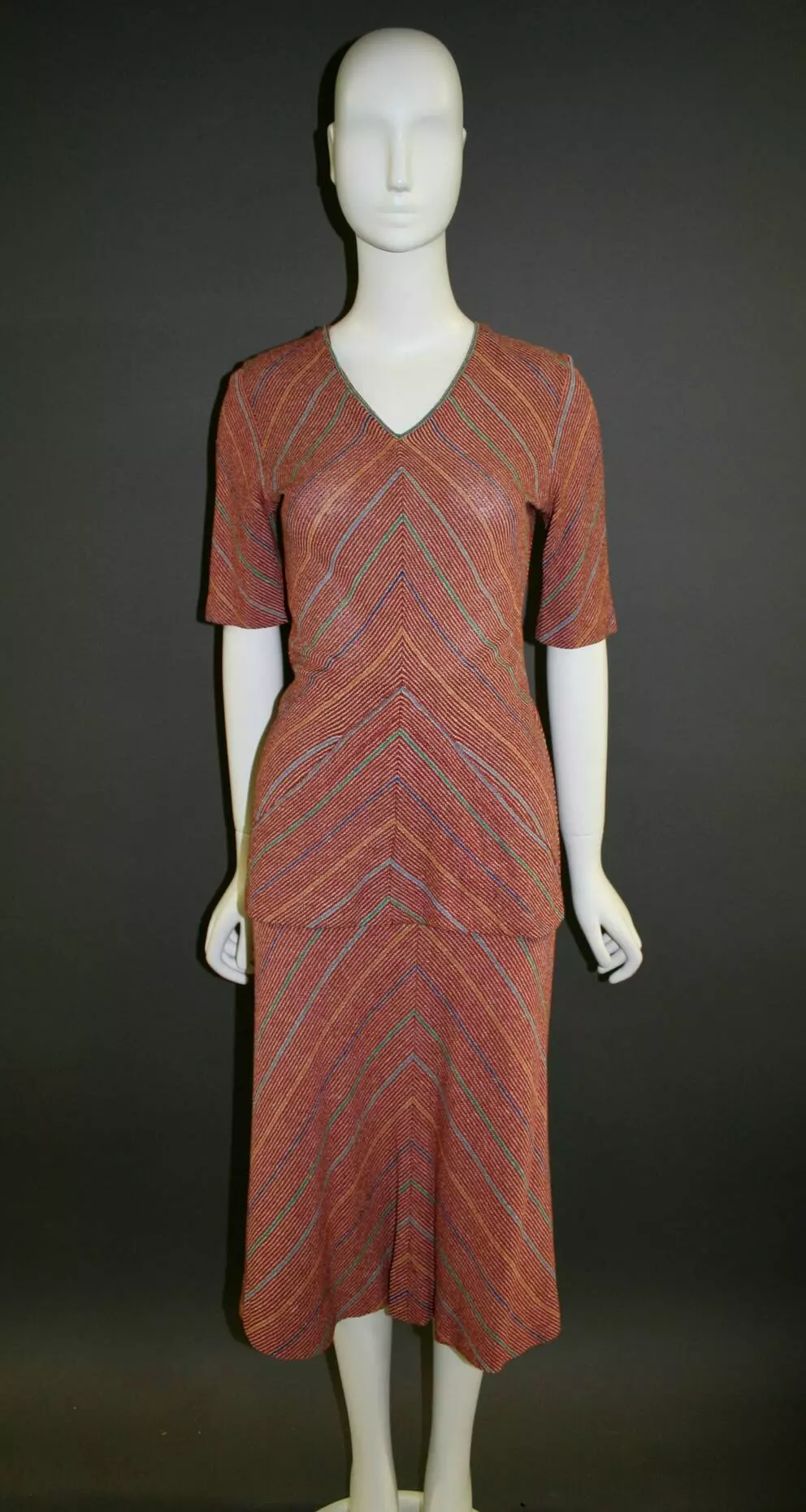
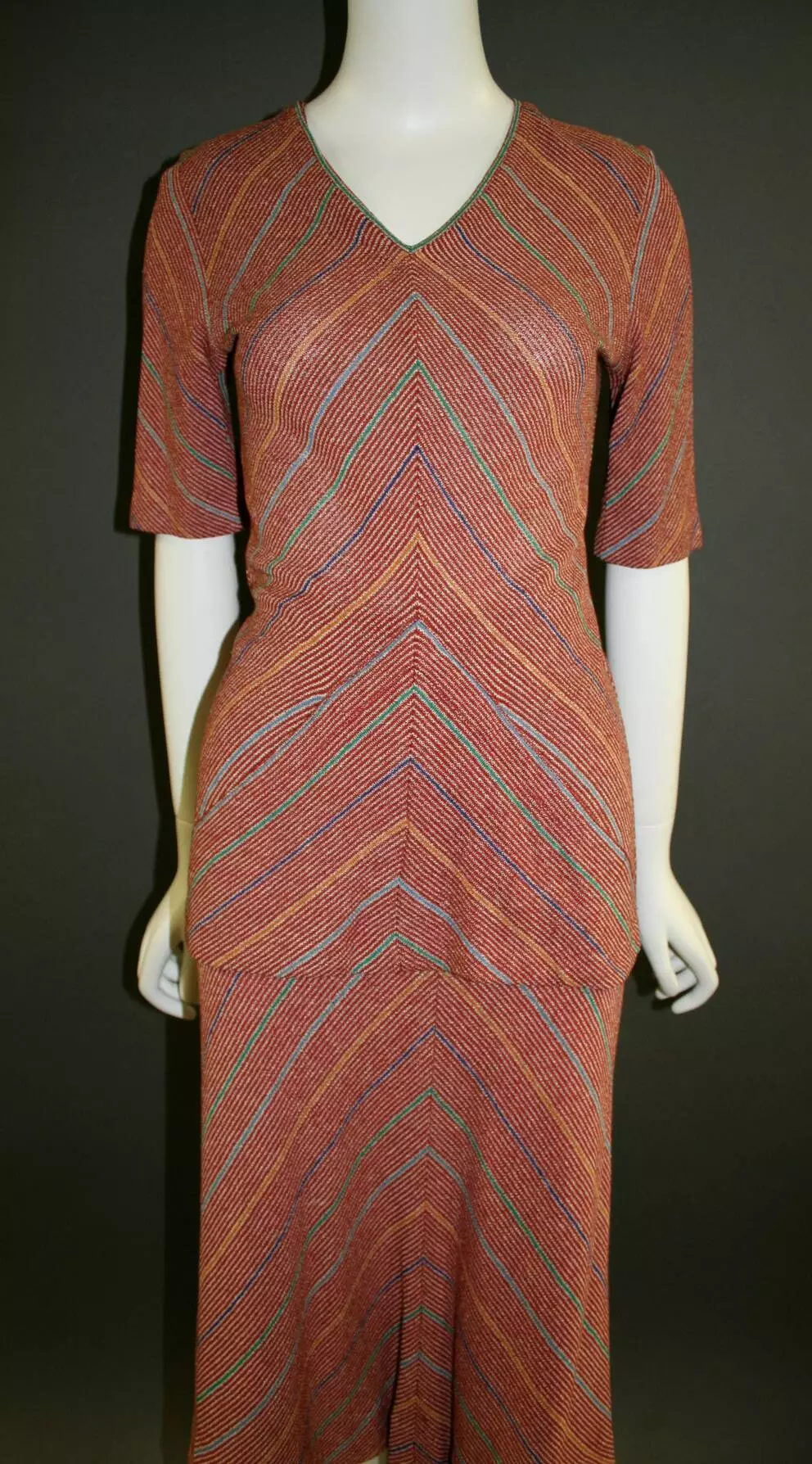
The 1974 ensemble M 22362 lists linen, jersey lining and elastic, and records Konfektion in its technique field. A knitted-garment title and visible pattern do not justify adding a particular needle technique or printing process. It is useful to leave a gap between what the catalogue establishes and what a viewer infers. The second image below belongs to the same inventory number, not a second outfit.
A small archive for your own knitting
The transferable idea is a method of comparison rather than a Missoni pattern. Give your own swatches identifiers and record yarn, fibre, needles, gauge and photography date. Separate colour changes within one structure from changes to the structure itself. This is an editorial suggestion for makers, not a reproduction of the archive’s internal cataloguing system.
Keep whole-object and detail photographs connected to the same sample. For before-and-after washing measurements, record conditions and measuring positions. An album becomes more useful when it preserves choices and unsuccessful colour experiments alongside finished results. Reading printing trials beside object records invites us to enjoy a surface while asking how it was reached—and what remains unverified.
Sources
- MA*GA · MISSONOGRAFIA, 22 January–30 June 2023
- MA*GA · Archivifuturi, June 2022
- Wien Museum · M 22375 (1972)
- Wien Museum · M 22372 (1971)
- Wien Museum · M 22363 (1979)
- Wien Museum · M 22362 (1974)
Checked 14 October 2026. Five real photographs, no AI images, covering four garments with two views of the 1974 ensemble. Image licences do not constitute blanket rights to the garment designs.