Spanish Liturgical Knitting: Four Silk Bible Marks and a Bishop’s Gloves
Research and writing: DDUJA KNIT / 뜨자뜨개
Unfold a red silk strip that looks ready to lie between the leaves of a large book. One has a horizontal band and two long descending arms; another is remarkably narrow and long. Birds, vessels and crosses appear on knitted silk surfaces. Cleveland Museum of Art records call four such pieces Spanish “Bible Marks,” broadly dated to the eighteenth or nineteenth century. An earlier Spanish pair of bishop’s gloves at The Metropolitan Museum of Art adds a different question: where does knitted construction end and applied embroidery begin? The five original records offer a way to study structure without pretending that an attractive photograph is a complete pattern.
Five records do not describe one workshop
For each of the four Cleveland works the catalogue says “Spain,” “1700s–1800s” and “knitted silk.” Those are collection attributions, a broad date range and a recorded medium. It does not name a maker, a town, a precise date or an owner of the book. The Wade gift in 1916 is a collecting history, not a maker’s signature. The four records link the pieces as related works, which makes comparison reasonable; it does not prove that they were produced for the same church on the same day.
The Met classifies its bishop’s gloves as Spanish and from the first quarter of the seventeenth century. Its text distinguishes a silk-knit foundation from gold metallic embroidery. A gap between that date and the Cleveland dating is not evidence of a continuous chain of transmission. Here the connection is an interpretive comparison among objects placed in religious textile contexts, not an invented genealogy.
Photo 1. A crossbar and two descending arms
Cleveland record 1916.1462 measures 64.5 × 78.7 × 2.5 cm overall. A horizontal band branches into two long arms. The museum’s visual description notes letters and scissors-like shapes across the top, and birds, pitchers and chalice-shaped vessels on the descending portions. The record does not supply an interpretation for every symbol, so we should not assign them to a particular saint or service. Instead compare the repeated units and watch where each arm meets the crossbar. The photograph does not prove whether these pieces were knitted continuously or joined after separate construction. CMA object record
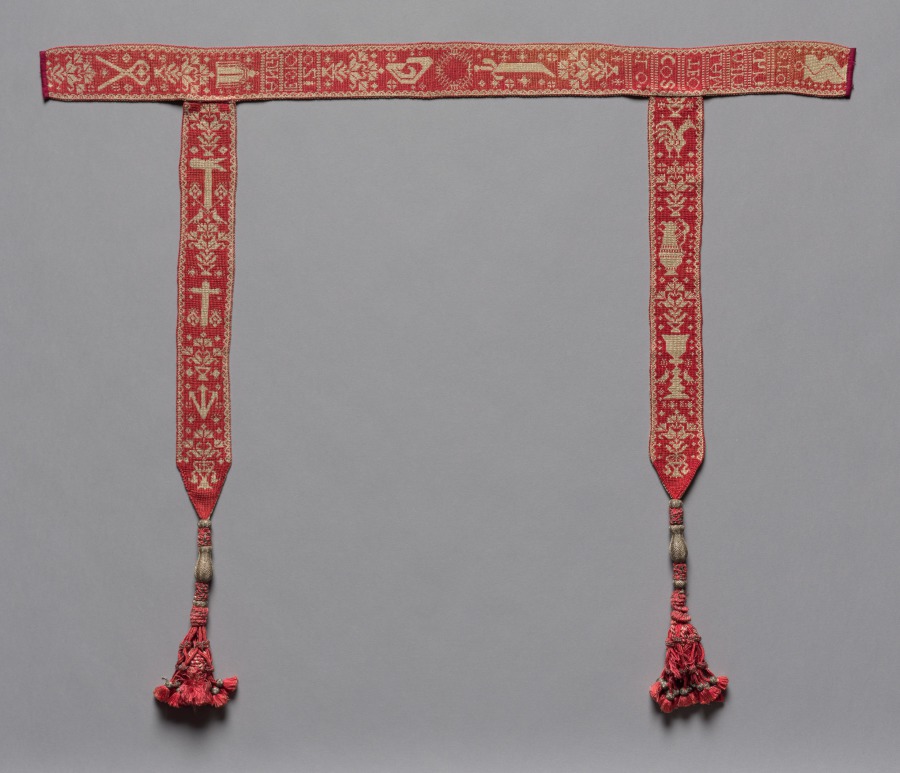
The tassels change the visual rhythm at the ends. Their presence does not tell us the stitch count, finishing order or whether every visible detail was made by exactly the same process. “Knitted silk” identifies the recorded medium of the work; it is not an instruction sheet. Separating what the catalogue states from what the image suggests keeps a reconstruction honest.
Photo 2. A related format at another scale
Record 1916.1464 again has a crossbar and two hanging sections, but measures 54.5 × 73.5 × 2.5 cm. Its image description mentions hands, birds, vessels and vegetation. A similar silhouette does not make it a duplicate of the first work or prove an identical chart. Compare the width of the top band, the relative length of the arms and the treatment of their ends. Even where motifs seem clear, a whole-object view cannot reveal a stitch-by-stitch sequence. CMA object record
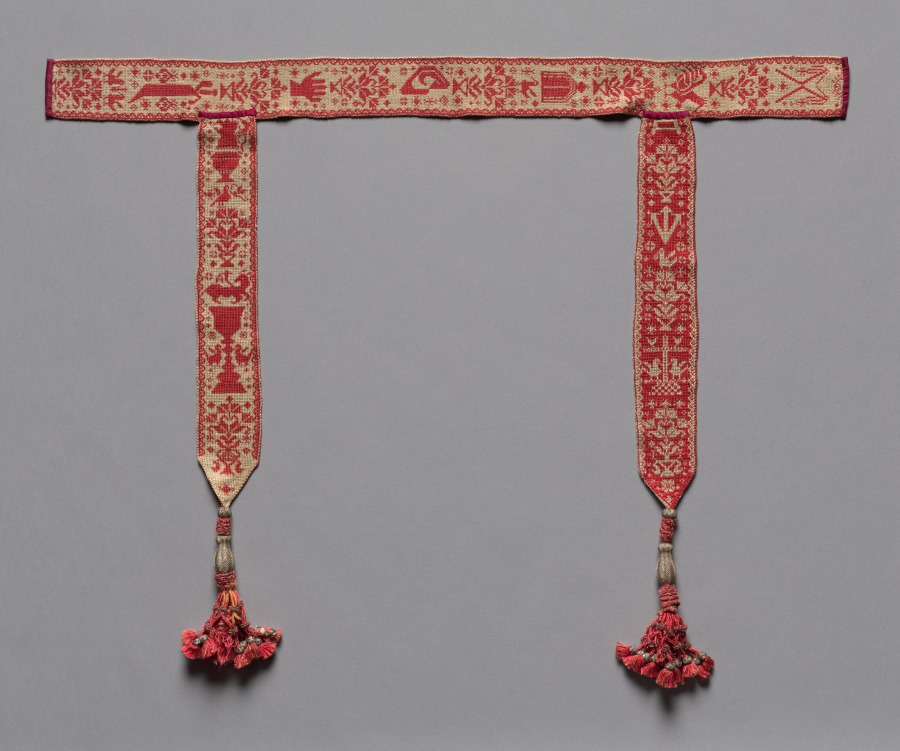
Both pieces entered Cleveland through the same Wade gift, yet their makers remain unnamed. The museum groups the works with ecclesiastical textiles and titles them Bible Marks. That is good evidence for a collection context, but it does not document a particular congregation, book or actual episode of use. The distinction between object type and object biography matters.
Photo 3. An exceptionally long narrow band
Record 1916.1465 measures 248.9 × 8.5 × 2.5 cm overall. Its narrow proportions differ strikingly from the two crossbar forms. Cleveland describes a red strip bearing ladder, cross, hand and chalice shapes with floral repeats, tapering into tasselled ends. One can look for a long central repeat and then for the transition to the terminal finish. The object is looped in the photograph; those loops are views of one piece, not evidence of several separate bands. The catalogue’s overall dimension is more reliable for comparing scale than the apparent length in a browser image. CMA object record
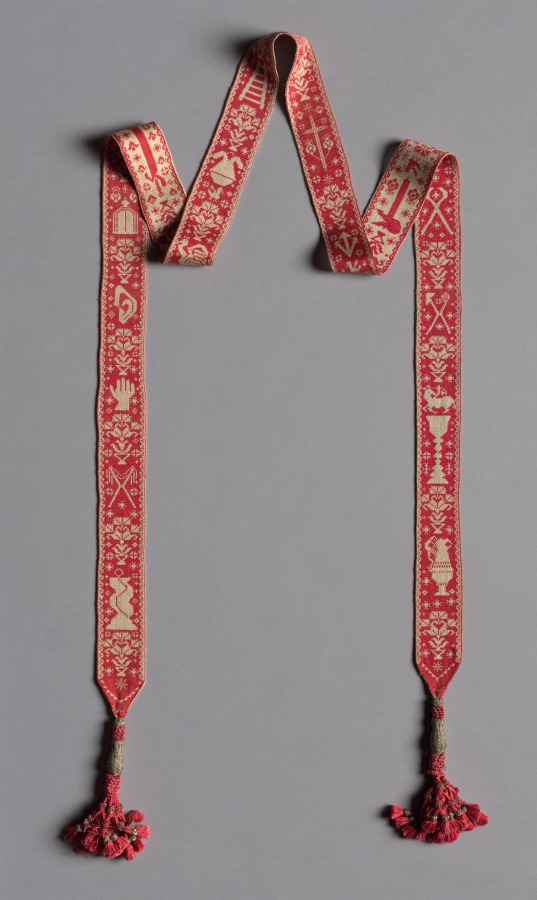
Recognizing a ladder or cross in a photograph is not the same as proving a full program of symbolic meanings. The museum gives a title, technique and visual description, but no maker’s explanation of the iconography. Interpretive claims that go beyond those records need separate evidence, so the pattern of forms is left distinct from a supposed definitive theological key.
Photo 4. A shorter single strip
The fourth mark, 1916.1471, is recorded at 42 × 5.7 × 2.5 cm. It is another single strip but far shorter than 1916.1465. Cleveland’s visual description mentions pale vegetal and geometric figures on red silk, a T-shaped form, a small bird and tassels. Those observations help distinguish this object from the longer band without assuming a universal size for Spanish Bible marks. Before adapting its proportions into a contemporary design, compare the museum measurements rather than the unscaled photographs. CMA object record
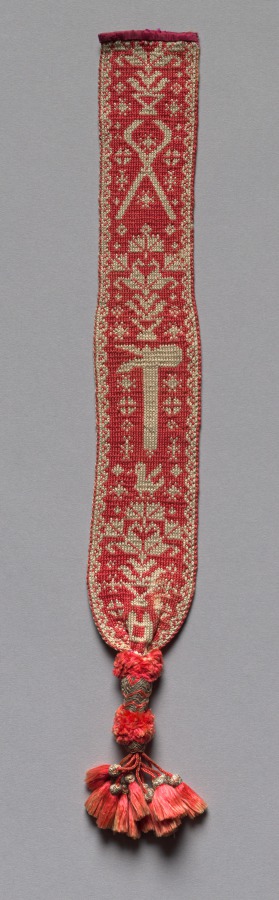
All four have a knitted-silk identification, yet the accessible images do not explain every reverse-side detail, yarn twist, cast-on edge or later alteration. A careful diagram would label the visible outline as observed and any method of making it as hypothetical. This article is a guide to reading evidence, not a tested pattern for reproducing the works.
Photo 5. Knitting beneath embroidery on bishop’s gloves
The Met’s pair 2009.300.1648a,b is classified as Spanish, first quarter of the seventeenth century. The recorded size is 20.3 × 25.4 cm, with silk and metal as media. The museum explains that liturgical gloves were traditionally silk-knit and enriched with metallic embroidery; this pair has a broad gauntlet cuff decorated with floral and fruit forms. Describing the entire red design as “knitted patterning” would erase the embroidery. Examine the hand-enclosing fabric, the shape of the cuff and the applied decoration as different questions. The Met object record
The Met’s contextual note describes the use of such gloves by bishops and cardinals during pontifical masses and explains that red is a liturgical color for certain feasts and Palm Sunday. The public record does not name the individual who wore this pair or connect it to the four Cleveland marks. Acquisition and gift dates centuries later are not evidence of the original wearer. We can describe the object and the museum’s general explanation while preserving that gap.
Four questions for the next pattern
First ask whether a museum title is a present-day collection label or an original maker’s name. Second, separate the recorded knitted silk from possible finishing processes such as tassels, and from the explicitly recorded embroidery on the gloves. Third, use measured dimensions to compare formats. Fourth, keep unknown makers, wearers and locations unknown. These five works demonstrate specific uses of knitting within objects catalogued in Spanish religious-textile contexts. They do not establish the origin of knitting in Spain or a nationwide practice. Their differences are precisely why a familiar-looking motif should never be mistaken for a proven construction method.
Primary museum records and image rights
- Bible Mark (One of Four) · 1916.1462 — Cleveland Museum of Art; Gift of Mr. and Mrs. J. H. Wade
- Bible Mark (Two of Four) · 1916.1464 — Cleveland Museum of Art; Gift of Mr. and Mrs. J. H. Wade
- Bible Mark (Three of Four) · 1916.1465 — Cleveland Museum of Art; Gift of Mr. and Mrs. J. H. Wade
- Bible Mark (Four of Four) · 1916.1471 — Cleveland Museum of Art; Gift of Mr. and Mrs. J. H. Wade
- Bishop’s Gloves · 2009.300.1648a,b — The Metropolitan Museum of Art; Brooklyn Museum Costume Collection
- Cleveland Museum of Art · Open Access
- The Metropolitan Museum of Art · Terms and Conditions, Open Access
Checked 15 October 2026 against the five object records and the museums’ reuse policies. All five images are actual open-access museum photographs; no AI image is used. Unnamed makers, wearers and exact stitch counts are not invented.