Japan’s Automatic Glove-Knitting Machine: Reading the 1964 Shima Seiki Record
Research and writing: DDUJA KNIT / 뜨자뜨개
Where does a glove become one piece? Its fingers, palm and wrist are familiar shapes, but a machine that knits them in sequence has to control more than a rectangle of fabric. Mechanical Heritage No. 90, documented by the Japan Society of Mechanical Engineers (JSME), preserves evidence of how Shima Seiki approached that task. The historical machine photograph on the JSME page was supplied by its maker; its reuse permission is not established here. Consequently none of the photographs below claims to show that machine. Four licensed comparison photographs, a licensed diagram and one clearly identified AI illustration help explain the questions raised by the record without impersonating the artifact.
A 1964 development and a surviving 1968 machine
The JSME heritage description dates Shima Seiki’s development of a fully automatic cotton work-glove knitting machine to 1964. The preserved machine it describes was made in 1968. Those are different dates: the object recognized in 2017 as Mechanical Heritage No. 90 should not be called an original machine physically made in 1964, nor does its 1968 manufacture postpone the development claim. JSME gives its outside dimensions as 325 mm deep, 840 mm wide and 1,200 mm high. This is a measured physical artifact, not a glove pattern or a national history of every Japanese machine. The photograph on the JSME record is credited to Shima Seiki. Linking that record enables readers to view the evidence there; it does not grant permission to republish the photograph on this site.
From fingertips through joined fingers to a wrist
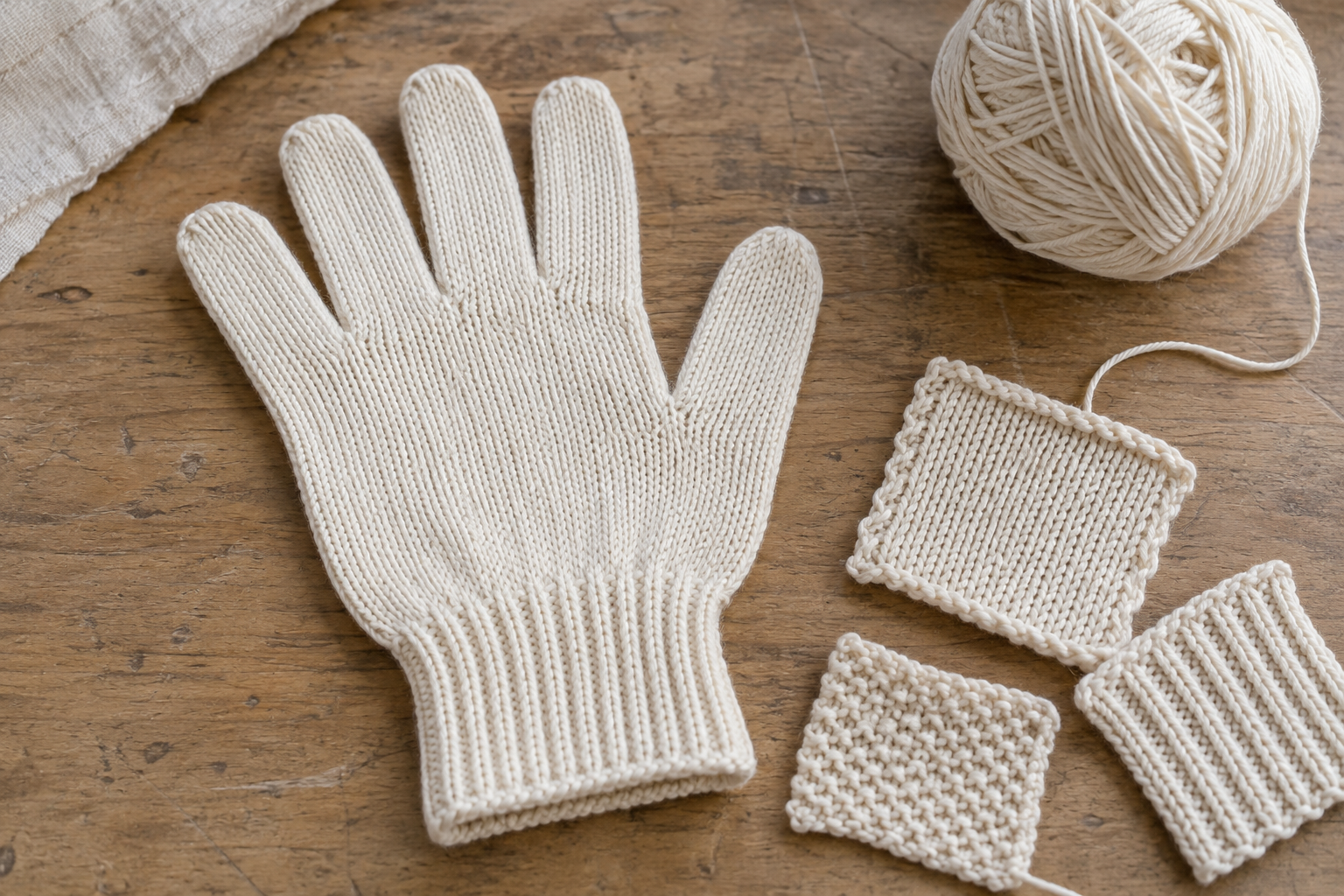
JSME explains the machine as a continuous operation that knits fingertips, joins the fingers, forms palm fabric and finishes the wrist. A rubber yarn was incorporated around the wrist. “Automatic” describes the coordination of those stages, not a claim that five fingers form as an indistinguishable single tube. Each change of shape needs a controlled relationship between needles, yarn and the fabric already made. The public heritage summary does not supply needle counts, stitch gauge, the exact cam paths or a complete technical pattern. A visually plausible glove illustration cannot fill those mechanical gaps.
The JSME text contrasts a semi-automatic process taking more than three minutes per glove, with one worker operating three machines, against two minutes and fifteen seconds per glove and one worker potentially overseeing as many as thirty machines on the new equipment. These are the conditions and comparisons stated in a heritage account, not audited production totals for every factory. One cannot convert the thirty-machine figure into a precise labour-saving percentage or daily output without knowing downtime, yarn changes and inspection. The evidential point is narrower and more interesting: the joining and subsequent fabric stages were brought under one automatically controlled sequence.
Masahiro Shima and the limits of company history
Shima Seiki’s company chronology places its founding in 1962, the automatic glove machine in 1964 and the FAC collar-knitting machine in 1967. Its founder profile describes Masahiro Shima’s earlier interest in glove machinery and an elastic wrist, and recounts completion at the end of 1964 followed by an early-1965 demonstration. That is a company account of the inventor’s work; it should be attributed as such. The company’s “world first” wording is not transformed here into an independently established global priority claim. A completed design, a public demonstration, commercial manufacture and a surviving museum object are distinct events. Maintaining those distinctions prevents a compressed chronology from seeming more certain than its sources.
A photograph of a related machine is still a different machine
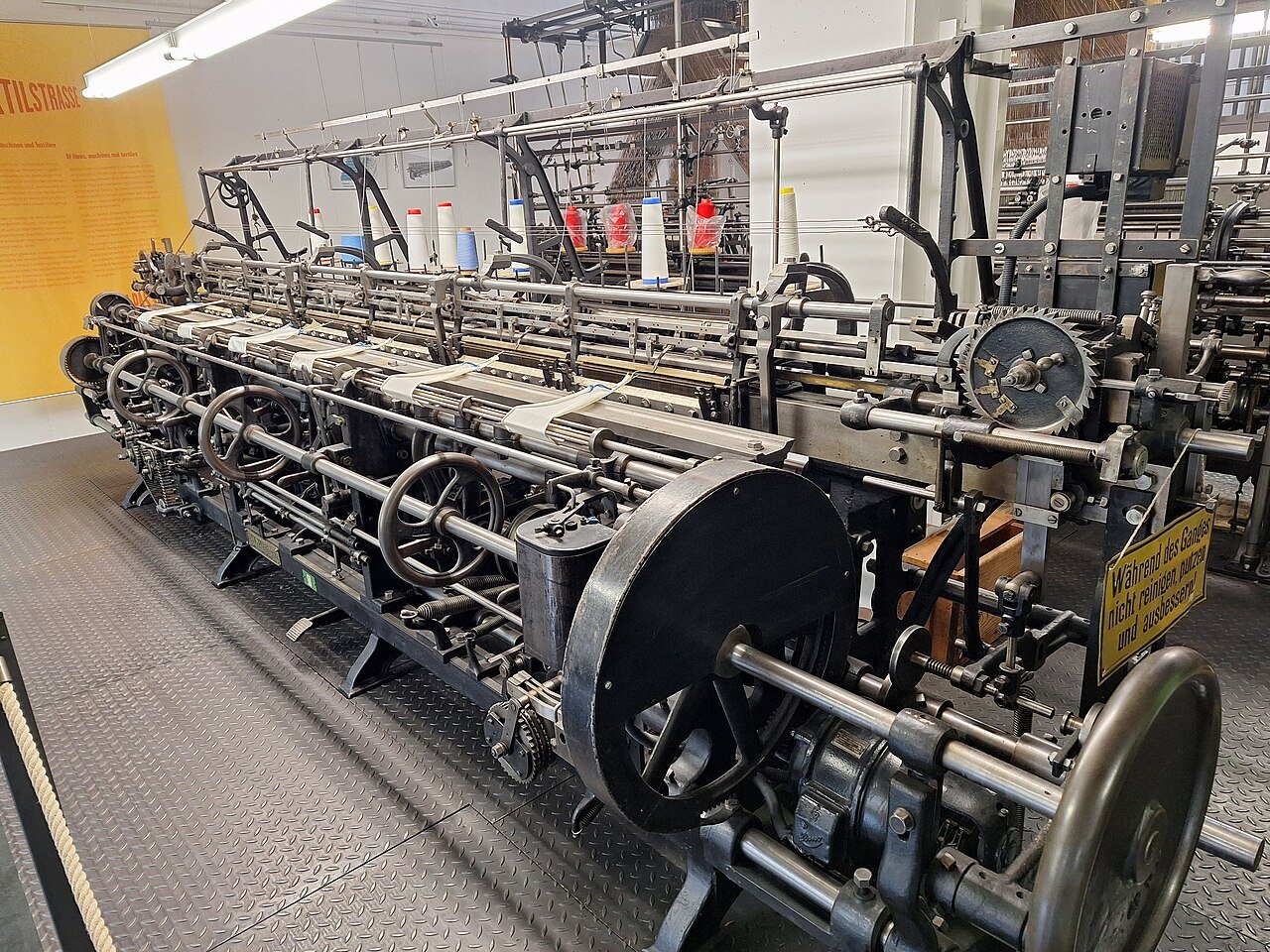
The first licensed photograph shows a 1907 glove-finger machine in Chemnitz, Germany. It offers a concrete visual comparison for a stage in glove production, but no source cited here proves it to be a direct ancestor of Shima’s device. The next photograph shows a modern domestic knitting machine and its row of needles. Tokyo’s museum collection independently records a Japanese Ars home knitting machine from 1947, object 95003070, measuring 82 by 19 by 6 cm. Its own photograph is not republished because reuse terms for that image were not confirmed. The modern domestic photograph is therefore not a substitute portrait of the 1947 object; it helps pose a contrast between domestic and industrial equipment.

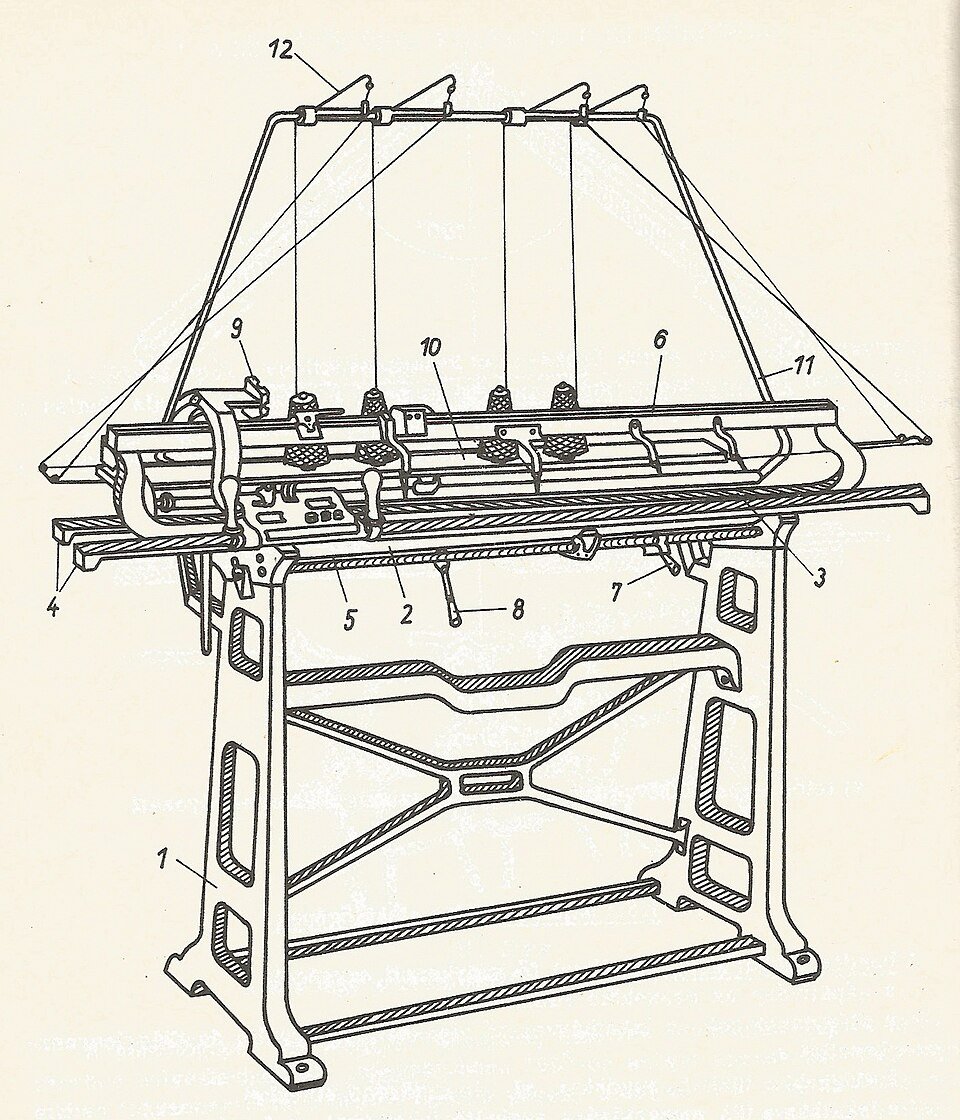
The V-bed image below is a generic explanatory diagram of two angled needle beds and a moving carriage. It is not a drawing of the patented or preserved glove machine. “Knitting machine” can mean a manually operated home device, a glove-specific automatic line or a later computer-controlled flat machine. Each achieves different shaping and production aims. Reading an unrelated modern diagram backwards as proof of an older machine’s internal architecture would confuse analogy with documentation.
A path toward new machinery, not one unchanged invention
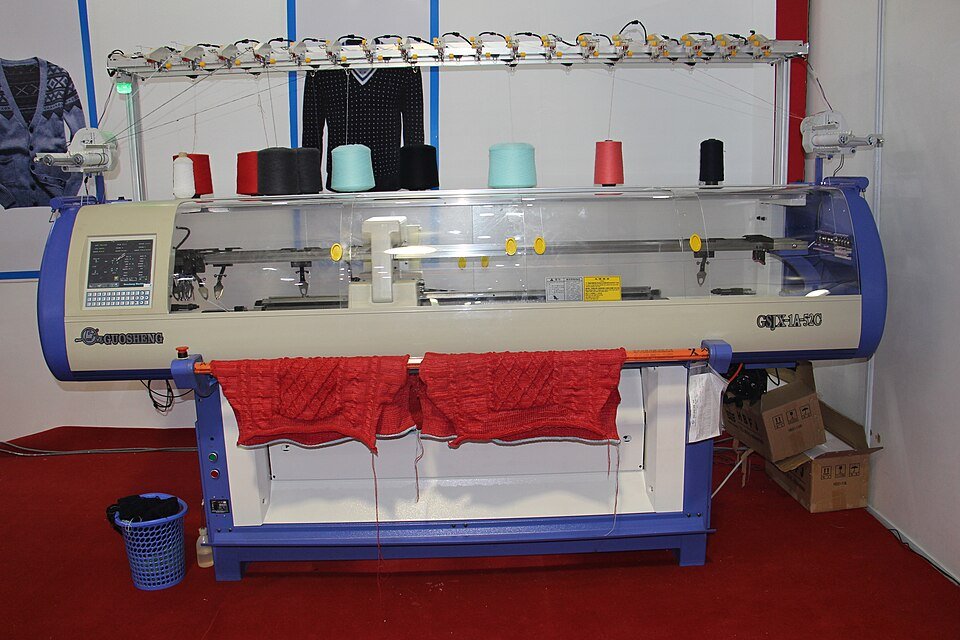
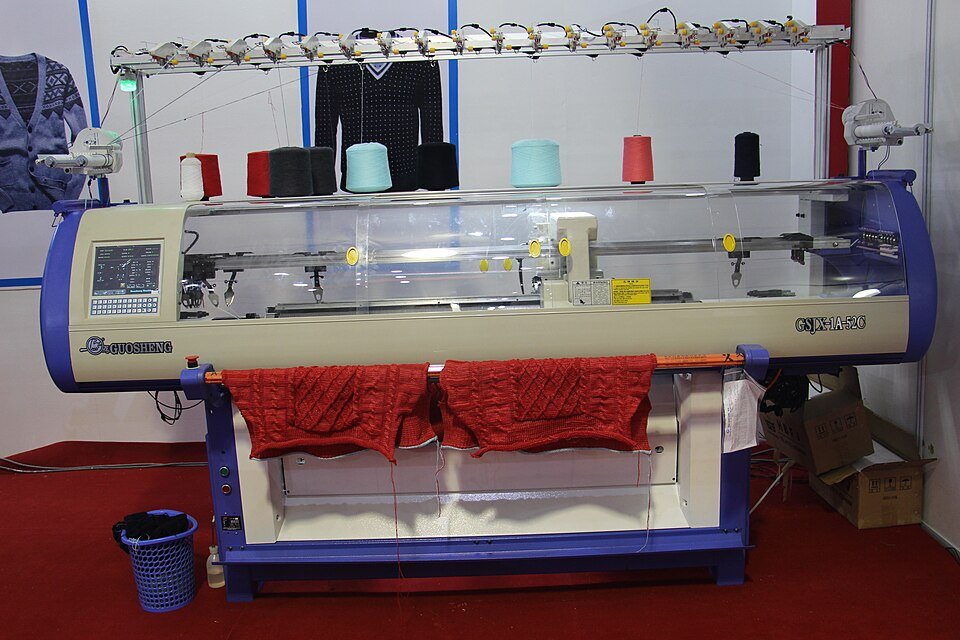
The manufacturer’s later chronology identifies the 1967 collar machine and computer control in 1978 as other developments. Its WHOLEGARMENT history starts the named whole-garment technology in 1995. Shaping a finished form on the machine is a useful thematic comparison, but knitting a work glove in 1964 and producing later seamless apparel are not the same machine or method. The two following photographs are different views of the same modern Chinese computerized flat machine. They can show a later machine’s enclosure and carriage area, not what the Japanese 1964 machine looked like. Treating two camera angles as two distinct artifacts would also exaggerate the visual evidence.
What to ask of a glove pattern
When reading a glove pattern, ask where fingers are separated or joined, how the palm grows from those joins, and how the wrist obtains stretch. A hand-knitting pattern may use ribbing, elastic yarn or another construction entirely. The JSME sequence is valuable because it prompts those questions, not because a brief heritage page provides a reproducible machine pattern. The outside dimensions of the 1968 artifact are not finished glove dimensions. Two minutes and fifteen seconds is a historical machine-process comparison, not a maker’s hand-knitting time.
This record marks a particular industrial solution in Japan, not the origin of Japanese knitting. Keeping development in 1964, the surviving 1968 object and the 2017 heritage recognition separate shows what the sources actually establish. The six visuals likewise span different countries, periods and purposes, each labelled so that the reader can compare technology without mistaking a modern illustration or another machine for the protected historical photograph.
Primary records and image rights
- JSME Mechanical Heritage No. 90
- JSME English record
- Shima Seiki company chronology
- Founder Masahiro Shima profile
- WHOLEGARMENT chronology
- Tokyo Museum Ars machine
Of six visuals, four are licensed photographs, one is a licensed diagram and one is an AI-generated illustration. No photograph of the 1964 Shima Seiki machine or the surviving 1968 example is reproduced. Each caption identifies the actual subject, maker, rights and original link.