Steinberg Drapery in Carlton: Mended Swimwear and Knitwear Left in Stock
A small repair on a grey wool bathing suit opens a larger story about a family shop in Carlton, Melbourne. The suit was kept among unsold stock that eventually entered Museums Victoria. Instead of treating these clothes as fashion illustrations alone, we can read their fibres, seams, repairs, labels and packaging as evidence of how knitwear was sold and preserved. This article follows four objects shown in five photographs from the Steinberg Drapery Collection. It does not claim that the Steinbergs manufactured any of these particular garments.
A hosiery business and a drapery shop
According to Museums Victoria, Hyman Steinberg arrived in Australia from Palestine in 1924; Phyllis arrived from the Polish–Russian border region in 1927. They married in 1929. Phyllis first sold fabrics and surplus stock at markets, then opened a drapery shop in Carlton around 1930–31. Hyman operated a hosiery business opposite the shop using American machinery. Manufacturing continued until 1938, and the business employed up to 20 people at its peak. These facts establish a connection between making and selling knitted goods, but they do not identify the makers of the swimwear and underwear below. [1]
During wartime rationing, customers paid with clothing coupons as well as money; the business then needed coupons to buy wholesale stock. Phyllis kept unsold goods rather than routinely disposing of them. Museums Victoria’s Steinberg Drapery Collection comprises 162 objects, including hosiery, underwear, swimwear and fabric. Phyllis and her son Myer donated the collection in 1989–90. The survival of ordinary stock makes it possible to examine garments that were never selected as the season’s celebrated designs. [1]
Four garments, five photographs
Blue Black Lance wool bathing costume
The women’s Black Lance bathing costume, dated approximately 1940–59, is made from dark blue knitted wool panels. Museums Victoria describes a finer cream-coloured knitted lining at the bust and sides. Narrow shoulder straps, a V-shaped back and a short skirt-like lower section show how shaped panels made a wearable garment. Its label says “Tailored Knitwear,” “100% Super Merino Wool” and size 42. The label and catalogue support those material details; neither proves that Hyman’s factory made this costume. [2]

The repaired grey wool suit
A grey men’s knitted wool bathing costume, dated about 1945, retains a small repair on the front. The museum record suggests that the shopkeeper may have mended the fault to sell the garment as a second. This is a qualified interpretation, not proof that the sale happened. A white waistband and short-legged form remain visible. The catalogue records size 12 and dimensions of 52 by 36 centimetres. It does not document the stitch count, gauge or exact method used in the repair. [3]

A Thistle nylon suit with its packaging
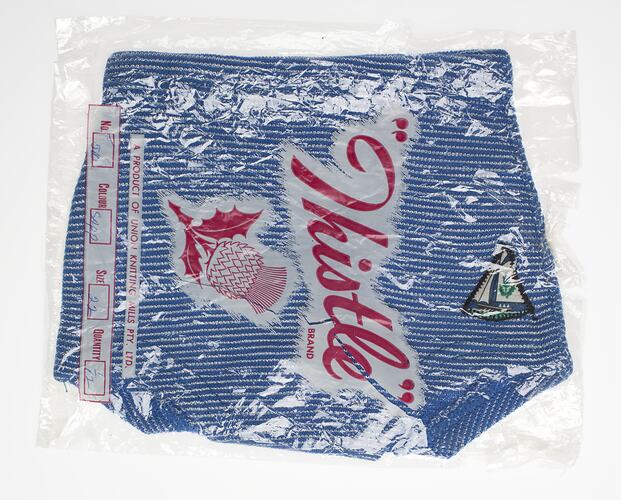
The Thistle boy’s bathing costume, dated 1950–59, is described as rib-knitted nylon with blue and white stripes and a small yacht decoration. Its original plastic package survived. The label gives size 22. The two photographs below depict the same catalogued object, not two different suits. Beside the wool garments, it offers a comparison of fibre, knitted surface and retail presentation. Since the recorded date ranges overlap, these three suits cannot establish a simple one-way chronology in which nylon suddenly replaced wool. [4]

Apricot bloomers with a separately knitted gusset
The apricot-coloured women’s bloomers are knitted from acrylic in an openwork pattern. Museums Victoria describes knitted bands at the waist and leg openings, a narrow elastic at the waist and a finer-textured gusset knitted separately and then sewn in. This makes the garment useful for thinking about construction: knitting and sewing work together to fit fabric to the body. The record says the object was collected when the shop closed in 1989, but it does not give an exact production year or maker. “Collected in 1989” should not be mistaken for “made in 1989.” [5]

Reading a garment before imagining a pattern
These museum objects are not knitting instructions, yet they suggest a disciplined way to examine old knitwear. Start by separating a manufacturer’s label from the museum’s material description: the Black Lance label claims merino wool, while the Thistle suit is catalogued as nylon and the bloomers as acrylic. Then look for ribs, changes in fabric density, shaped panels and seams. The finer lining of the blue suit and the separately knitted gusset of the bloomers show that a garment need not be one continuous piece of knitting. A repair belongs to the garment’s later commercial history; original packaging belongs to its presentation and storage.
The catalogue dimensions describe surviving objects, not a modern knitting gauge or recommended size. The public records do not reveal precise needle sizes, row counts or full factory processes. Nor does finding an item in the drapery shop mean it was manufactured in the family’s hosiery business. The distinction matters whenever a shop’s history is used to interpret the clothes it once sold.
What unsold stock can tell us
The surviving collection brings together a repaired wool costume, packaged nylon children’s wear and underwear without a named maker. It permits a more grounded view of mid-century knitwear than a single fashion image: migration, small-scale manufacturing, retail, wartime rationing, mending and long-term storage all matter. When reading an old knit or pattern, ask not only how its stitches look, but how its label, fibre, seams, repairs and route into a collection shape the story.
Primary sources and image rights
- Museums Victoria, Steinberg Drapery Collection — family, shop and donation history.
- SH 890489, Black Lance wool bathing costume.
- SH 890399, repaired grey wool bathing costume.
- SH 890451, Thistle nylon bathing costume.
- SH 890424, knitted apricot bloomers.
Five photographs of actual objects; zero AI-generated images. Museums Victoria marks these individual image files CC BY 4.0. Each caption links to its object record, file and reuse terms. Where the record is silent about maker, date or technique, this article does not fill the gap with invented details.