A Hand-Knitted Aircrew Scarf: Graham Conning and Two Different Wartime Textiles
Who knitted the navy scarf that accompanied an Australian airman? The surviving collection record does not say. That gap matters. Museums Victoria identifies object ST 39504 as a hand-knitted wool scarf worn by Flight Lieutenant Graham Stewart Conning when flying, but gives no maker, exact date, needle size or stitch instructions. Instead of turning an unknown maker into a convenient wartime story, we can read what the scarf, its photographs and its neighbouring objects actually establish. [1]
A wool object measured, not merely remembered
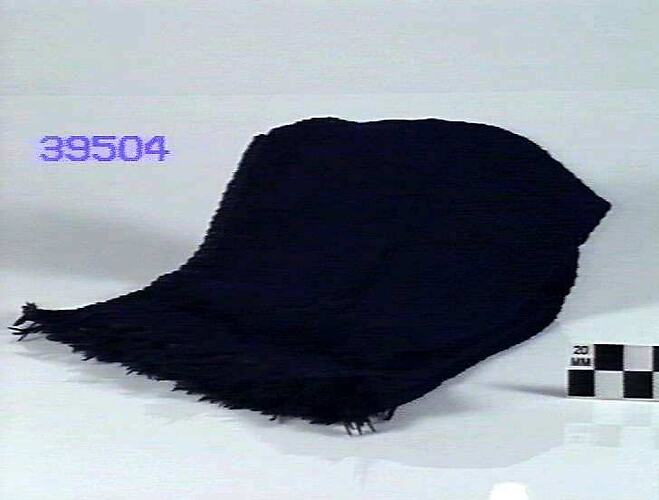
The museum describes navy-blue wool, hand knitting and fringe at both ends. It records an overall length of 146 centimetres and width of 33 centimetres. Those dimensions tell us more about the garment’s scale than a cropped photograph can: this was a substantial piece of cloth for the body, not a tiny symbolic ribbon. They do not reveal how Conning wrapped it, the warmth it achieved in a particular aircraft, or which flight he wore it on. No surviving pattern or gauge is supplied with the record. [1]

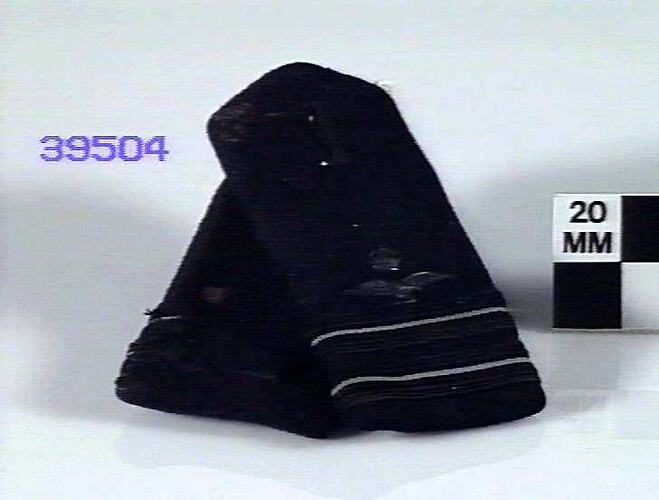
The next two photographs show other views of the same scarf, rather than additional examples of wartime knitting. Compare the outline in the second view with the light stripes and insignia near an end in the third. The photographs invite close looking, but they cannot establish whether a marking was knitted in, sewn on or added later. Those would require an examination of the textile or a more detailed technical record. [1]
The wearer and the squadron
Conning was born in Richmond, Victoria, in 1919. The museum’s biographical record says he worked in furniture sales and stockkeeping at Myer in Melbourne before joining the Royal Australian Air Force in 1942. After training, he served with No. 461 Squadron from November 1943. The museum attributes 629 hours in a Sunderland aircraft to him. He arrived in Sydney in July 1945 and was discharged that October. These dates place the wearer in time; they do not date every stitch of his scarf or prove that it accompanied every sortie. [2]
A February 1944 group photograph of 461 Squadron beside a Sunderland belongs to the same family donation. Its catalogue connects Conning to the group, while a corresponding Australian War Memorial record identifies the squadron’s official records for 1942–44. The photograph supplies a setting for the person’s service; it is not an image of this scarf in use. Nor does the catalogue alone justify pointing to one face in the crowd. Keeping those distinctions visible lets a museum object tell its own story without being made to illustrate claims it cannot support. [3][4]

Two scarves, two ways of making
Another scarf in the Conning collection, ST 39518, can easily be mistaken for the knitted one if captions are lost. Museums Victoria describes it as a commemorative scarf painted by Vita Turner for Mrs M. Conning. Its decoration includes a Sunderland, the RAAF emblem, a map marking Pembroke Dock and signatures. It is a different textile, with a different recipient and a different recorded method of decoration. The collection does not identify Turner as the knitter of ST 39504. Setting the two pieces side by side therefore reveals different ways a wartime textile could carry use and memory, without merging their makers or methods. [1][5]

Marjorie Conning donated the knitted scarf, painted scarf and 1944 photograph to the museum in 1986. A first-aid outfit from the aircrew collection, ST 39508, has the same documented donor and helps explain the grouping, though it is not a knitted object. Provenance matters here: items preserved together can illuminate a life, but physical association is not proof that their makers, dates or uses were identical. [1][3][5][6]
What would a responsible reconstruction require?
If you wanted to knit a scarf in conversation with this object, begin with the four secure specifications: navy wool, hand knitting, fringe at both ends and finished dimensions of 146 by 33 centimetres. Any yarn weight, needle size, stitch pattern or shaping chart would be a present-day design decision unless a separate technical study established it. The same applies to the pale markings visible in one photograph. Label a modern pattern as an interpretation, and keep the museum record beside it. That approach makes room for creativity without disguising it as a surviving instruction. [1]
Primary records
- [1] Museums Victoria, ST 39504 hand-knitted aircrew scarf.
- [2] Museums Victoria, Graham Stewart Conning biography.
- [3] Museums Victoria, ST 39524 squadron photograph.
- [4] Australian War Memorial, AWM64 1/334 unit record.
- [5] Museums Victoria, ST 39518 painted scarf.
- [6] Museums Victoria, ST 39508 aircrew first-aid outfit.
Each reproduced image is explicitly marked CC BY 4.0 on its Museums Victoria record and credited above. The separately painted scarf is labelled as such. A related personal letter is not illustrated because its images are marked all rights reserved.