After Black Saturday: Ruby Tyler’s Bed Socks and a Possum Volunteer’s Knitted Beanie
One knitted object went to a hospital ward; another marked the people working in a burned mountain habitat. In the records of the 7 February 2009 Victorian bushfires, these modest textiles tell two different stories of care. Ruby Tyler made bed socks for people recovering from burns. Parks Victoria produced a blue beanie for volunteers in a Leadbeater’s possum supplementary-feeding program. The museum records let us connect these objects to their recipients, but they do not let us call the beanie handmade or reconstruct either knitting pattern. [1–6]
Six pairs from Queensland to Melbourne
Ruby Tyler lived in Queensland and normally knitted bed socks for patients at her local hospital in Logan. A week after the fires, she sent six similar pairs to the Burns Unit at The Alfred hospital in Melbourne. Her accompanying letter, dated 14 February 2009, says she knitted the socks for patients with burned feet or for whatever use the unit thought appropriate. The letter itself remains under all-rights-reserved image terms, so its photograph is linked as a source rather than reproduced here. [2,4]
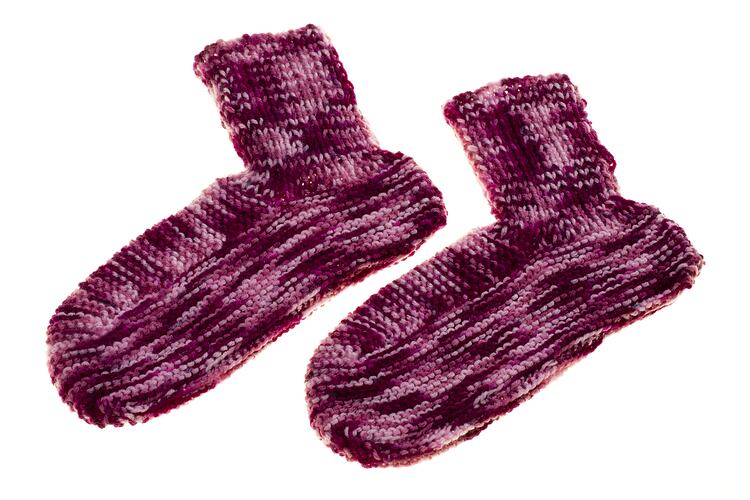
The hospital distributed the socks to patients. Museums Victoria records that one recipient, Peter Anderson, later thanked Tyler after returning home. This documented exchange matters more than a generic claim that knitting “healed” anyone: the sources establish a gift, its hospital route, and a response, while medical effects cannot be inferred from the textile. The pink-to-burgundy wool pair now catalogued as HT 25904 is a sample Tyler donated in July 2010, not demonstrably the exact red pair named in the recipient’s letter. [2]

Turn to the second museum view of that same pair rather than counting it as a separate object. What the catalogue does confirm is wool, hand knitting, and variegation from pink through burgundy. It does not provide stitch count, gauge, heel construction, or a pattern. A viewer can compare the cuff and toe in the photographs, but should resist assigning a named heel or stitch structure without a close technical examination. [2]
A single sock left in the archive
HT 25905 presents a revealing difference. Tyler knitted a green bed sock with a yellow cuff but ran out of wool before completing its mate. The museum says she considered that a person needing only one sock might still use it; she later donated this single piece as another sample of the gifts sent to The Alfred. Its singularity is an archival fact, not evidence that the hospital supplied single socks to burn patients. The catalogue gives the dimensions of this sock as 265 by 185 millimetres and those of each sock in the variegated pair as 230 by 170 millimetres; the dimensions describe the museum objects, not a universal size or a reproducible knitting instruction. [2,3]

A beanie for another kind of volunteer
On the Lake Mountain plateau, the fires also damaged Leadbeater’s possum habitat. Museums Victoria identifies a blue knitted beanie with black polar-fleece lining and the inscription “HELP” as an item Parks Victoria produced in July 2009 for volunteers in a supplementary-feeding program. Joanne Antrobus of Parks Victoria commissioned it, and the object was donated to the museum on 14 May 2010. The record does not identify the knitter, specify hand or machine knitting, or supply a pattern. It also discusses a school group called HELP; that shared name is not evidence that the pupils knitted this beanie. [1]
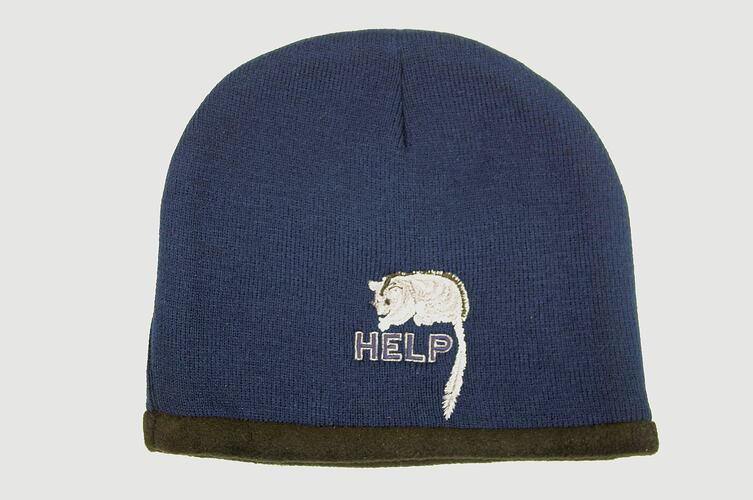
The beanie is not a knitted habitat or a medical gift. It is clothing for the people doing conservation work and a visible sign of a cause. The museum’s fire-damaged wooden nesting box from Echo Flat gives scale to that work: it was one of 30 survey boxes installed on the plateau; according to the object record, 22 were destroyed, six partly burned and two remained intact. Those numbers describe this particular group of boxes, not all possum nests or all of Victoria. The Victorian government’s later recovery report separately documents supplementary feeding and replacement nesting boxes during 2009–10. Neither source proves how the cap was knitted. [5,6]

What the stitches can and cannot tell us
These two uses of knitting should not be collapsed into one relief campaign. Tyler is named as the hand knitter of the socks, and her letter documents a route from her home to the hospital. Parks Victoria is named as producer of the beanie; its record documents a volunteer program, not an individual maker. The socks’ softness and the beanie’s fleece lining suggest attention to the wearer, yet comfort or thermal performance was not tested in these records. Comparing the items shows how knitted clothing can travel through different institutions after a disaster: a hospital and a wildlife recovery team. [1–5]
When reading a charity-knit pattern today, ask three practical questions that these records make visible. Who will receive the object, and through which organisation? Which material and care details are actually documented? Which attractive story is still only an assumption? The museum can preserve a pair, a single sock, a beanie and a letter, but careful reading preserves the differences between them. [1–5]
Primary records
- [1] Museums Victoria, HELP volunteer beanie HT 25906.
- [2] Museums Victoria, Ruby Tyler variegated bed socks HT 25904.
- [3] Museums Victoria, Ruby Tyler green single sock HT 25905.
- [4] Museums Victoria, Tyler’s 14 February 2009 hospital letter HT 25903 (image all rights reserved; not reproduced).
- [5] Museums Victoria, fire-damaged nesting box HT 25117.
- [6] Victorian Government, 2009 Bushfire Recovery Program report.