What Can a Small Knit Tell Us? Reading Amsterdam Foundling Clothing Records
A row of buttons on a tiny cardigan invites a story about the hands that made it. The Amsterdam Museum’s records ask us to slow down. They preserve materials, dimensions, associations with other garments and, in some cases, a name or a date of discovery. They do not necessarily identify a knitter or recount everything that happened to the child who wore an object. This article starts with three garments the museum explicitly describes as knitted: a cap, a cardigan and a pullover. It then looks at a separate pair of wool wrist coverings and the city’s records about foundlings. The objects span different catalog groups and date ranges; they cannot be assembled into one child’s wardrobe. [1–8]
A wool cap: what the catalog says and what the photograph shows
Amsterdam Museum object KB 2135.1 is a dark-blue knitted wool cap. Its catalog gives a date range of 1930–1942 and measurements of 30 by 21.5 cm. The description specifies pale-blue triangles worked onto the surface, earflaps, chin straps and a press-stud fastening. In the photograph, one pale triangle, an earflap and the straps are visible. Neither the image nor the catalog supplies a stitch count, a needle size, the number of triangles around the entire cap or the identity of its wearer. The date range is not a documented day of discovery. [1]

This cap is the first item in catalog group KB 2135.1/4. The group description calls its second item an orange, white and brown crocheted outfit; it also lists a sweater and trousers. Calling the whole group knitting would erase a distinction the museum actually makes. Equally, using the cap’s close photograph as if it showed every item in the bundle would blur the boundary between one object and its associated garments. The evidence gives us a knitted cap with particular fittings and a group relationship, not a technique for every item in the bundle. [1, 6]
A cotton cardigan in a bundle with a discovery date
KB 2027.8 is a buttoned knitted cardigan. The museum lists cotton, a height of 24 cm, a width of 26 cm and a broad 1935–1945 date range. Its photograph shows a white front with buttons and vertical ridges. Those ridges alone do not establish the precise stitch pattern, gauge, or whether a person or machine produced the fabric. The catalog’s gebreid vestje met knopen—a knitted little cardigan with buttons—is the evidence for classifying this object as knitted. [2]
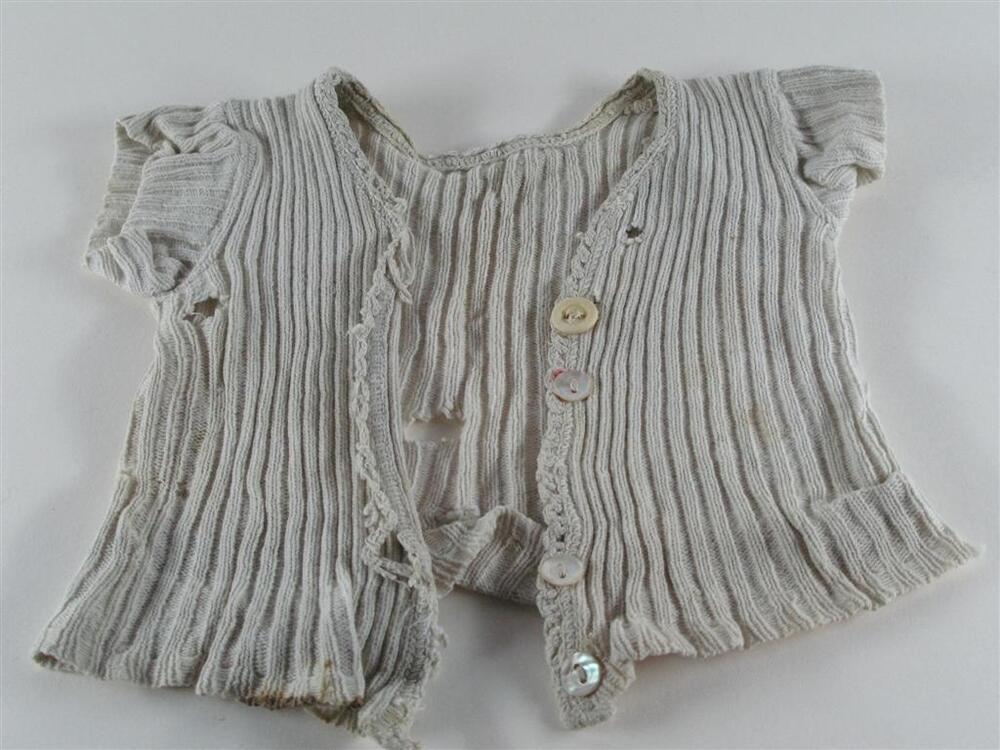
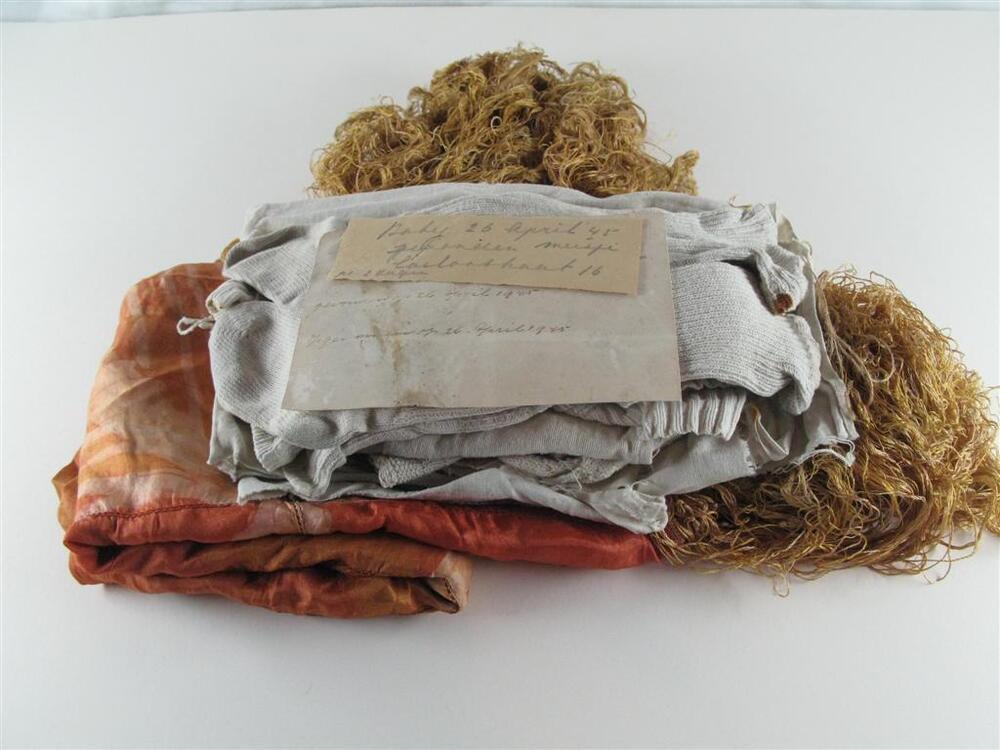
The cardigan belongs to group KB 2027.1/11. The associated record and notes concern the clothing of a girl found on 26 April 1945. They do not yield a single unambiguous age: estimates on the card and note differ. The place-name in the note reads Carlonstraat, while the catalog suggests Carillonstraat; this article retains the uncertainty and the record’s other original street spelling, Van Woutstraat. More fundamentally, the object’s 1935–1945 range and the group’s date of discovery answer different questions. Neither is evidence of the exact day the cardigan was knitted. [2, 7]
A cotton pullover: a name on wrapping paper is not a biography
The museum records KB 2132.5 as a short-sleeved knitted cotton pullover, 33 by 40 cm, with a 1930–1950 date range. It transcribes Vondelingenkleeding Frieda Wilson from brown wrapping paper. Without independent evidence explaining that inscription, we cannot turn Frieda Wilson into the securely identified child or the maker of the pullover. Nor does the folded garment in the photograph let us check its short sleeves visually; that feature comes from the museum description. A broad catalog range should not become an invented date of discovery. [3]
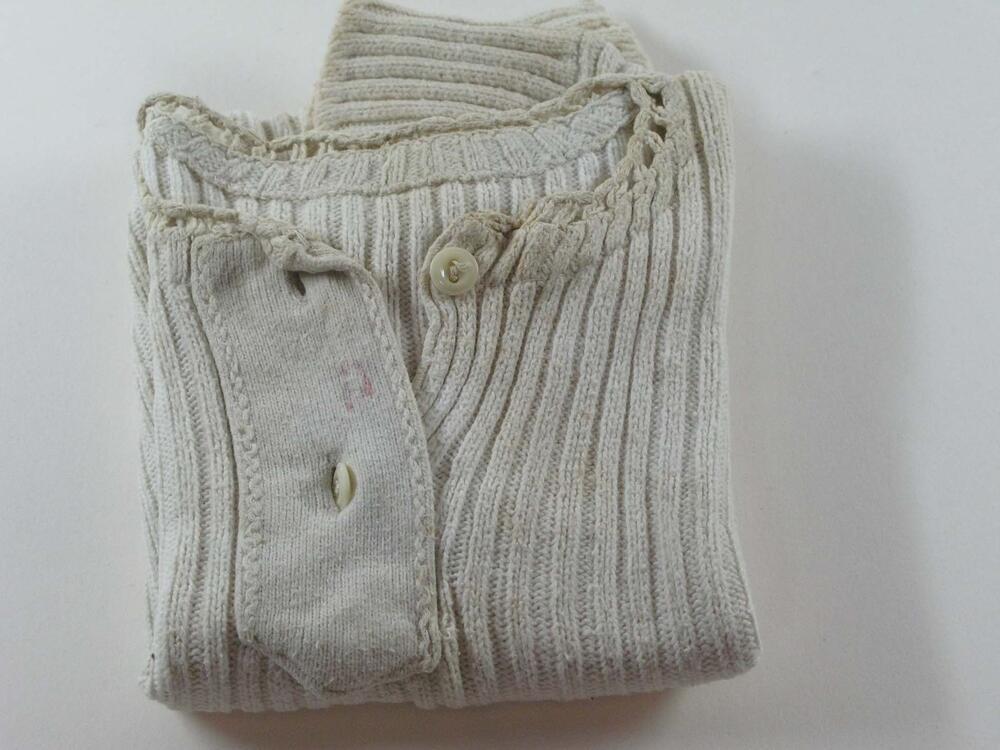
The three garments are not interchangeable samples. The cap is wool; the cardigan and pullover are cotton. Their recorded sizes are 30 × 21.5, 24 × 26, and 33 × 40 cm respectively. Rather than infer warmth or softness from a photograph, we can read the fiber and measurements that the museum actually supplies. A knitter looking at an old pattern faces a similar task: a vertical ridge in a picture is not, by itself, a complete instruction to work ribbing. Stitch directions, gauge, yarn and the orientation of loops require their own evidence. These brief object records do not give us a reproducible pattern. [1–3]
Grazia Evers’s pair: where exactly is a name recorded?
Objects KB 2128.10 and KB 2128.11 are a pair of wool wrist coverings whose photographs show red and black ridges. The original catalog measures them separately: 21.1 by 8.2 cm and 21.5 by 8.3 cm. Both records transcribe Grazia Evers from a brown label, and both belong to group KB 2128.1/15. The group’s museum description connects Grazia Evers, a foundling, with admission to a city foster-child institution. It does not say that these two objects belong to the girl recorded in 1945, or establish that the pair was worn at the moment of admission. Two photographs make two object views, not two children’s stories. [4, 5, 8]

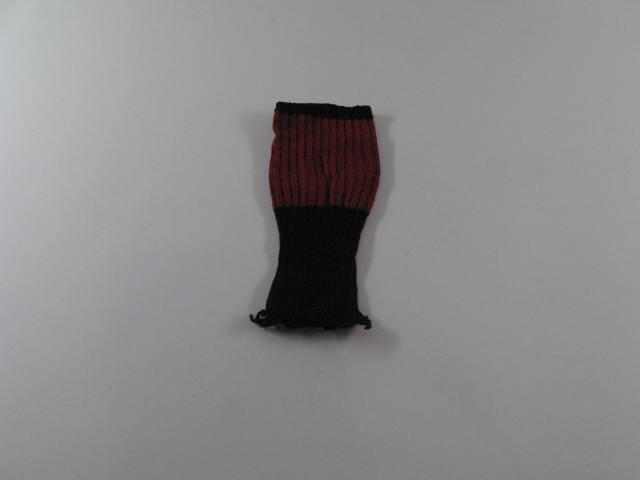
The two museum cards identify wool mitaines but do not explicitly classify their construction as knitted. A knitting researcher who visited the museum store in 2016 described gebreide mitaines, or knitted wrist coverings. That firsthand observation is useful, but it does not turn a missing field in the museum catalog into an official technique attribution. Here, the three garments described as knitted remain the secure technical examples; the pair is a carefully labelled comparison. The ridges in the photographs cannot establish hand knitting versus machine knitting. Nor should a name on a label be recast as the maker’s signature. [4, 5, 8, 9]
Amsterdam’s City Archives describe the wider practice of recording foundlings. An archives account says that, from 1811, intake forms noted sex, estimated age, place of discovery and clothing. A different archives notice discusses a case around 1910 in which clothing was preserved for later identification. These are a general record practice and a separate case, not proof that an intake form survives for each museum garment here or that the 1945 cardigan was kept for the identical reason. The archive’s earlier statistics cannot be assigned to these twentieth-century objects either. [10, 11]
When you next encounter an old knitted garment or pattern, keep three questions apart. What can you actually see in its photograph? What material, dimensions and technique does the object record explicitly name? And where is a person or date written—on the object, an attached label, wrapping paper, or a later catalog card? Those distinctions let a small knit speak with greater precision, without supplying a child’s missing life story for it.
Primary sources and clearly identified supplementary observation
- Amsterdam Museum, knitted cap KB 2135.1; Modemuze individual record and image rights.
- Amsterdam Museum, cotton knitted cardigan KB 2027.8; Modemuze individual record and image rights.
- Amsterdam Museum, cotton knitted pullover KB 2132.5; Modemuze individual record and image rights.
- Amsterdam Museum, wrist covering KB 2128.10; Modemuze record and image rights.
- Amsterdam Museum, wrist covering KB 2128.11; Modemuze record and image rights.
- Modemuze/Amsterdam Museum, group KB 2135.1/4.
- Modemuze/Amsterdam Museum, group KB 2027.1/11.
- Modemuze/Amsterdam Museum, group KB 2128.1/15.
- Nederlands Gebreid, 2016 firsthand store visit — supplementary observation, not an official museum technique field.
- Amsterdam City Archives, 2019 account of foundling records.
- Amsterdam City Archives, 2020 exhibition notice.