The Unfinished Sock: Nellie Blaine and the Names Behind Australia’s Wartime Knitting
English · 한국어로 읽기
DDUJA KNIT JOURNAL · AUSTRALIA · HISTORY & ARCHIVES
The time held in an unfinished sock: Nellie Blaine and the names behind Australia’s wartime knitting

One sock was finished. Its mate stopped partway along, still held on bamboo needles. The Australian War Memorial preserves this 1915 pair as more than a keepsake of wartime knitting: its record says that Nellie Blaine could not finish the work after learning that her brother Arthur had died at Gallipoli. Follow the unfinished object, a paper ruler for measuring socks, and photographs of makers in different places, and the scale of a wartime relief effort comes into focus through repeated handwork—and through the names that records did or did not preserve. This article centres surviving objects and named makers rather than repeating the organisation and logistics discussed in our earlier piece on Australian wartime knitting funds.[1][2]
The sock and the measuring tools
Nellie Blaine’s sock was knitted from black four-ply wool. One sock was complete; three bamboo sock needles remained in the unfinished one, with spare needles and a ball of yarn nearby. The collection record says that Blaine was 21 and that she stopped knitting after her brother Arthur was killed at Gallipoli. The object and the family story have been preserved together. But one pair cannot stand for every Australian woman’s wartime experience, nor can we know more about Blaine’s thoughts than the record allows.[1]
Hand knitting depended on individual skill, but wartime relief also needed measurements that different makers could share. The National Archives of Australia describes a 1916 Red Cross sock ruler associated with Sydney knitter Annie Robina Monie. Its instructions caution against knots that could rub the foot and call for enough stretch at the top of the sock. A separate folding ruler at the Australian War Memorial is recorded as having been used by Emma Roberta “Robin” Kendall. It marks leg length, the ribbing, and the point where the heel begins. The two tools address similar practical questions, but they have different makers, users, and collection histories.[2][3]
These measurements should not be treated as a universal size chart for socks today. The 15-inch dimension mentioned in the Archives’ account and the graduations on Kendall’s folding ruler document particular wartime comfort-sock standards. They could help keep a sock from slipping and make finished items more comparable. Yet the rulers alone do not tell us the stitch count, needle size, or method of shaping the heel. A measurement written on paper and the construction of a knitted fabric are different kinds of information.[2][3]
Records of wartime knitting extend from 1915 into the 1940s, but they do not describe one unchanging movement. A sock guide distributed by a relief organisation in 1917–18 and a New South Wales guide published in 1940 came from different publishers and moments. A surviving title or catalogue entry is a starting point for research, not proof that every knitter followed the same instructions. Rather than repeat statistics about the scale and logistics of the relief organisations, this article asks what individual objects and archival records can—and cannot—show.[4][5]

Names, communities, and missing names
A photograph of women at the Robe Soldiers’ Comforts Club, taken about 1918, preserves the name of a local group rather than the names of each person pictured. The Australian War Memorial records that the image was sent from the Robe Snaps League to Henry Bailey Burnley, who was serving overseas. The collection page does not identify every woman. The place and the route taken by the photograph are specific; individual makers’ names are absent. That difference is part of the history, too.[6]
A 1941 photograph from the Cummeragunja Aboriginal reserve in New South Wales preserves more names. It shows Aboriginal women and girls knitting socks, sweaters, and balaclavas. The Memorial credits photographer Beatrice Austin and identifies people row by row, including Merle Morgan, June Morgan, Winnie Charles, and Amy Briggs. We should not flatten these makers into an anonymous group of “Australian women.” At the same time, one group photograph cannot tell us each person’s reasons for taking part or the conditions under which the work was done.[7]
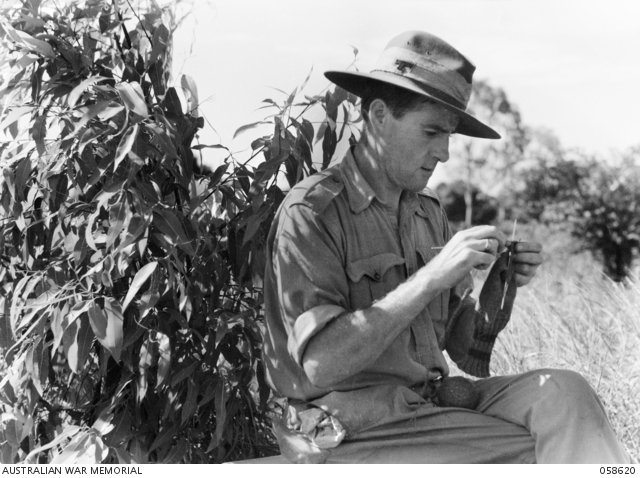
The Memorial records a knitter called “Miss Cole,” working socks directly from fleece, and notes that she may have been Miss McCall of Bendigo. Because the identification is tentative, it should not be repeated as a settled biographical fact. A 1943 photograph of Private W. Conway knitting socks in Atherton offers a documented example of a serviceman knitting in his spare time. It corrects the assumption that wartime knitting belonged only to women; it does not justify claims about the habits of soldiers as a whole.[8][9]

What the surviving objects can tell us
The unfinished sock makes the time involved in knitting visible more clearly than a finished pattern motif might. One sock reached a wearable state while its mate remained on the needles. The black four-ply wool, the bamboo needles, and the second sock left incomplete should be read alongside the collection description. A photograph alone cannot prove that the pair was made from a standard issue pattern.[1]
When reading a measuring ruler, separate its marks from a set of knitting instructions. Leg length, the end of the ribbing, and the start of the heel relate to fit and wear. They do not give us stitch counts, row counts, or gauge. Recreating a period sock from these objects would require additional pattern documentation. Resisting the temptation to fill those gaps with guesses is itself a useful skill when studying historical knitting.[2][3]
The five photographs are not consecutive scenes from one event or organisation. The women at Robe, “Miss Cole” handling fleece, Sydney schoolgirls, the Cummeragunja knitters, and Private Conway belong to different places and dates. The description of the schoolgirls’ photograph does not say how many pairs of socks are in the pile or where they were sent. Each image is linked to its Australian War Memorial catalogue record, which labels the item “Copyright expired—public domain.” That image status is separate from the copyright in any wartime booklet; this article does not reproduce the original pattern text.[6][7][8][9][10]

A timeline
- 1915 — Nellie Blaine’s unfinished sock is preserved. [1]
- 1916 — A Red Cross sock-measuring tool and records of the Australian Comforts Fund. [2][4]
- 1917–18 — Guides for knitting socks, including instructions for working both socks together, are distributed. [4]
- About 1918 — A photograph records women’s relief work at Robe. [6]
- 1940 — A New South Wales wartime knitting guide is published. [5]
- 1941 — The Cummeragunja knitters are photographed. [7]
- 1943 — Private Conway is photographed knitting socks at Atherton. [8]
Reading the record again
One sock was finished; its mate was not. Between them remain a ruler marked with measurements, names that were recorded and names that were not, and makers working in different communities. When you next open an old sock pattern, look beyond the finished object. Who set the measurements? Which numbers describe the size, and which do not tell us the stitch count? Whose name appears in the photograph caption? These questions bring the people behind wartime knitting into view without claiming more than the sources can show.
Sources and image credits
Bracketed numbers in the article refer to the following records. Every photograph also links to its own catalogue page and image file; the Australian War Memorial identifies each image as public domain because its copyright has expired.
- Australian War Memorial, Nellie Blaine’s unfinished socks.
- National Archives of Australia, “Measure up: knitting socks for soldiers.”
- Australian War Memorial, Emma Roberta “Robin” Kendall’s sock ruler.
- Australian War Memorial, Australian Comforts Fund records and finding aid.
- Australian War Memorial, New South Wales wartime knitting guide, 1940.
- Australian War Memorial, Robe Soldiers’ Comforts Club photograph, about 1918.
- Australian War Memorial, Cummeragunja knitters, 1941.
- Australian War Memorial, Private W. Conway knitting socks, 1943.
- Australian War Memorial, “Miss Cole” / “From Fleece to Sock.”
- Australian War Memorial, Sydney schoolgirls knitting socks during the First World War.
- Australian War Memorial, image record H11581.
- Australian War Memorial, copyright and reproduction guidance.