From Factory to Home: Four Australian Hosiery Objects and the Work Behind Them
What should we ask of a pair of socks? Fibre, stitch direction and heel shape matter, but so do the people who made, dried and repaired it. Four objects now held by Museums Victoria let us compare factory knitting with the labour of caring for hosiery at home. They did not come from one household or one production line. This is a comparison of separately collected objects, not a reconstructed journey of a single pair.
Factory stitches in a 1931 account
In the October 1931 issue of Swinburne Technical College’s The Open Door, D. Peacock described circular and full-fashioned hosiery while discussing Prestige’s Brunswick factory.[1] On the circular machines in that account, latch needles knitted the stocking as one piece, apart from a toe linked later; a mock seam could then be added. Full-fashioned production used a flat fabric and reduced the number of working needles to shape the leg. The foot was knitted on another machine, followed by seaming and finishing. These are the processes reported for that factory and moment, not evidence that every Australian stocking—or any particular object below—was made on those machines.
Peacock also described dyeing, moisture extraction, steam shaping, inspection and boxing.[1] A machine formed loops, but installation, operation, joining, finishing and checking still required decisions by people. Museums Victoria’s account of Brunswick records the opening of a Prestige hosiery factory in 1922 as part of the district’s growth in clothing and footwear production.[2] Neither source makes this one business the origin of all Australian knitting.
White lisle stockings: read the seam and reinforcement
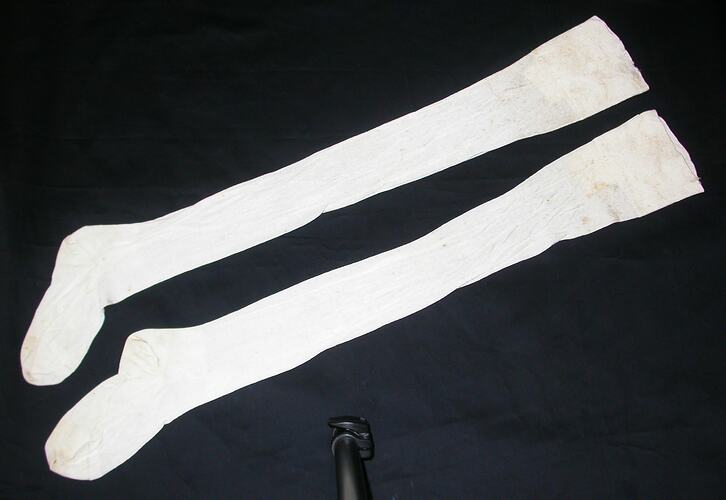
The pair of white lisle stockings SH 900399, catalogued as 1910–1930, has a back seam running up from the heel, reinforced toes, heels and tops, and a mend on one calf.[3] The recorded length of 83 cm and width of 10.5 cm describe the surviving object; they are not a modern pattern size or gauge. Nor does a visible seam alone prove manufacture on a particular full-fashioned machine. The 1931 article reminds us that a circular stocking could also receive a mock seam.
The donor said the stockings had sometimes formed part of a Voluntary Aid Detachment uniform. The museum itself flags a conflict between the suggested First World War use, the donor’s Second World War service, and the uncertain basis of its dating.[3] We therefore cannot label this photograph as proof of a specific 1914 uniform. We can examine its physical construction and the uncertainty preserved in the catalogue.
Drying and darning after the factory
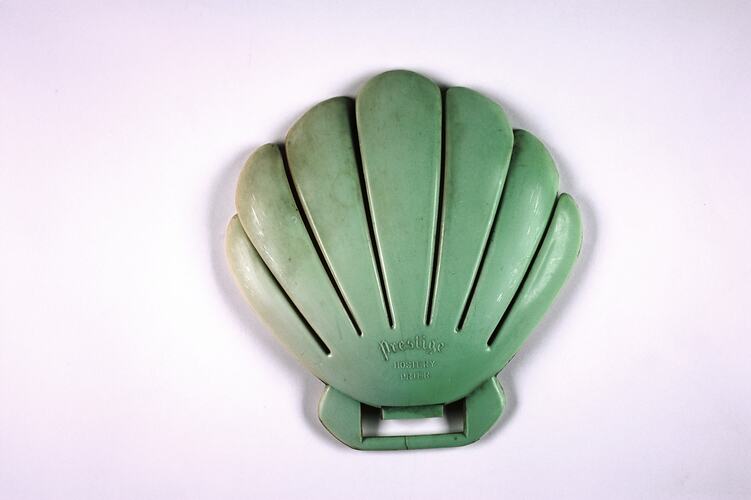
Prestige’s green plastic hosiery drier HT 38932 dates to about 1949–1953.[4] Its shell-like body has seven slots to hold hosiery and a place from which it could hang. One photograph shows the arrangement of the slots; the other shows the raised Prestige name. These are two views of one object. The museum describes a 1952 newspaper promotion in which readers could receive the drier after sending their lingerie measurements. A tool for drying stockings was also a way to gather information about customers’ sizes. The record says Amy Turner or her mother may have used this example; it does not identify the user with certainty.

A different household preserved the heavily darned grey sock HT 49016. It belonged to the Saunders family collection from Port Melbourne and is dated approximately 1930–1960.[5] Museums Victoria lists Elizabeth Jane Saunders as its probable maker and James Saunders as a probable wearer. Elizabeth made and mended family clothing, but the catalogue does not establish who worked each repair in this particular sock, which yarn was used, or the exact darning method. The patches offer evidence of extended use, not a licence to invent a detailed repair pattern. This sock was not collected with the white stockings or the Prestige drier.

A later sock speaks in layers
The red Holeproof ‘Explorer’ socks ST 38712 are another industrial product.[6] Their catalogue describes a wool-terry inner layer and a nylon outer layer. The package gives 80% wool for the inner layer while the overall composition is 50% wool and 50% nylon. Those percentages refer to different scopes: it would be wrong to describe the entire sock as 80% wool. The inner cushioning and outer wear layer suggest distinct jobs for the materials, yet the photograph does not reveal the machine model or exact needle arrangement. The Australian Wool Corporation donated the object in 1991. That is an acquisition date, not a documented production date.

Five places to look in the next sock pattern
First, ask whether the fabric was made as a tube or as flat pieces that were joined. Look at toe finishing and stitch direction as well as any seam. Second, locate reinforcement at the toe, heel and top. Third, distinguish later repairs from the original knit. Fourth, read a layered fibre label separately from the overall composition. Fifth, ask what drying and other care tools required of their users after the knitting was done. The 1931 technical article documents one factory account; object records document what survived. Neither supplies the stitch count, needle size, precise period of use or identity of every repairer for these four objects. Keeping their different provenances visible lets us see hosiery both as manufactured fabric and as clothing people worked to preserve.
Original records and image rights
- Swinburne Technical College, The Open Door, October 1931, D. Peacock, ‘The Hosiery Industry in Australia’, pp.16–17 — a period account of production.
- Museums Victoria, Municipality of Brunswick — local industrial context.
- SH 900399, white lisle stockings — construction and dating uncertainty.
- HT 38932, Prestige hosiery drier — object, use and promotion.
- HT 49016, darned sock — Saunders family and repair.
- ST 38712, Holeproof Explorer socks — layered structure and fibre labels.
Five real collection photographs; no AI-generated images. Museums Victoria identifies each file as reusable under CC BY 4.0 on its object page. The object record, image file and licence appear immediately below every photograph. Photos 2 and 3 show different sides of the same drier.