Three Hands Around a Teapot: Australian Knitted Cosies, Shows and Making Do
Where should the openings for a teapot’s spout and handle begin? Even a small piece of knitting records decisions about making and use. Museums Victoria holds three teapot-related knitted objects that followed very different paths. Violet May Wilson’s bird-decorated tea cosy travelled to agricultural shows. Kath Davis placed a striped cosy in her glory box before using it in married life. The museum calls Ada Perry’s parrot-shaped piece a “teapot holder,” a distinction that matters. These objects offer a small history of women’s work in Victoria from the 1930s onward; three survivors cannot represent all Australian knitting.
1. Violet May Wilson’s bird cosy went to the shows
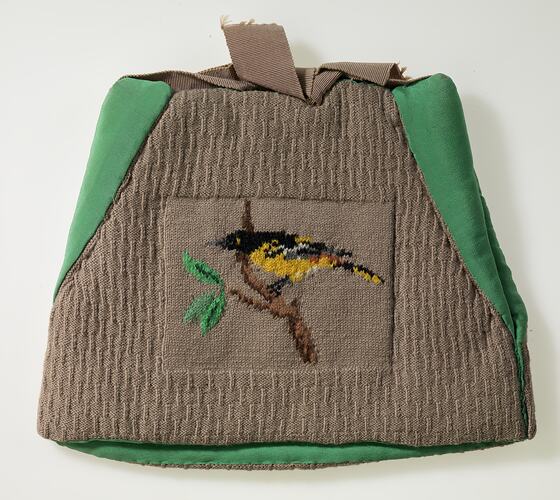
In Beaconsfield, Victoria, Violet May Wilson knitted a brown wool tea cosy around 1933. The museum describes a green silky lining, a brown nylon ribbon and bow, a tree with woodpecker, kingfisher and robin on one side, and an unidentified black-and-yellow bird on the other. Its sides are sewn only halfway down, leaving openings for the teapot handle and spout. That detail makes the object more than a decorative surface: its maker accommodated the vessel’s shape. The recorded overall dimensions are 17 cm by 23 cm. The catalogue does not provide a gauge, needle size or knitting pattern.

The catalogue says the cosy was entered in agricultural shows across Australian states between 1933 and 1974, winning 143 first prizes and 17 second prizes. That is evidence of one maker’s object moving through a public judging circuit, not a national count of knitters. A separate 1932 record for Wilson’s tapestry bag recalls her daughter watching her pack work for shows and enjoy its return with a prize certificate. The bag is tapestry, not knitting, so it cannot prove how the cosy was made. It does help explain what exhibiting craft meant in Wilson’s household.
2. Kath Davis’s stripes moved from a box to a table
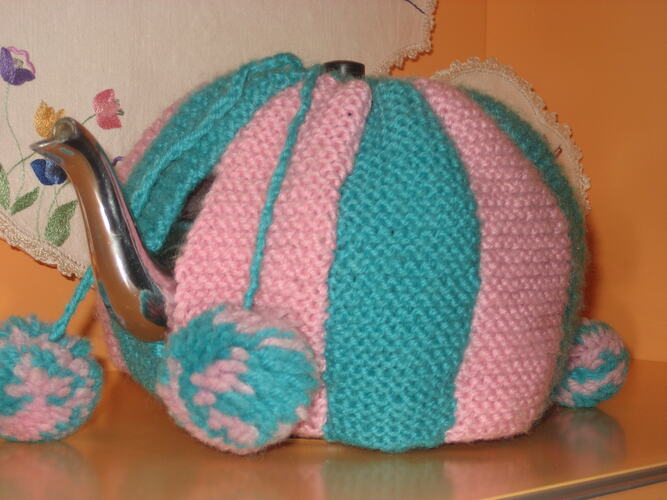
Kath Davis made a pink-and-green wool tea cosy around 1938 and attached four pom-poms to its top. Museums Victoria records that she made it for her glory box before World War II and used it after marriage. A glory box gathered goods for a possible future home, but Davis’s documented experience should not be projected onto every woman. She began collecting at about seventeen while earning her own income in Traralgon, had largely completed the collection by about 1940, and married in 1944.

The museum’s account of Davis’s oral histories supplies a second kind of evidence. A boyfriend had bought her an earlier glory box and later asked for it back when their relationship faded; she bought a similar cabinet herself. This does not reveal a stitch count or a knitting instruction. It does make ownership and storage part of the object’s history. The museum reads her collection as a meeting point of handmade textiles, purchased goods and changing postwar consumption. It does not document how often this particular cosy was used or washed.
3. Is Ada Perry’s parrot a cosy at all?
Ada Perry came from England to Australia in 1924 as a widow with eight children. At Mirboo North in Victoria, a buggy accident in 1928 prevented her from continuing heavy physical work, while her children worked the land. The museum says she made handcrafts, often using available scraps or old clothes. One surviving piece, HT 2921, is catalogued broadly between the 1930s and 1960s as a parrot-shaped “teapot holder.” The body is knitted in green, blue and yellow and the head in red and white. The record does not give a precise making year or identify the yarn fibre of this particular piece.

The museum explains that Perry kept the first example of a craft she made and gave later versions to her children. The collected parrot can therefore be read as a retained prototype as well as a domestic object. Yet the record does not say exactly which teapot it held, how it was fitted, or how much heat it retained. A catalogue title cannot resolve its construction. Keeping the difference between “holder” and “cosy” visible is more useful than quietly treating all three as the same pattern.
What can a knitter read from these objects?
Wilson’s cosy offers a visible solution for handle and spout openings, with lining and bird decoration on two faces. Davis’s offers stripes, four pom-poms and a documented journey from prospective household collection to use. Perry’s offers blocks of colour and a practice of saving prototypes, alongside significant gaps about fit and method. The three records have different makers, dates, materials and paths of ownership. They invite us to read the openings, seams and afterlives of knitting as carefully as its motifs.
When you next choose a tea-cosy pattern, check where the openings begin, how lining and outer fabric meet, and whether decoration permits ordinary use. These museum records can sharpen observation, but they are not executable patterns. A usable stitch count still requires your own teapot measurements and gauge swatch.