More Than One Stocking: Reading Knitted Layers in Dubrovnik Footwear
A stocking is an easy object to imagine in isolation. The Dubrovnik Museums' Ethnographic Museum asks us to see it in a different position: beneath a covering for the toes and a leather shoe. Its exhibition on traditional footwear in the Dubrovnik area describes several materials meeting at the same foot. What did knitting do within that arrangement, and where does the surviving record stop? The evidence concerns the Dubrovnik area, principally practices from the final decades of the nineteenth century through the middle of the twentieth. It does not establish a single origin story for all of Croatia. [1]
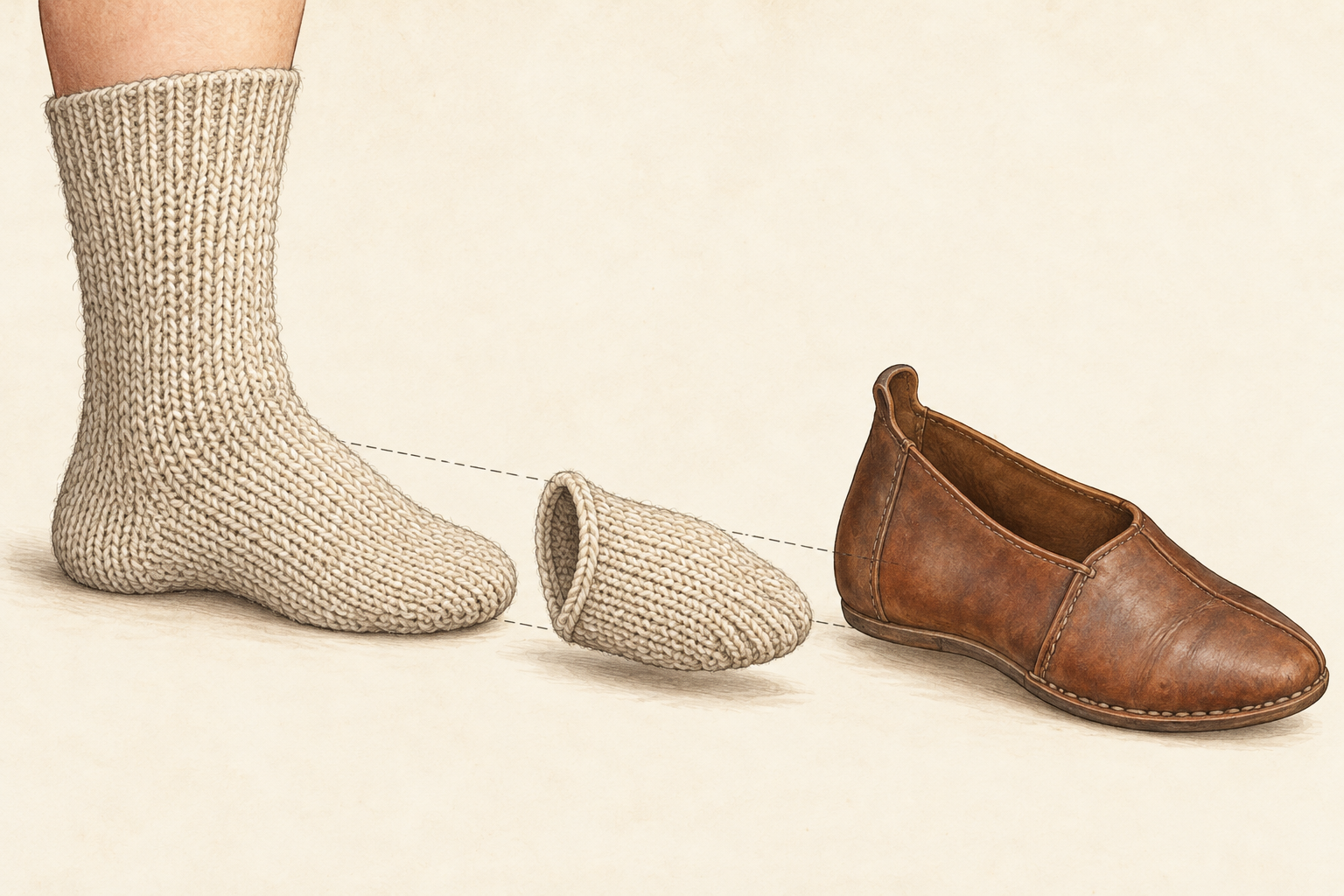
AI-generated reference illustration. This separates the three materials conceptually; it is neither a photograph nor an exact reconstruction of a museum object. Museum source and object-photo page. The source photographs were not used or copied.
Reading a sequence without inventing a complete outfit
The museum describes an everyday sequence of wool bječve, toe coverings called nazuvci, and leather opanci. The exhibition separately highlights naprsci, the knitted parts of toe wear. Its short description does not prove that both terms name exactly the same thing in every place and collection. Calling the whole arrangement a shoe would hide the contrast between knitted material and leather. But a sequence described in an exhibition is not proof that every surviving piece belonged to one wearer. The exhibition draws heavily on the Dubrovnik coastal area and also compares material from Konavle and the island of Mljet. Those places help explain a regional practice; they do not license us to assemble objects from different dates and collections into a supposed single outfit. [1]
The difference between everyday and festive dress is more than a change of color. In the museum's Croatian description of its exhibition catalogue, everyday bječve are wool, while festive bječve are cotton and are paired with low red or green leather crevlje. The English exhibition page mentions white festive stockings, but that phrase alone should not turn cotton into wool. Material is part of the story. If we flatten both settings into one generic knitted sock, we miss how a familiar garment name could sit within different combinations of fibers and footwear. [1]
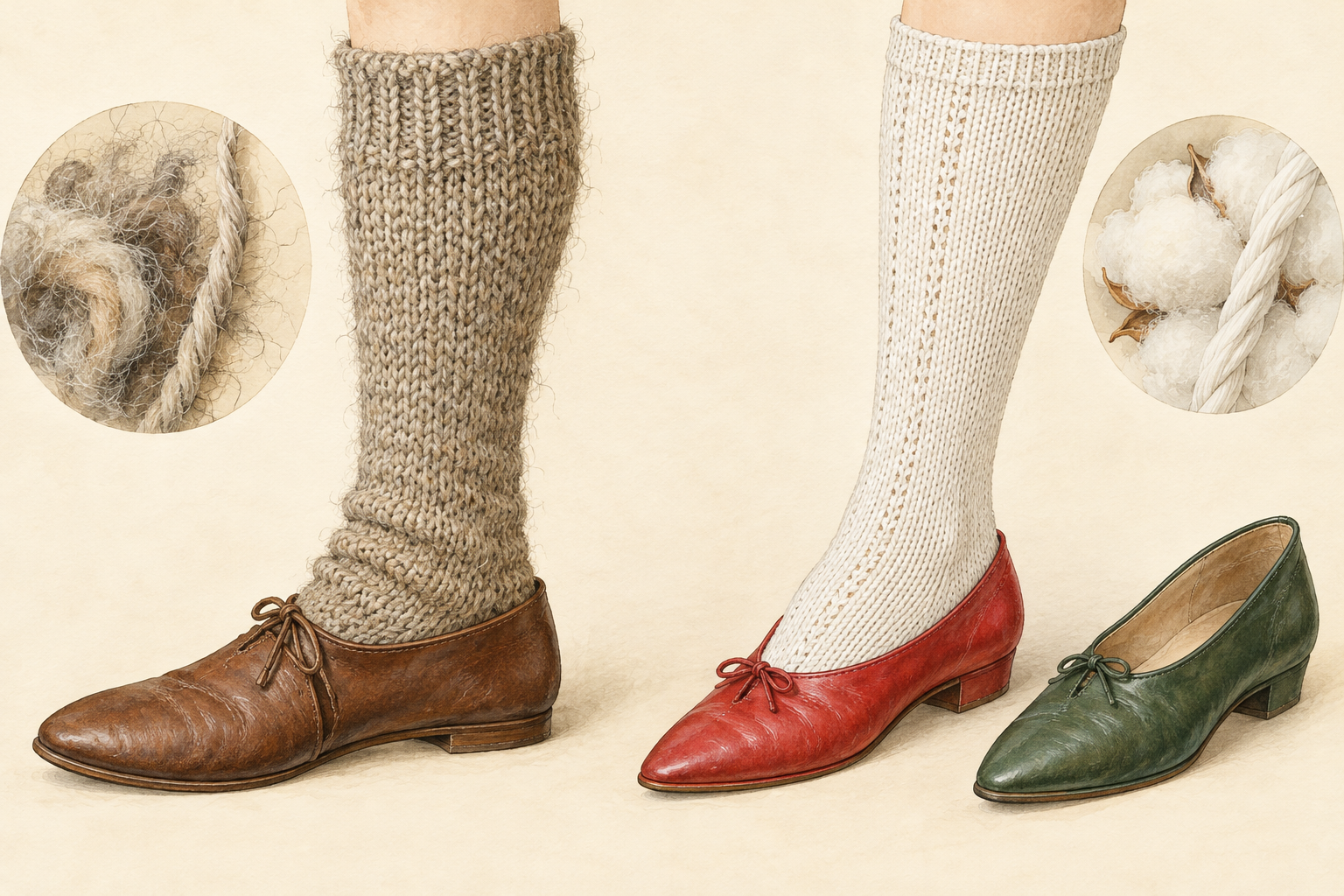
AI-generated reference illustration. It compares wool, cotton and leather; the shoe shapes are not reconstructions of particular Dubrovnik objects. Museum source and object-photo page. The source photographs were not used or copied.
The named work of an exhibition
Barbara Margaretić is named as the exhibition's author, with Marija Vraničić as collaborator. They are identifiable people in the history of this museum project, not documented makers of the older footwear. The Dubrovnik Museums' 2016 annual report records field research, photography, filming, and collection photography during preparations. It shows the labor required to turn surviving pieces into an exhibition. It does not reveal the names of the people who knitted the nineteenth- or early-twentieth-century objects. Keeping those roles distinct allows the museum workers' contribution to be acknowledged without assigning them a fictional place in the objects' original production. [1][3]
The report also says that 348 pairs of nazuvci and 50 pairs of bječve and dokoljenice were photographed for the exhibition. That is a record of museum activity, not a count of openly licensed image files. Three JPEGs linked from the exhibition page can be loaded directly, but their individual photographers and commercial reuse terms have not been established. No object photograph appears in this article; the separate AI reference illustrations explain materials and evidence without claiming to reproduce a particular accessioned object. [3]
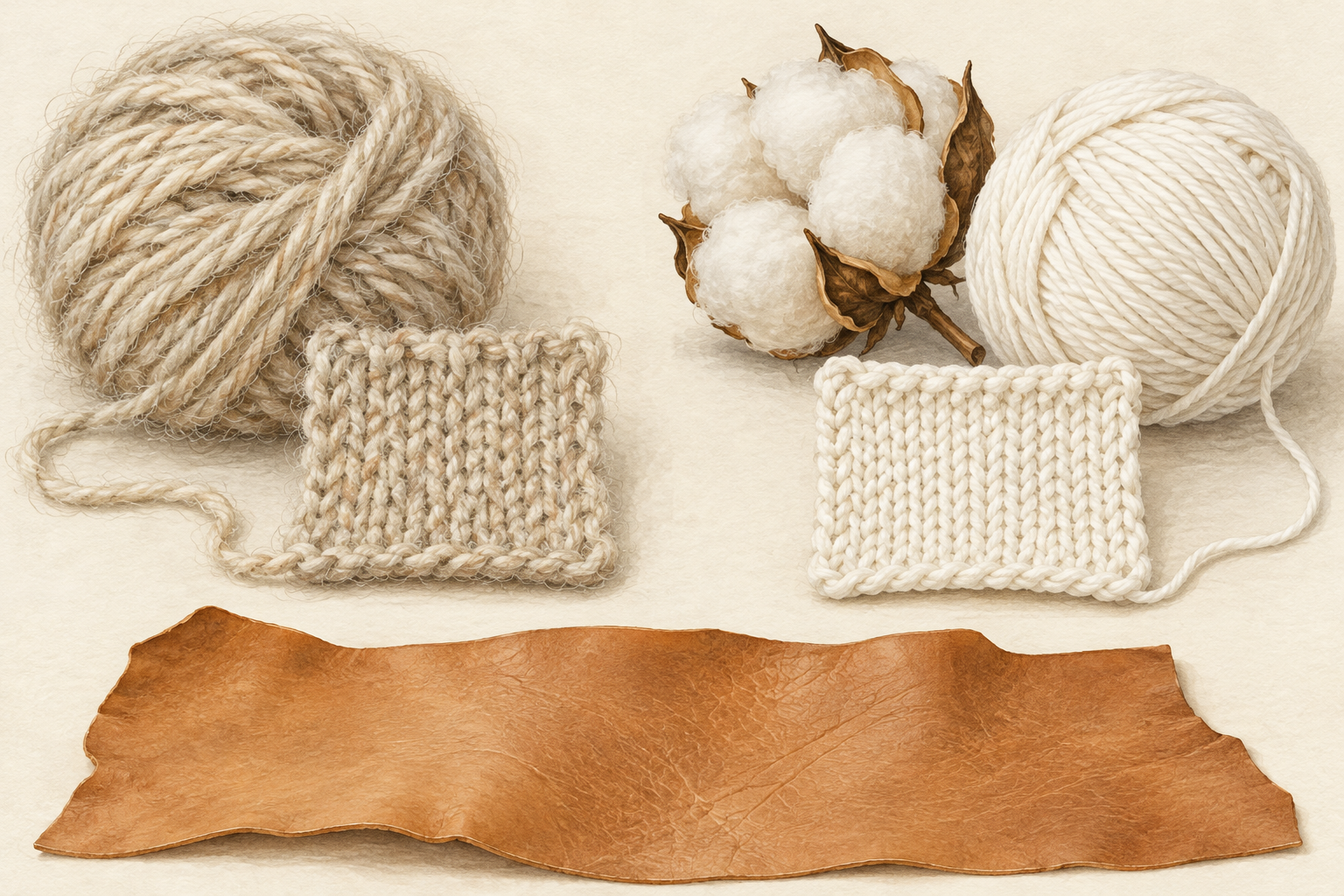
AI-generated reference illustration. These are imaginary material samples, not object evidence or a historical making sequence. Museum source and object-photo page. The source photographs were not used or copied.
What “five needles” actually describes
The most specific technique in the evidence belongs to a specific acquisition. The museum's 2016 report lists eight pairs of wool nazuvci from Mljet, dated to the first half of the twentieth century, under DUM EM 5819–5826. It describes them as knitted with five needles. That statement concerns those registered pairs. It does not show that every toe covering in the exhibition used five needles, nor does it supply stitch counts, gauge, a cast-on position, or a finishing sequence. A knitter can take “five needles” as a documented clue about the process, but not as a complete pattern to recreate the objects. [3]
A wider comparison comes from the Zagreb Ethnographic Museum's 2006 footwear catalogue. It discusses layered footwear in Adriatic and Dinaric contexts, five-needle knitting of wool stockings, and differences in color and decoration across regions. Its account helps place the Dubrovnik records within a broader study of dress. It is not an individual object card for the eight Mljet pairs, still less for every piece shown in Dubrovnik. Where the accession record is silent on a stitch structure, a regional comparison cannot fill in the missing row count. Knitting, embroidery, and leatherwork also remain different processes even when they contribute to one worn arrangement. [2][3]
Later accessions are separate evidence
Museum collecting did not end with the exhibition. The 2017 annual report records the purchase of a pair of early-twentieth-century naprsci, DUM EM 6111(1–2), for a Dubrovnik coastal and Elaphiti traditional-dress collection. A 2023 report lists donated clothing from Babino Polje on Mljet, including bječve DUM EM 8327 and nazuvci DUM EM 8328 (1–2). These are distinct registration events, not a second count of the eight pairs acquired in 2016. They broaden the surviving record while leaving important technical details open: the later entries do not state the stitch structures or materials needed to write a reliable reconstruction pattern. [3][4][5]
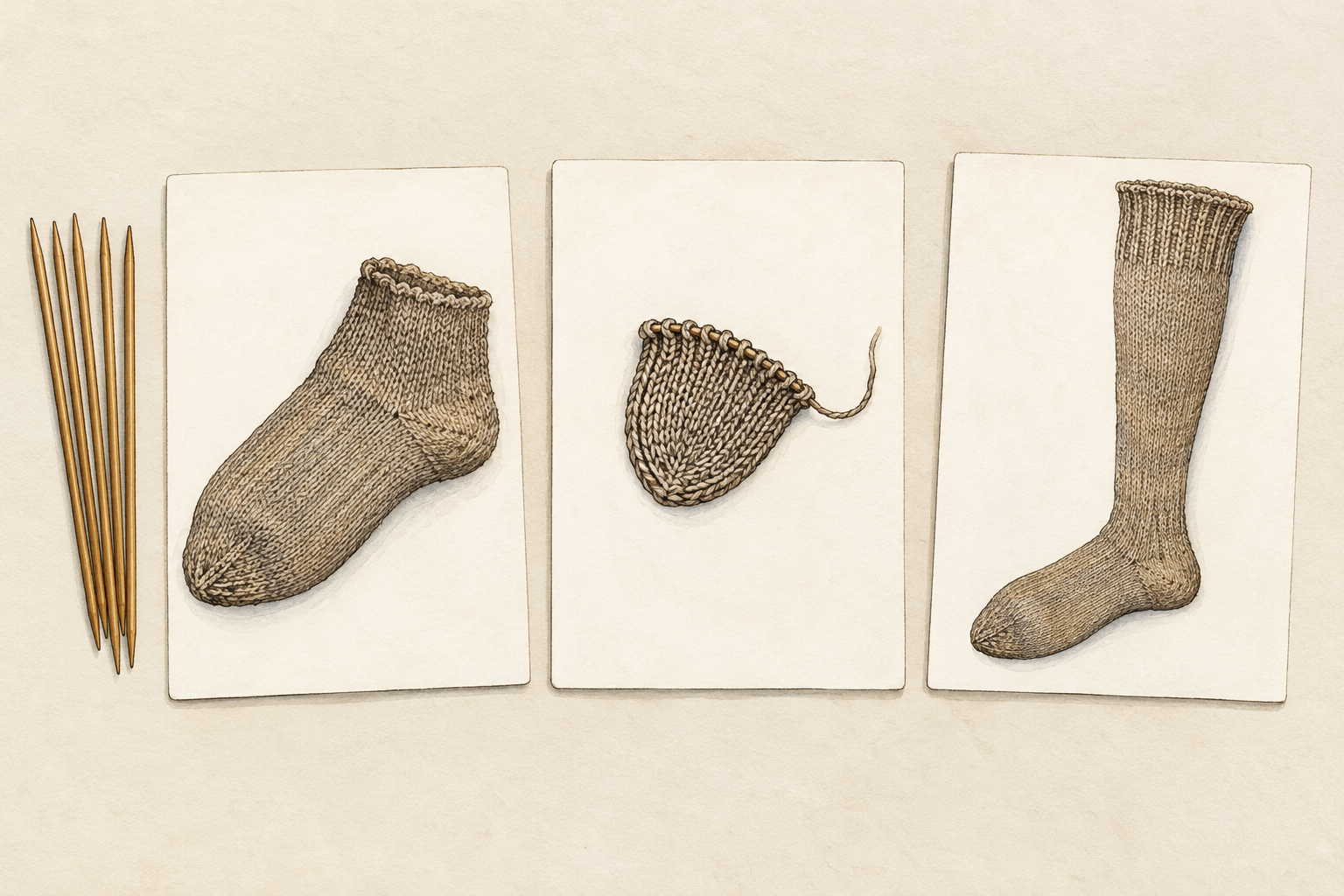
AI-generated reference illustration. The cards are not actual accession records, and their knitted shapes do not describe any specific object. Museum source and object-photo page. The source photographs were not used or copied.
The 2017 report contains another distinction worth preserving. It credits Marija Vraničić with stitching fifteen pairs of toe coverings back together after they had been separated for the exhibition and catalogue. That is evidence of what the museum did to care for the objects, not evidence of the original knitter's construction order. Likewise, the 2023 report lists field interviews but does not provide the speakers' words for this article to quote. The gaps are productive questions, yet they remain gaps. Neither a conservation action nor the existence of a recording authorizes a story about how a particular knitter worked. [4][5]
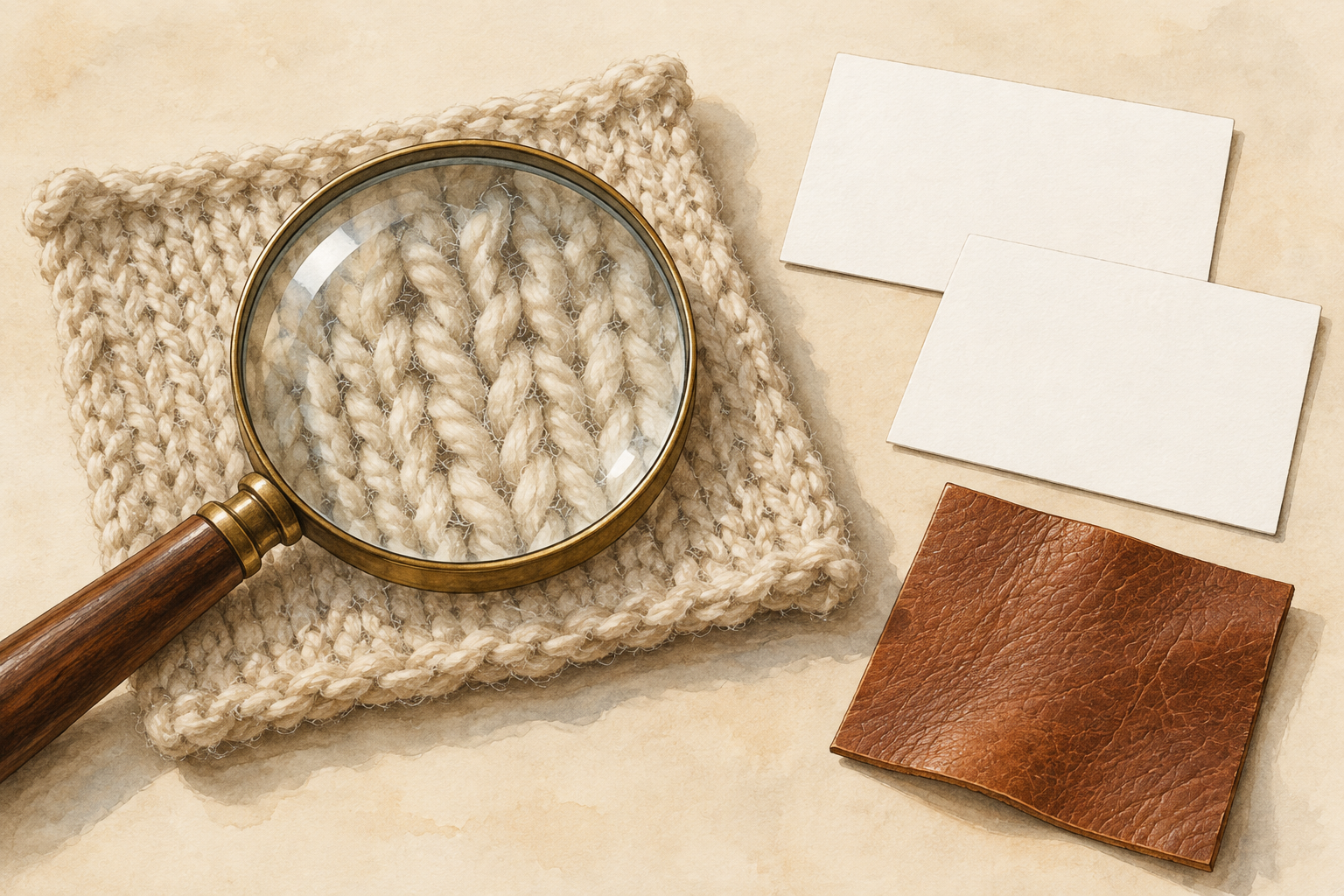
AI-generated reference illustration. The blank cards stand for what the sources do not establish; they are not copies of conservation records. Museum source and object-photo page. The source photographs were not used or copied.
A question to take to the next pattern
Dubrovnik's layered footwear is not an invitation to copy one imagined “old sock.” A stocking and a toe cover occupy different layers; the leather shoe is not knitting at all. Everyday wool and the cotton specified for festive bječve also should not be collapsed into one material. The next time you open a sock pattern, ask what part of the foot its knitted fabric covers, whether another layer sits above it, and which specific object supports any claim about needles or stitches. The reward of reading museum records is not a seamless reconstruction. It is a more precise sense of how separate things met on a moving body, and of what the surviving evidence can honestly tell us. [1][2][3][4][5]