Five Historic Finnish Stockings: Wool, Linen, Cotton and Construction
Research and writing: DDUJA KNIT / 뜨자뜨개
Colour is the first thing most of us notice in a historic stocking. An object record can tell a more precise story: which fibre was used, how a calf was shaped, whether a toe was decreased at the sides or radially, and whether a heel was crocheted instead of knitted. Five stockings held by the National Museum of Finland, displayed with photographs and descriptions in Finna, make a useful comparison. They are associated with use in Säkylä, Alahärmä, Somero, Ruokolahti and Vöyri. The group spans red and undyed wool, linen and cotton, and includes a piece where knitting and patterned crochet meet.
Read a date limit as a limit, not an exact year
“Made before 1885” means the object was made no later than that year; it does not place every stitch in 1885. A documented place of use is also not automatically the place of manufacture or the name of the maker. We retain each museum accession number and separate catalogue statements from observations prompted by the photographs. These five museum holdings cannot establish what most people across Finland wore or which construction was statistically typical. They can, however, show that several structures and fibres are documented in surviving stockings.
Säkylä: red wool and shaped side decoration
KA2526 is catalogued as a long red-wool woman’s stocking used in Säkylä, Satakunta. Its stated manufacture is before 1885. The museum describes three rows of purl at the opening and otherwise mostly stockinette. At the sides, vikkelit include a pearl-knit triangle and diagonal lines. A one-stitch vertical line at centre back alternates knit and purl, with calf decreases placed on either side. The heel has ordinary decreases in the catalogue description, while the toe is decreased at the sides. This distinction between decorative lines and shaping is more informative than saying only that the sock is patterned. The record does not supply a stitch count or a row-by-row recipe. Original object record

Finna also describes the specimen as worn or ragged. The state visible in a current photograph should not be confused with a complete account of its original appearance. The first image file credits photographer Ilari Järvinen; the other selected files have no individual photographer named in their displayed metadata.
Alahärmä: undyed wool and a radial toe
KA3022 is a long natural-white wool stocking whose place of use is given as Alahärmä in Ostrobothnia. It too was made before 1885. The catalogue describes it as entirely knitted in plain knit fabric, with a central rear seam or seam-like line and decreases on either side. The heel is shaped by decreases and the toe is described as radially decreased. The Säkylä stocking’s side toe decreases and this one’s radial toe cannot be collapsed into a single universal Finnish toe. Original object record
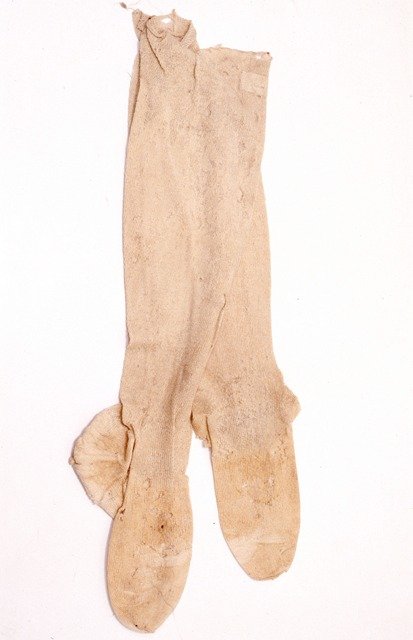
The word “seam” in a short description does not by itself tell us the complete order of making. We would need the reverse of the object and closer conservation photographs to decide whether the line is an actual sewn join or a visual construction detail. This is a question to preserve rather than fill in from a modern pattern.
Somero: knitting and crochet in one stocking
KA4166, associated with Somero in Häme, is a long stocking in red and black wool. The museum dates its making to before 1893 and classifies both knitting and crochet as techniques. Its description identifies patterned crochet on the leg, with diagonal, zigzag and square motifs, and says the heels were crocheted too. The foot is decreased at the sides. A catalogue label such as “stocking” therefore does not guarantee that every section was worked with the same tool. Unlike our existing article on the mixed-technique Korsnäs sweater, this example concerns heel and leg construction in an actual sock. Original object record
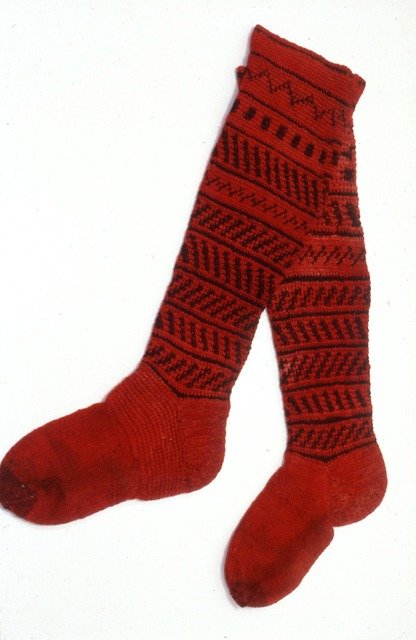
The front-facing public photograph is not enough to map the exact transition from needles to hook row by row. The museum’s technique labels and specific description of parts support the narrower claim. They do not license a complete reproduction pattern without examining the reverse and interior.
Ruokolahti: linen instead of wool
KA3781 is associated with women’s stocking use in Ruokolahti, Savo, and was made before 1893. It is knitted from natural-coloured linen yarn. The museum notes two purl rows at the opening and otherwise plain knit fabric, calf decreases at the centre back, an ordinary shaped heel and a radial toe. Compared with the white Alahärmä wool stocking, this linen example shows how a similar named structural solution can occur in a different fibre. It does not prove that the two makers shared a pattern. Original object record
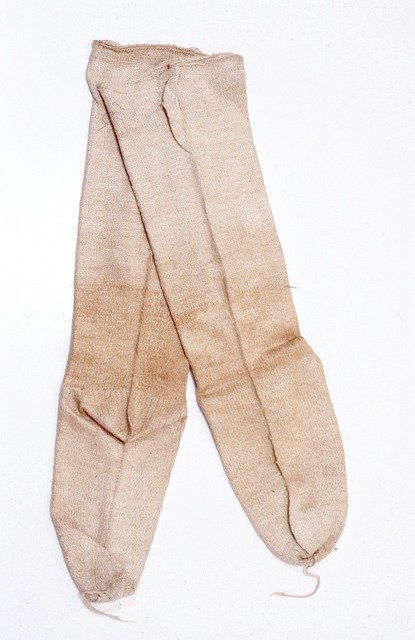
The museum measures its leg from the sole at 35.5 centimetres and its foot at 20 centimetres. Measurements of an object are firmer evidence than an impression from photographs, though neither tells us the original wearer’s full body dimensions or the intended fit without more documentation.
Vöyri: cotton, a 3×3 rib and a purl line
K4331:44 is catalogued as a natural-white cotton stocking used in Vöyri, Ostrobothnia, with a making date before 1903. Its opening has a 2.5-centimetre 3-knit/3-purl rib. Beneath that is 3 centimetres of plain fabric and a 1-centimetre patterned band. A two-stitch purl column runs down the centre back, with calf shaping on either side. The heel has what the catalogue calls ordinary decreases; the toe is decreased at the sides. The three sections at the opening, the rear line and the side toe make this a different construction account from the linen stocking’s simpler opening and radial toe. Original object record
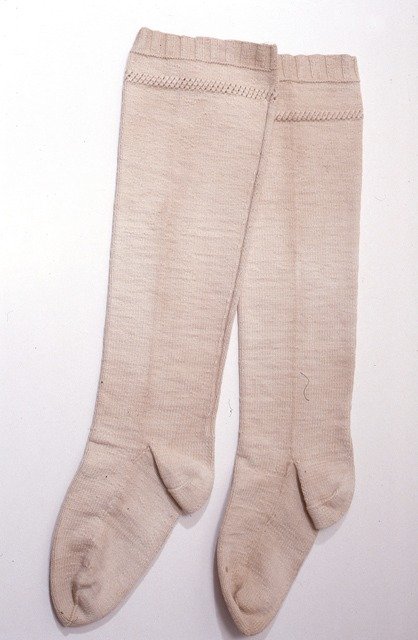
We retain the museum’s accession form “K4331:44” rather than normalising it to the KA identifiers of the other objects. Four of the selected public image views are only 640 pixels tall. They are good evidence for the object’s overall appearance but are not a reliable means to count every stitch on the reverse.
What five objects can and cannot show
Placed together, the five records distinguish side motifs in Säkylä, the radial toe of Alahärmä, a crocheted heel in Somero, linen in Ruokolahti, and cotton plus ribbing in Vöyri. The comparison tells us that a museum’s category “stockings” contains multiple material and construction decisions. It does not establish regional prevalence, the direction in which a technique spread, or an invention date. Places of use and latest possible manufacture years are evidence with limits, not a map of who knitted first.
A responsible reconstruction would require examining each object’s interior and back, measuring yarn and needle size, recording cast-on stitch counts and tracking every heel decrease. The public photographs and concise catalogue texts do not provide that sequence. Rather than invent the missing instructions, this article marks what is documented and what needs further collection research.
Primary object records and image rights
- KA2526 — Säkylä, Satakunta (made before 1885; red wool; KA2526.tif)
- KA3022 — Alahärmä, Ostrobothnia (made before 1885; natural-white wool; A3022_30342.jpg)
- KA4166 — Somero, Häme (made before 1893; red and black wool; A4166_30380.jpg)
- KA3781 — Ruokolahti, Savo (made before 1893; natural-white linen; A3781_30358.jpg)
- K4331:44 — Vöyri, Ostrobothnia (made before 1903; natural-white cotton; 4331_44_30460.jpg)
- Creative Commons Attribution 4.0 International (CC BY 4.0)
Checked the five National Museum of Finland records and the file-level CC BY 4.0 notices in Finna on 15 October 2026. All five images are photographs of real collection objects; none is AI-made. One file names its photographer; the other four do not show an individual photographer, so the institution and file are credited.