Five Russian Shawls: Knitting, Weaving and What the Records Actually Say
Research and writing: DDUJA KNIT / 뜨자뜨개
Colour and ornament draw the eye to a shawl. For a knitter, the more consequential question is how that surface was constructed. Was its fabric formed from interlocking loops, from warp and weft, or through another technique? Wool or cashmere names a fibre, not the answer. Five nineteenth-century Russian shawls in The Metropolitan Museum of Art illustrate why that distinction matters. One record explicitly identifies knitting, another specifies two weaving structures, two are classified as woven and one does not state the method in its individual catalogue card. The five public-domain photographs below show five different objects, each tied to its own record and image.
Object 65.201 actually says “knitted”
The Met’s object 65.201 is a nineteenth-century Russian shawl. Its medium is recorded as “Knitted cashmere goat fiber, Z spun, 2S plied.” “Knitted” is the significant construction claim. The shawl measures 304.8 by 223.5 cm: this is a large textile, not a small scarf. The broad museum classification “Textiles-Laces” should not override the much more specific medium statement. The photograph lets us examine open geometric motifs along a border and adjacent ground fabric, but it cannot reveal every needle size, stitch count or direction of work. The object’s maker is unnamed. This single collection record does not establish that all Russian shawls of the period were knitted in the same way.
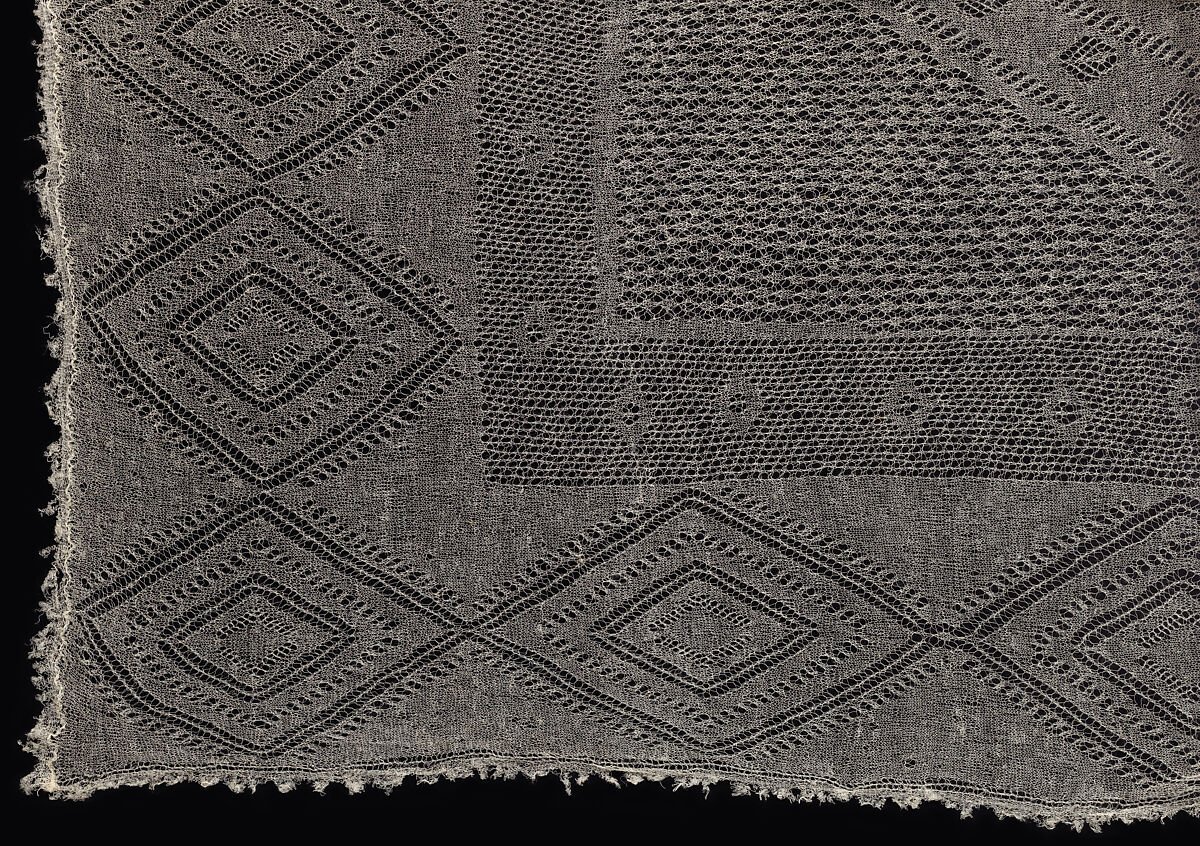
The twist behind a fine cashmere surface
The museum reports a microscopic fibre diameter of 12–20 micrometres and explains that strong twist helped the yarn withstand knitting and wear. Its notation “Z spun, 2S plied” describes the direction of spinning the singles and plying two strands in the opposite direction. It does not mean that the entire shawl was knitted in a Z or S direction. Fibre diameter, yarn construction and the openwork surface are three different levels of evidence. Keeping them separate avoids a tempting but false shortcut: calling every soft goat-fibre shawl a knitted cashmere shawl. A soft hand cannot, by itself, identify a textile structure. Nor does the object card give a complete working pattern from which a modern knitter could reproduce its border.
It is also worth distinguishing the technical observation from a story about national origin. The museum measured and described this surviving piece. No named knitter, specific Russian town or complete production chain appears in its card. Its fine fibre and considerable finished size are meaningful properties of the object, but they are not a statistical sample of an entire country. Comparing nearby museum records tests what survives when the material label is held loosely constant and the method changes.
Nadezhda Merlina Manufactory: goat fibre, but woven
Object 65.91.1, attributed to Nadezhda Merlina Manufactory, dates to the early nineteenth century and is described as Russian, probably from Nizhny Novgorod province. The Met calls its medium “Tapestry and twill weave, goat fiber.” Measuring 241.3 by 60.3 cm, it has a long narrow form with bright stripes and ornamental ends. The goat-fibre label can invite comparison with the knitted cashmere object, yet this is a woven shawl. Its floral fields cannot be presented as a knitting colourwork chart. The named manufactory is an attribution on this particular object; it does not tell us that a single person made every part of the textile.
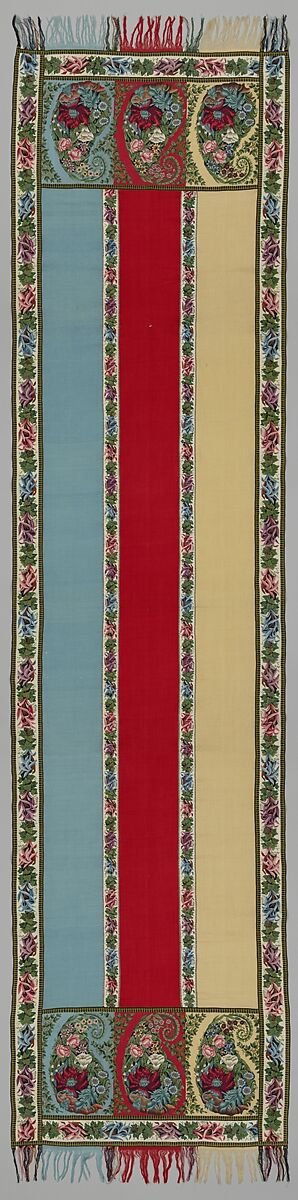
The museum’s essay attached to this record traces a wider history of shawls, including producers who retained tapestry weaving amid changing European demand. It identifies workshops associated with Nadezhda Merlina and Vera Andreevna Eliseeva and discusses their reliance on serf labour. That social context matters when viewing an exceptionally fine luxury textile. Yet an essay about workshops is not a complete individual work log for this photographed shawl. The page also contains substantial discussion of Iranian and Polish sashes; that wider history should not be copied as if it were the documented biography of object 65.91.1. The narrower, secure comparison is the card’s maker, approximate place, date, dimensions and explicitly woven medium.
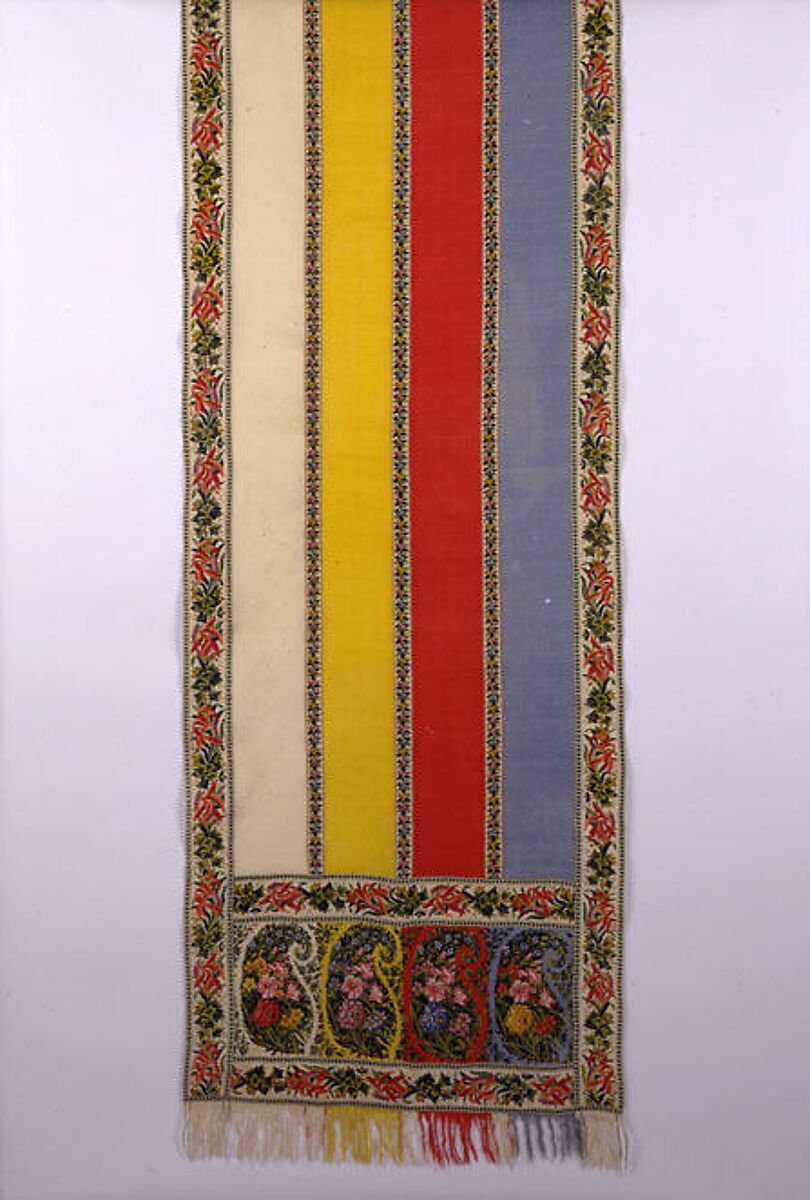
A wool shawl dated about 1820, with no method specified
Object 1972.175 is catalogued as a Russian wool shawl dated about 1820. Its individual card does not specify a construction method. A cross-reference in the essay on the Merlina object points to a similar signed shawl under this number, but the medium field of this particular page says only “wool.” It would be misleading to turn the photo into a second confirmed knitted example, or to assert a specific weave from the object image alone. “Not stated” is a real state of evidence. It does not prove that the object was knitted, nor that knitting has been ruled out. We therefore label its method as unrecorded in the card and allow the original record to set that limit.
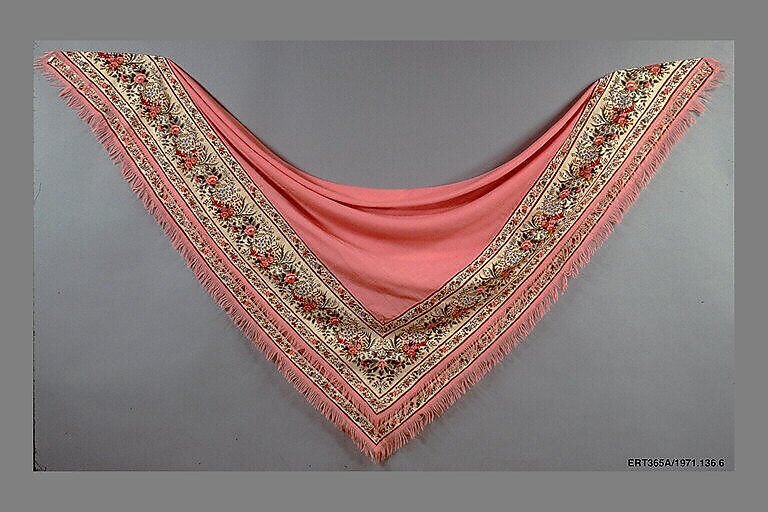
A square shawl and a Saratov manufactory
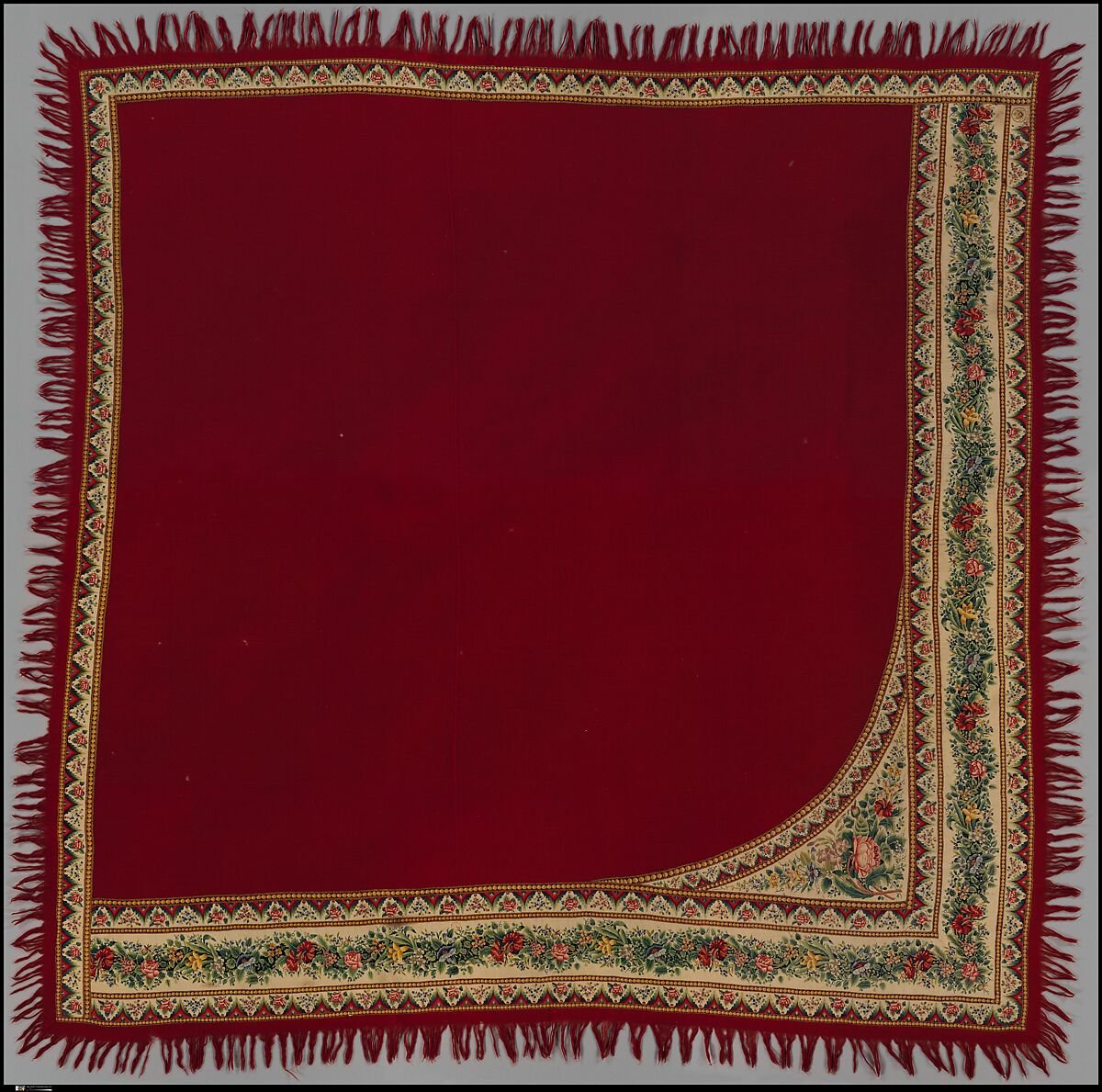
Object 1971.136.6 is a Russian wool shawl dated about 1850. It measures 149.9 by 149.9 cm, close to a square, and sits in The Met’s “Textiles-Woven” classification. The shape differs markedly from Merlina’s long narrow example. Shape alone does not establish a wearer, purpose or market, but it warns against imagining one uniform object whenever a catalogue says “Russian shawl.” The medium “wool” and the classification “woven” answer different questions. Wool can be knitted or woven; here the collection department gives the latter classification.
Object 46.180 is attributed to Dimitri Kolokoltzev Manufactory in Saratov Province and dated about 1830. The medium is wool, the size is 147.3 by 152.4 cm, and the collection classifies it as woven. The named place and manufactory differ from the Merlina attribution. A workshop name records how the museum assigns this piece; it does not reveal every worker who prepared yarn, wove, finished or sold it. Nor do the dimensions alone explain how it was worn. Its image is a fifth distinct object, useful for comparison without being treated as another photograph of the knitted shawl.
Three questions for a modern shawl pattern
First ask what the fibre label tells you: “wool” and “cashmere” describe material, not knitting. Next check the construction word: knitted loops, a woven warp and weft, and embroidery are different operations even when their motifs look related. Finally remember that a museum’s finished dimensions do not supply gauge, needles or yarn quantity for a reproducible contemporary pattern. The open border of 65.201 may be a visual prompt for new lace knitting, but an illustration of that border is not an original pattern diagram.
Of these five records, only the first explicitly establishes knitting. The Merlina shawl explicitly combines tapestry and twill weaving; the 1820 wool record leaves method unspecified; and the remaining two are classified as woven textiles. That modest conclusion is more useful than a sweeping origin story. It lets a maker admire colour, fibre and form while remaining precise about which techniques the historical records actually identify and which details still need further research.
Primary records and image rights
- The Met collection object 65.201 — visual 1, knitted
- The Met collection object 65.91.1 — visual 2, woven
- The Met collection object 1972.175 — visual 3, unspecified
- The Met collection object 1971.136.6 — visual 4, woven-classification
- The Met collection object 46.180 — visual 5, woven-classification
- The Met Open Access policy
These five photographs show five distinct collection objects. Each object page marks its image Public Domain; the museum states that open-access public-domain images may be reused commercially and noncommercially. The object data and image terms were checked separately.