Halland Binge: Berta Borgström and the Evidence in Three Knitted Samples
DDUJA KNIT JOURNAL · HALLAND, SWEDEN · HISTORY AND COLLECTIONS
Research and writing: DDUJA KNIT
A red motif on a wool mitten can be read as decoration. It can also lead to questions about who supplied the yarn, who knitted the garment and who found a buyer. Halland’s binge tradition becomes more interesting when we follow those relationships alongside its patterns. This article considers a regional history, Berta Borgström’s organizing work and three individually catalogued samples. It does not claim to explain the origin of all Swedish knitting.
Livelihood and history · Berta Borgström · Three samples · Reading a pattern · Sources
Image note: All five images are AI-generated reference illustrations, not photographs of historical objects or named makers’ work. Each caption links to a source containing authentic photographs.
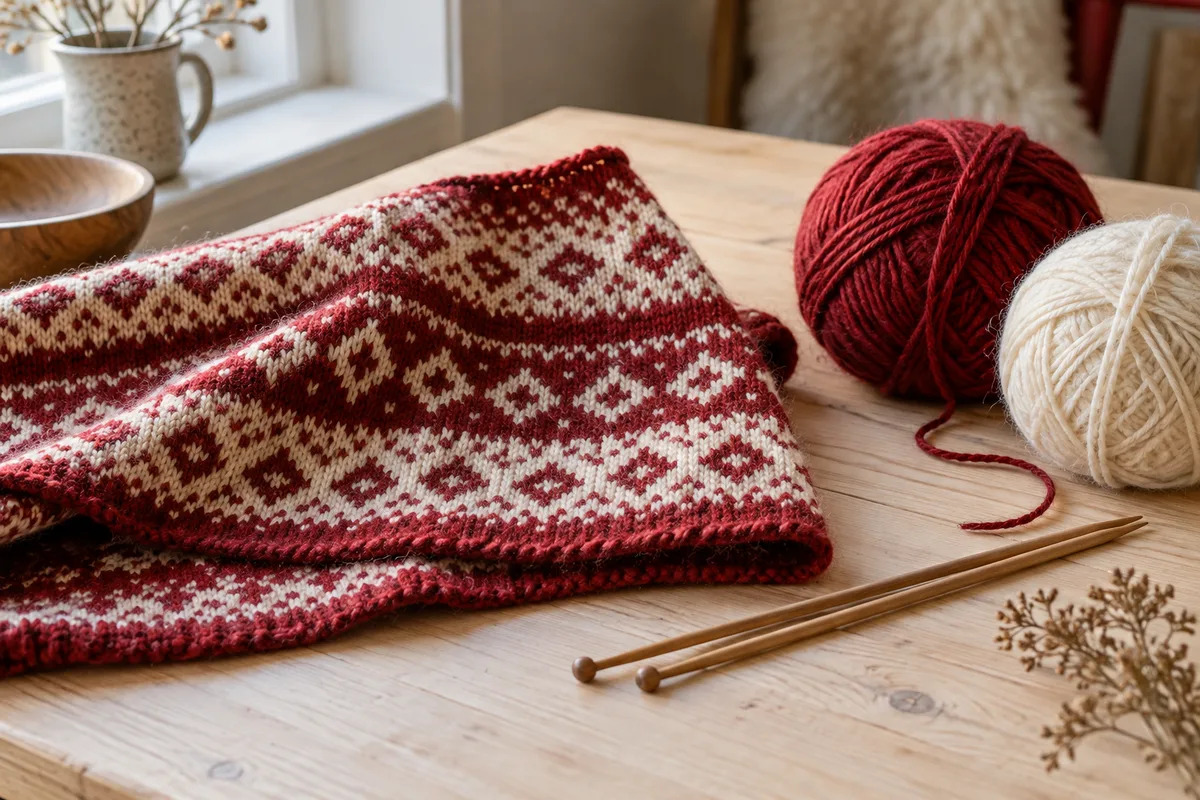
A regional word, a changing livelihood
Sweden’s national living-heritage inventory traces binge as a Halland tradition to the seventeenth century while stating that knitting’s exact arrival cannot be established. The word once covered knitting broadly; today it is associated especially with traditional two-color pattern knitting. Red, blue and white are customary colors, but other colors occur. The inventory also cautions that many motifs are not unique to Halland. [1]
That distinction changes how we describe regional identity. A pattern need not have been invented in only one place to matter deeply there. Its importance can lie in the community that taught it, the materials people could obtain and the work for which it was used. Claims about a single inventor require a different kind of evidence from records showing repeated local practice.
The inventory cites Pehr Osbeck’s 1796 account of wool being distributed on the Wallen estate and knitted stockings forming part of the tenants’ dues. Birgitta van Cracau and Magnus Durell owned the estate. Van Cracau’s possible familiarity with organized Danish knitwear selling is presented as a possibility, not proof that she invented binge. The same inventory describes commercial production involving women, men and children, with itinerant traders and military purchasers among its connections. [1]
A stocking in that setting was more than an isolated household object. Material had to be prepared, work allocated and finished goods collected. Reading the history through those stages helps avoid reducing every maker to a modern hobbyist. It also prevents a successful organizer’s name from standing in for all the people who actually did the knitting.
Berta Borgström connected patterns with buyers
As machine knitting made handknitted goods harder to sell in the late nineteenth century, Borgström sought orders through businesses including Militärt Ekiperings AB in Stockholm. She also collected and classified local patterns. In 1907 she founded Bindslöjden, linking documentation with the provision of wool and the sale of garments to support makers’ income. The national account describes later sales beyond Sweden, difficulties after the Second World War, and a move toward yarn-and-pattern kits with garment assembly services in the 1950s. [1]
These changes suggest a useful way to think about preservation: keeping a pattern in circulation can involve keeping a route to payment open. A kit also changes the relationship between buyer and garment. The buyer participates in making it, rather than acquiring only the finished object. This is an interpretation of the documented business forms, not a claim that every household experienced the changes in the same way.
Hallands Konstmuseum identifies Bindslöjden’s collection and archive among its holdings. Its collection is broader than any single knitting technique, so the relevant object records matter. The cultural-history museum’s binge page provides a route into digitized pattern collections and interpretation. Together, these resources let the reader move from an overview to individual evidence. [2][3]
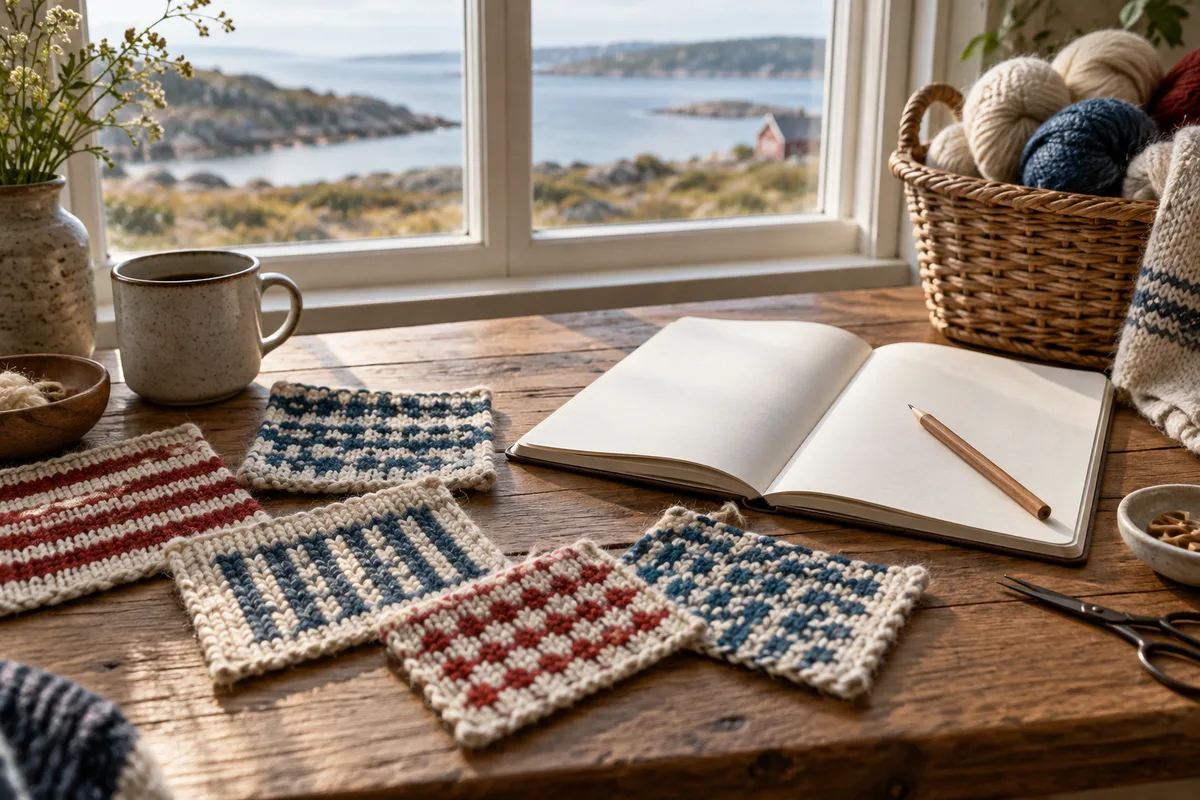
Three catalogue numbers, three different questions
Väröbacka: material, function and construction
NHHB-0832 is catalogued as a mitten sample in red and black three-ply wool. Its recorded length is 150mm and width 95mm. The listed techniques include stockinette, pattern knitting, knitting in the round and ribbing. The collection owner is Hallands Konstmuseum; the record belongs to the Bindslöjden collection presented through Hemslöjdens Samlingar. [5]
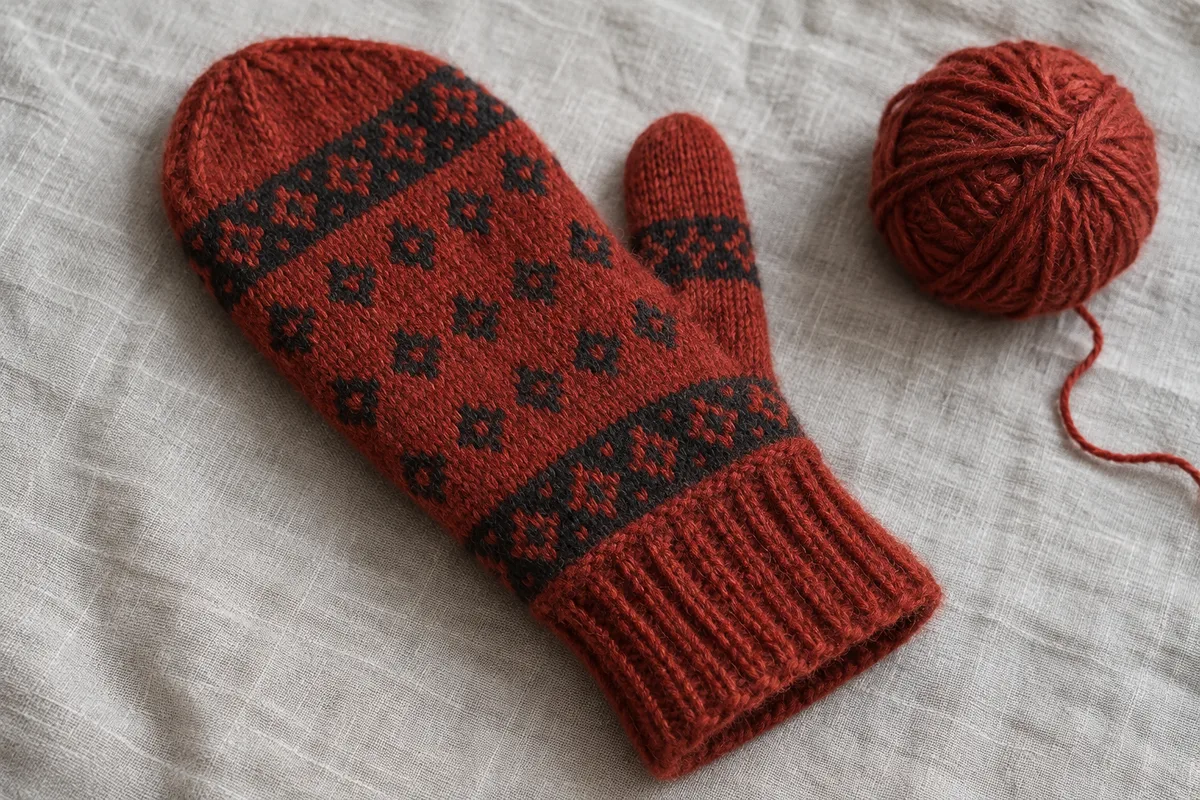
The record makes it possible to ask separate questions about the patterned hand and the cuff. Where does the motif begin? Which part seems designed to fit closely? Compare the authentic photographs before drawing conclusions. The invented mitten shown here is a visual aid about wool and contrasting colors, not evidence for the exact construction of Väröbacka.
Fasan: reversing the ground changes the reading
NHHB-0317, titled Fasan, is recorded in two-ply wool, with black on white and white on black. Its length is 225mm and width 380mm. The catalogue lists stockinette, pattern knitting and binge. These details establish a specific sample to examine rather than a general rule for every garment carrying that pattern name. [6]
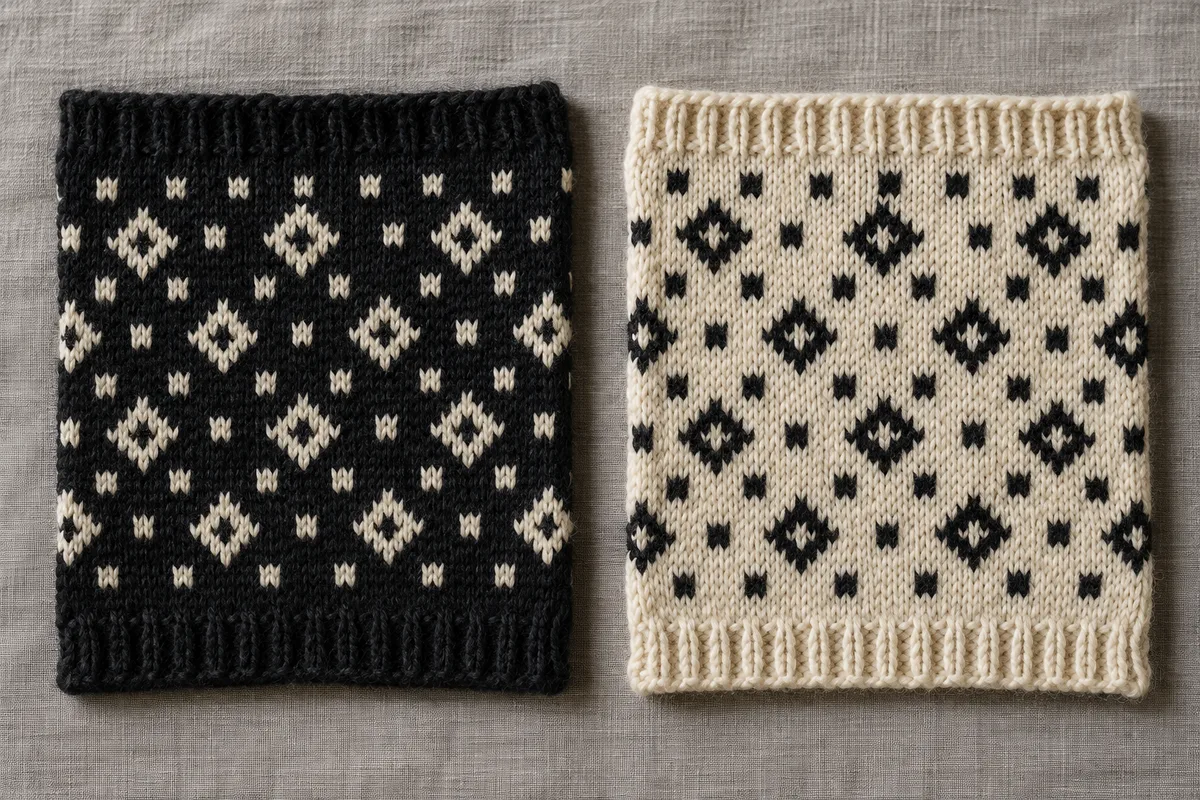
When comparing light and dark grounds, note the contour that attracts attention first, the shapes that read as empty space and the motif’s relationship to the edge. Reversing two color names does not guarantee an identical visual emphasis. This is a proposed viewing exercise; a photograph alone cannot reveal the maker’s intention or the knitting gauge.
Bjärbo: three colors in a textile, two at a time
NHHB-0182, Bjärbo, is described as red and blue on a natural-white ground in three-ply wool. The recorded dimensions are 150mm long and 175mm wide, with stockinette, pattern knitting and circular knitting listed. The history field associates the pattern with the seventeenth or early eighteenth century. That statement must not become an unsupported date for the surviving physical sample. [7]
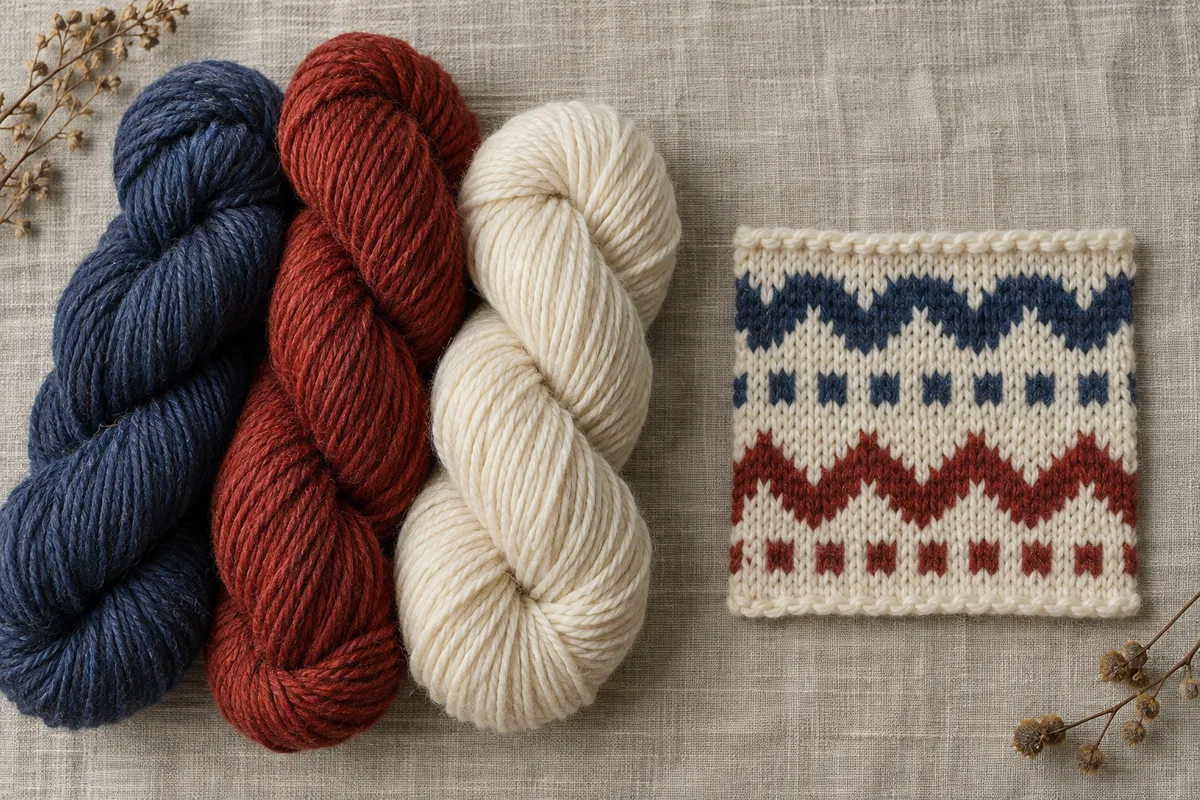
The national inventory describes traditional binge as circular knitting using two colors at a time, even when a garment contains more colors overall. It also records newer work in other techniques, including flat and double knitting, and differing opinions about those interpretations. A familiar regional label does not settle every technical or cultural choice in advance. [1]
From a museum sample to your own project
Recorded object dimensions are not a finished garment size or a gauge measurement. A sample width of 95mm does not give a wearer’s hand circumference. Nor does a ply count specify a needle size: it describes strands in a yarn’s construction, not a universal thickness. Keep the catalogue number, object dimensions, chosen yarn, needle and washed gauge in separate fields when making notes.
A reproduction requires another date as well. In her research essay, Viveka Hansen distinguishes a 1909 exhibition photograph from a cap she knitted in 2019. A new cap using an earlier design does not become an original historical object. The illustrations in this article are not even knitted reconstruction experiments: they are synthetic reference images. Documentary evidence, a physically worked reproduction and an invented image answer different questions. [4]
For an actual project, begin with a usable, attributed pattern. Mark its stitch repeat, starting point, round join and the way shaping interrupts or continues the motif. Work and wash a swatch in the intended yarn before deciding on size. Collection photographs can guide observation, but cannot supply missing construction instructions with certainty. No stitch chart for copying a collection object is provided here.
What the next mitten can reveal
Reading binge means holding several kinds of work in view: the maker’s knitting, Borgström’s organization and the museum’s documentation. For a contemporary maker, a final question remains useful: which decisions came from a source, and which are your own changes? Recording that boundary gives an honest account of both inheritance and invention.
Sources and image note
- ISOF / Levande kulturarv · Binge
- Hallands kulturhistoriska museum · Halländsk bingestickning
- Hallands Konstmuseum · The Collection
- Viveka Hansen, The IK Workshop Society at The IK Foundation · Historical Reproductions (2022)
- Hemslöjdens Samlingar / Hallands Konstmuseum · NHHB-0832, Väröbacka
- Hemslöjdens Samlingar / Hallands Konstmuseum · NHHB-0317, Fasan
- Hemslöjdens Samlingar / Hallands Konstmuseum · NHHB-0182, Bjärbo
The historical overview is adapted from ISOF’s national inventory; object descriptions are checked against individual catalogue records. ISOF permits text reuse with attribution. That permission is not treated as a licence for photographs. All five images here are newly generated illustrations. Follow each caption’s source link to see authentic photographs. ISOF: text-use policy.