WORLD KNITTING JOURNAL · THE NETHERLANDS · HISTORY & CULTURE
From Guild Needles to Fishing Sweaters: A Dutch Knitting History in Five Objects
A national knitting history is larger than its best-known garment. Fine babywear, detachable sleeves and coastal wool pull us into different rooms, jobs and centuries.
Ask someone to picture Dutch knitting and a dark fisherman’s sweater may come to mind. It is a compelling garment, but it cannot stand for the whole history. A museum article dates the arrival of knitting in the Low Countries to the sixteenth century, when knitted gloves were costly status goods and professional male knitters organised into guilds. A rare cotton baby jacket made around 1718 belongs to a very different world of luxury and fine handwork. Later, coastal communities adapted knitted garments to fishing, Sunday dress, children’s clothing and even the problem of keeping a blouse clean. Five museum objects make those differences visible—and remind us that a technique travels through changing lives rather than remaining a single, timeless tradition. [1][2][3]

When knitting arrived: a new technique, not an ancient national uniform
Modemuze’s overview begins with a useful correction: around 1500, most fabric in the Netherlands was woven, and gloves were made by sewing pieces of cloth together. The article distinguishes that older practice from nalbinding, a single-needle technique that can look like knitted fabric but is not the same construction. It places the spread of knitting in the Low Countries in the sixteenth century and connects it to the Eighty Years’ War and Spain. That is the museum network’s account of how the technique arrived; it does not mean every Dutch region began knitting at the same moment. [1]
At first, knitted work could signal status. The same overview describes silk gloves with gold thread and a carefully repaired wool glove excavated in Groningen. It says knitting was carried out by male professionals in the sixteenth century, with guilds specialising in goods such as stockings or gloves. A knitting sheath—a small support tucked into a waistband—helped a worker hold the work and knit faster. These records show an organised craft, but they do not tell us that women never knitted; they show which professional structures and surviving objects the account documents. [1]
Mechanisation did not instantly replace hand knitting. William Lee’s stocking frame, invented in England in 1589, could make flat pieces but not the shaped, in-the-round garments that a knitter could construct by hand. Guild knitters therefore continued to have work. The point is not that hand and machine formed separate eras: they answered different needs and coexisted as garment construction changed. [1]
Cotton, babies and the value of fine handwork
In the early eighteenth century, cotton opened another chapter. Modemuze’s textile-history feature describes cotton arriving from India through the Dutch East India Company and becoming a costly, fashionable material. An exceptionally fine knitted cotton baby garment dated 1718 belonged to the Coenders-Harinxma family in Friesland. The museum account stresses how unusual both cotton and knitted cotton were at the time. It is a reminder that “knitting history” includes intimate clothing and elite household display, not only robust wool for outdoor work. [2]
The article’s technical description is especially revealing. The jacket was worked by hand from the bottom upward and in the round; at the armholes the work was divided, while stitches were held for the underarm. The fronts and back were continued separately, stitches were decreased for the round neck, and the shoulders were bound off. Stitches were then picked up around the armhole to knit the sleeves in the round. Purl-knit eight-pointed stars decorated the edges. The fabric looks almost machine-made, yet the source explains that a stocking frame could not knit in the round. Fine, delicate cotton thread was also easier to control by hand. [2]
This garment is discussed here but not reproduced as a photograph: the source page does not provide a clear reuse licence for that image. The licensed photographs below instead show other objects whose records state their image-use terms. This distinction matters. A museum’s public catalogue entry is valuable evidence, but access to a picture does not automatically grant permission to republish it. [2]
The baby jacket also belonged to a particular social setting. Modemuze describes comparable knitted cotton baby garments as rare clothing for a limited elite before knitted sweaters became a routine part of baby dress in the twentieth century. It would be misleading to turn this single surviving object into a picture of every Dutch infant’s wardrobe. Its rarity is precisely what makes the record useful: it tells us what a family could display, and what ordinary surviving evidence often leaves out. [2]
The coast: workwear, Sunday dress and local variation
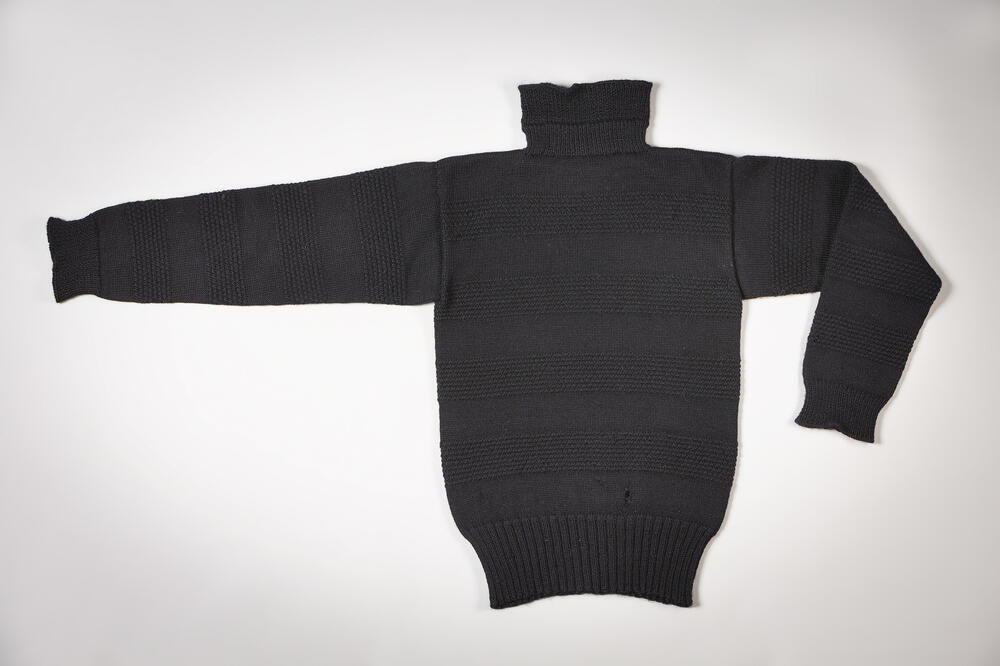
The fisherman’s sweater has a history of its own, but even here the evidence resists a neat origin myth. Modemuze describes Dutch fisherman’s sweaters as woollen work or dress garments worn by fishers and other crew from roughly 1860 to 1950. It suggests that English ganseys may have influenced Dutch examples, while noting that patterns were adapted in different villages and communities. Individual sweaters could contain personal details as well as local features. “May have influenced” is not the same as proving that one English design was copied everywhere; the museum’s wording leaves room for exchange and adaptation. [3]
The Scheveningen sweater pictured above, HM.936, offers a close study rather than a universal template. Its record identifies blue sajet wool and a date around 1950. The lower body is largely plain stocking stitch; cables appear higher up, separated by a zigzag band. Such changes in texture help explain how one garment can combine warmth, a close fit and ornament. They do not establish that every coastal sweater used the same chart. [4]
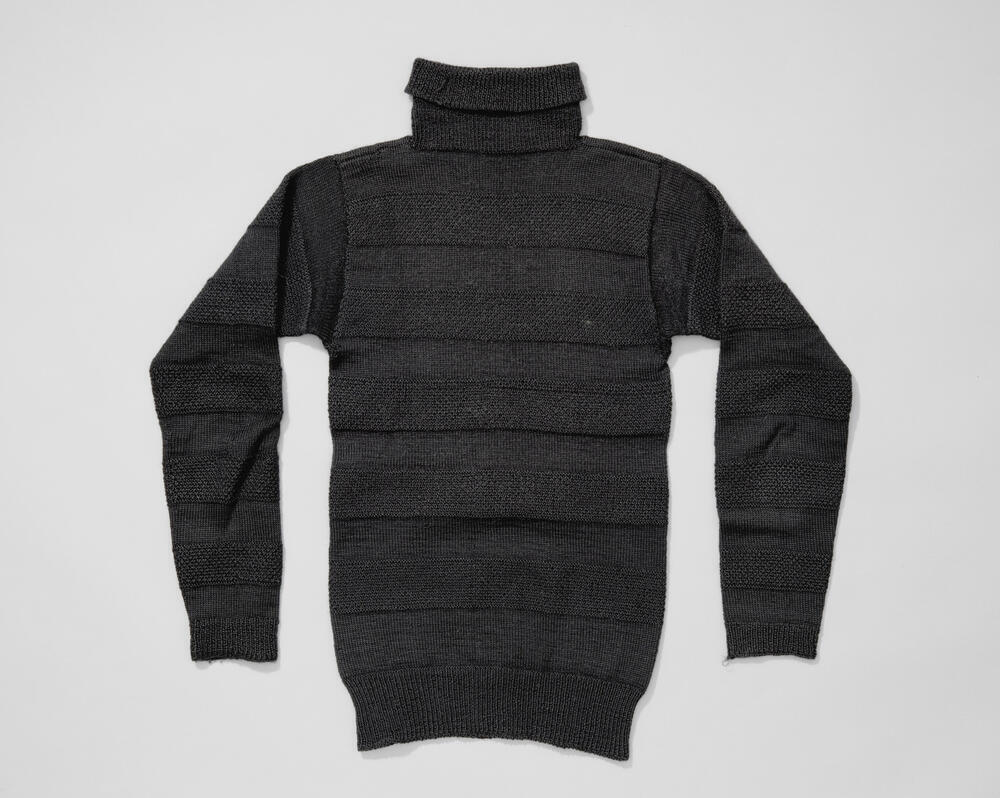
Volendam adds a change of use. The Zuiderzeemuseum’s record for the black sweater 011456 says these garments entered local dress after 1900, initially as Sunday or “dressed-up” clothing, and were later worn for work around 1920. Its description notes fine black sajet wool, a tube-knit body and alternating bands of stocking stitch and seed stitch. A garment could move between social settings as practical needs and local dress changed. The catalogue does not make every black sweater a fisherman’s uniform. [5]
Another Volendam garment, the boy’s sweater K.26-69, complicates the familiar adult-male image. The record says boys wore this kind of sweater after their third birthday. It gives both a broad period of 1925–1950 and the date notation “1945 / 1969,” so those details should be quoted as catalogue data rather than compressed into a falsely exact year. Horizontal bands alternate plain stocking stitch with knit-and-purl variations. The shape and surface pattern are evidence of children’s dress, not a miniature clue to an adult fisherman’s identity. [6]

Makers, names and the work behind the pattern
Many collection records preserve the garment more clearly than the maker. The Marken sleeve 022890 is an unusual exception. The Zuiderzeemuseum records donor Gertje Zeeman-Visser’s recollection that her mother, Marretje Visser-van-Altena, knitted the sleeve and that Gertje worked its border. A removable sleeve protected the sleeve of a blouse and could be washed separately; over time, this useful layer also became part of Sunday dress. One object therefore preserves a mother and daughter’s work, a practical solution and a change in how an accessory was worn. [7]
Names also appear in the history of documentation. Textile historian Gieneke Arnolli, formerly curator of fashion and textiles at the Fries Museum, wrote Modemuze’s broad survey of Dutch knitting. Researcher and author Stella Ruhe published a study of 65 historical sweaters from 55 Dutch fishing villages, with knitting charts. The book is a modern research and reconstruction resource, not a list of 55 perfectly uniform village codes. Distinguishing makers of the garments from later researchers who record them keeps credit where the evidence places it. [1][8]
Printed instruction brought another kind of shared knowledge. Modemuze notes that yarn company Everlasting published Praten en breien in 1934, described there as the Netherlands’ first dedicated knitting magazine. After the Second World War, when ready-made clothing was difficult to obtain and expensive, women knitted many garments at home, especially for children. The magazine, a museum object and a family-made garment are different records of the same craft: one circulates instructions, one preserves a material example, and one may carry a household’s labour. [1]
Five objects, five questions for a knitter
When reading a historical knit, begin with construction before symbolism. Is the body worked in the round? Where are stitches divided or picked up? Does a border protect an edge, reinforce a cuff or simply finish it? A catalogue can tell us the fibre, date, place and provenance; a photograph can show the visible structure. Neither alone supplies an exact modern pattern, gauge or needle size. Treating a museum object as a source to study is more responsible than calling it a ready-to-knit free pattern. [4][5][7]
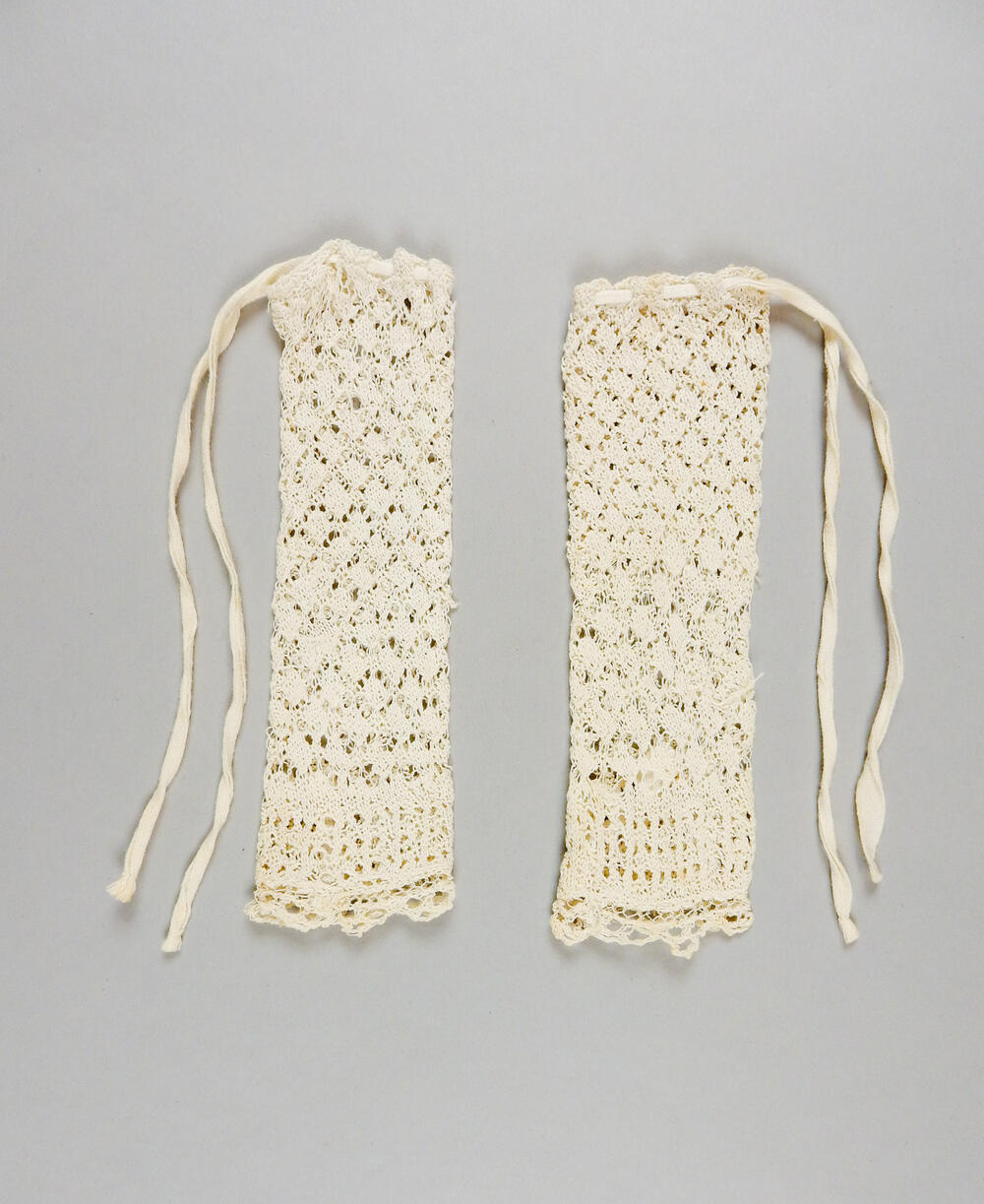
The Marken sleeve asks a different question: why knit a garment part separately? A detachable piece protects the blouse beneath, makes laundering more manageable and allows decoration to concentrate at the wrist. The Amsterdam Museum’s white sleeve pair, KA 12890, dated 1890–1910, shows another answer. It is worked in white cotton with openwork knitting and a contrasting lower band; crochet lace finishes the edge. Calling the whole object crochet would erase the knitted structure at its centre. The two sleeves belong to different places and dates, so they should be compared as related solutions, not treated as one regional tradition. [7][9]
The five objects also show why “Dutch knitting” cannot be reduced to one famous sweater. Guild gloves speak to professional skill and status; the 1718 baby garment to rare cotton and elite dress; fisherman’s sweaters to a coastal life shaped by work and local preference; separate sleeves to care and maintenance; and the 1934 magazine to printed instruction. Each source has limits, and each becomes more informative when read beside another. That is how a national history grows: not by forcing every object into a single pattern, but by asking what people made, who wore it, and what the surviving record can—and cannot—tell us. [1][2][3][8][9]
A short timeline
- Sixteenth century: knitting spreads in the Low Countries; professional guilds specialise in items such as gloves and stockings. [1]
- 1589: William Lee’s stocking frame is invented in England; the machine makes flat pieces but not garments worked in the round. [1]
- 1718: a rare knitted cotton baby garment is recorded in the Coenders-Harinxma family’s Friesland collection. [2]
- c. 1860–1950: Dutch coastal communities wear wool fisherman’s sweaters as work or dress garments. [3]
- After 1900: black sweaters enter Volendam dress; around 1920 they are also worn for work. [5]
- 1934: Everlasting publishes Praten en breien, identified by Modemuze as the Netherlands’ first dedicated knitting magazine. [1]
- 2015: Stella Ruhe’s study records 65 historical sweaters from 55 Dutch fishing villages. [8]
Sources and image credits
Numbered citations link claims to the original museum or publication record. Each photograph is credited beneath the image; reuse terms are stated there and linked to the relevant licence or public-domain dedication. The 1718 baby jacket is discussed from its source record but is not reproduced here because its image reuse terms are not clearly stated.
- Gieneke Arnolli, “Breien” (Knitting), Modemuze.
- Gieneke Arnolli, “Babyborstrokje van gebreid katoen” (Knitted cotton baby jacket), Modemuze.
- “Visserstrui” (Fisherman’s sweater), Modemuze topic page.
- Scheveningen fisherman’s sweater, c. 1950, object HM.936, Nederlands Openluchtmuseum via Modemuze.
- Volendam fisherman’s sweater, object 011456, Zuiderzeemuseum via Modemuze.
- Boy’s sweater from Volendam, object K.26-69, Nederlands Openluchtmuseum via Modemuze.
- Detachable knitted sleeve from Marken, object 022890, Zuiderzeemuseum via Modemuze.
- Stella Ruhe, Visserstruien: 65 historische truien met breischema’s uit 55 Nederlandse vissersplaatsen, Rijksmuseum publication record.
- Pair of knitted openwork sleeves, object KA 12890, Amsterdam Museum via Modemuze.