Ruby Fisher’s 1910 Knitting Machine: Orders, Instructions and Five Surviving Objects
A finished sock tells us what a machine could produce; the tools and notes around it tell us how one person worked. Museums Victoria holds a hand-powered Wertheim “Preciosa” flat-bed knitting machine bought by Ruby Fisher (1890–1958), along with an instruction booklet, handwritten patterns, parts, receipts and two knitted objects. These records allow us to follow a small rural enterprise rather than treat every surviving sock as an anonymous wartime comfort. The purchase story and much of the family history come from the donor, Ruby’s granddaughter. Where the museum labels an object’s maker as probable or possible, that uncertainty remains part of this account. [1]
From a Melbourne shop to a Gippsland farm
Object HT 31934 is a manually powered flat-bed machine made by Wertheim in Germany and sold by Hugo Wertheim in Melbourne. According to the donor’s account, Ruby bought it on Bourke Street in 1910 for 10 pounds and 15 shillings. She lived at “Alisdale” near Yarragon. The acquisition included spare needles, winding equipment, weights, bills, notebooks, two knitted pieces and a family photograph. Seen together, they form a record of setting up a machine, obtaining yarn, making garments and passing the equipment between generations. The associated notebooks carry “R. FISHER KNITTER” and “ALISDALE YARRAGON” stamps; they tie a named worker to a place, rather than proving that every object in the group was made for sale. [1]

The model name is not plainly visible on the machine itself. Museums Victoria explains that it inferred “Preciosa” from the accompanying manual and period advertisements. It also notes a difference: advertisements show a floor stand, while the surviving example can be fixed to a firm table. A catalogue title is therefore a researched identification, not a label we can independently read from the metal photograph. [1][2]
What the incomplete manual can and cannot show
Instruction booklet HT 31934.14 survives as pages 3–18. Its first extant page explains how to fit the yarn guide, winder and bobbin stand, and how to oil the machine. Patterns start on page 6: men’s socks, singlets, cycling stockings, caps, a boy’s sweater, a cardigan and other garments. This breadth helps explain why a machine advertised for family use could also serve paid orders. It does not establish that Ruby made or sold every pattern in the booklet. A printed instruction and an order entered in a notebook are different evidence. [1][2]
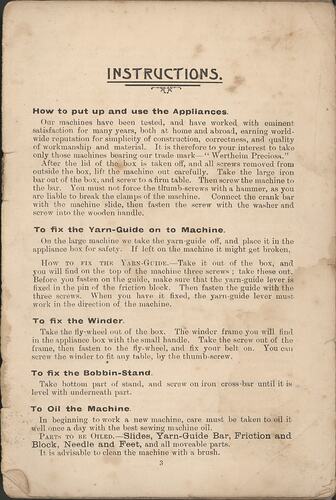
Unlike two-needle hand knitting, this device brings several working elements together: a bed of needles, a guided yarn path, weights and hand operation. Preparation and maintenance are therefore part of the making process, not incidental chores. Because some manual pages are missing, the museum’s copy should not be presented as a complete, ready-to-follow operating guide. [2]
The black sock and a cautious wartime connection
HT 32798 is a long black sock with a ribbed opening. The museum records it as made with the Preciosa machine and lists Ruby as its probable maker. It measures 570 mm long and 155 mm wide. Those measurements describe the preserved object; they do not yield the wearer’s size or a reliable stitch gauge. Nor can this sock be identified confidently as one sent to a soldier. The museum says its individual provenance is unknown, and black is not the standard khaki colour of the Australian uniform. [3]

The donor recalled that Ruby knitted socks for soldiers during the First World War and once made 23 pairs in a single day. That figure is a family recollection, not an independently audited production total. Handwritten patterns for soldiers’ long socks and stockings survive in the collection, but no surviving mark connects this particular black sock to one of those orders. Reading the object carefully means keeping the collection-level wartime story separate from the uncertain destination of a single garment. [1][3][6]
The blue mitten and the reach of a home machine
HT 32797 is a blue fingerless mitten with a separate thumb opening and ribbed edges. Museums Victoria identifies Ruby only as a possible maker. Beside the long sock, it shows two very different forms associated with the same equipment: a leg covering and a hand accessory that leaves the fingers free. The public record does not name a buyer or price for this particular mitten. It would be an overreach to call every surviving piece a commission. [4]

The machine record describes orders for boys’ long socks, women’s stockings, socklets, jumper bands, neck and arm bands, buttonholes, cardigans and jumpers. It also says one notebook recorded customers and amounts generally between two and five shillings. Those are reported entries across orders, not a fixed price for the mitten or sock pictured here. They nevertheless show how a household tool could connect clothing for the family with income earned at home. [1]
A pencilled scrap beside the printed instructions
HT 32920 is a fragment, apparently torn from a cigarette packet. Red “STATE EXPRESS / CIGARETTES” printing shares the surface with pencilled knitting numbers and abbreviations. The museum dates it possibly to the 1910s and calls Ruby its probable author. Without the original operator’s full context and machine setup, the shorthand is not a complete pattern for modern readers to copy. [5]

The printed booklet describes a manufacturer’s intended sequence; the reused scrap suggests the compact notes a worker needed in practice. Both matter. When reading an old machine-knitting pattern, begin with its machine, yarn, needle count and shaping marks. Filling gaps with current hand-knitting abbreviations may erase the work the historical note was designed to support. [2][5]
Evidence, image rights and further records
The five photographs here show actual collection objects: machine, manual, sock, mitten and scrap. Museums Victoria marks each corresponding image CC BY 4.0 and permits reuse with attribution. No AI images were used. A yarn price list and wool receipt are also catalogued with the machine, but their images are marked “All Rights Reserved”; they are linked as records, not reproduced. [7][8]
Primary records: [1] machine HT 31934; [2] manual HT 31934.14; [3] sock HT 32798; [4] mitten HT 32797; [5] note HT 32920; [6] sock-pattern notes HT 32918; [7] yarn price list HT 32963; [8] wool receipt HT 32964.