Six British Stockings: Fibres, a Maker’s Mark and a Royal Cipher
Research and writing: DDUJA KNIT / 뜨자뜨개
A stocking can carry a more useful clue than its colour: a manufacturer’s stamp, a numeral at the toe, or two letters beneath a crown. Six pairs catalogued as British by The Metropolitan Museum of Art make it possible to compare surviving objects without inventing a national timeline. They range from 1775–1795 to 1894. The records name silk and cotton, linen, wool, cotton and silk, cotton, and silk. Each object has an actual collection photograph marked Public Domain by the museum.
What “British” does not tell us
The Met separates culture, date, materials and acquisition or donation history in its object records. Its designation “British” does not by itself identify a city, knitter, or whether a pair was hand or machine knitted. “Ca. 1800” is approximate; “early 19th century” and “fourth quarter 19th century” are broader periods. These six survivals are not a statistical sample of what everyone in Britain wore. We distinguish what a photograph shows, what a museum record states, and what a wider social history would still need to prove.
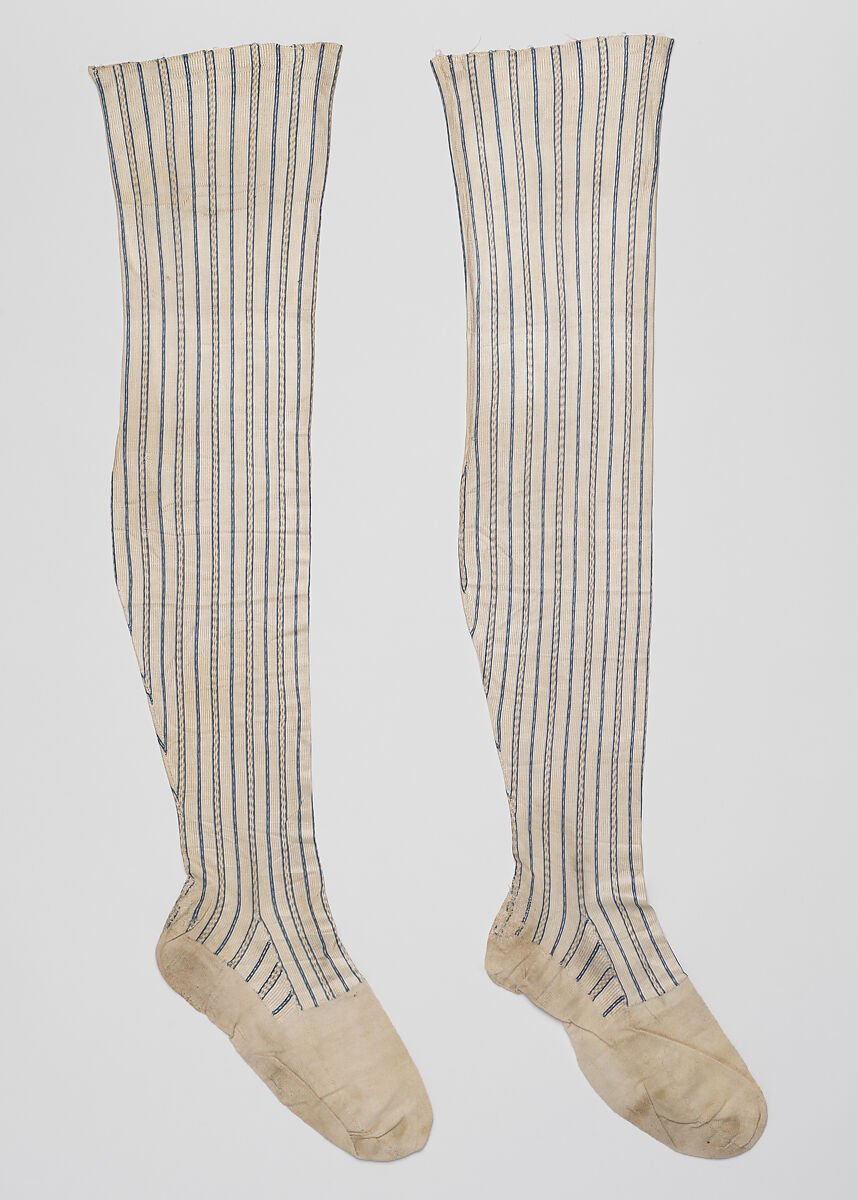
1775–1795: silk and cotton on one card
Stockings 2024.519a, b are dated 1775–1795, classified British, and recorded in silk and cotton. The record’s credit line names a 2024 endowment fund, but its concise overview does not identify the original maker or state exactly where each fibre sits within the pair. A viewer can compare surface and shape in the photograph, but lustre alone is not a secure map of the silk. This object gives us a surviving pair and a material description, not a full knitting recipe. Object record
Around 1800: what “linen” can establish
Pair 1988.342.4a, b is catalogued as British, ca. 1800, in linen. That is a different material entry from the first pair. The short record gives no spinning method, heel construction or wearer’s social position. We should not call it a “summer stocking” solely because it contains linen; that would attach an undocumented use to a material. The public image supports comparison of an object’s present outline, not measurement of its stitch density. Object record

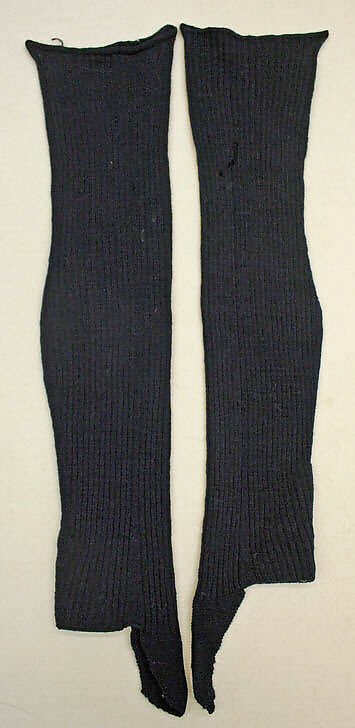
Early 19th century: wool and provenance
Object 08.187.5a, b is an early-19th-century British pair recorded in wool. The family of Thomas Coutts gave it to The Met in 1908. A donor is not automatically the maker or the original wearer. Keeping those roles separate matters: a catalogue credit cannot legitimately be rewritten as a story about who knitted the item. The photograph shows a surviving pair; the museum card supplies the culture, broad date, material and gift history. Object record
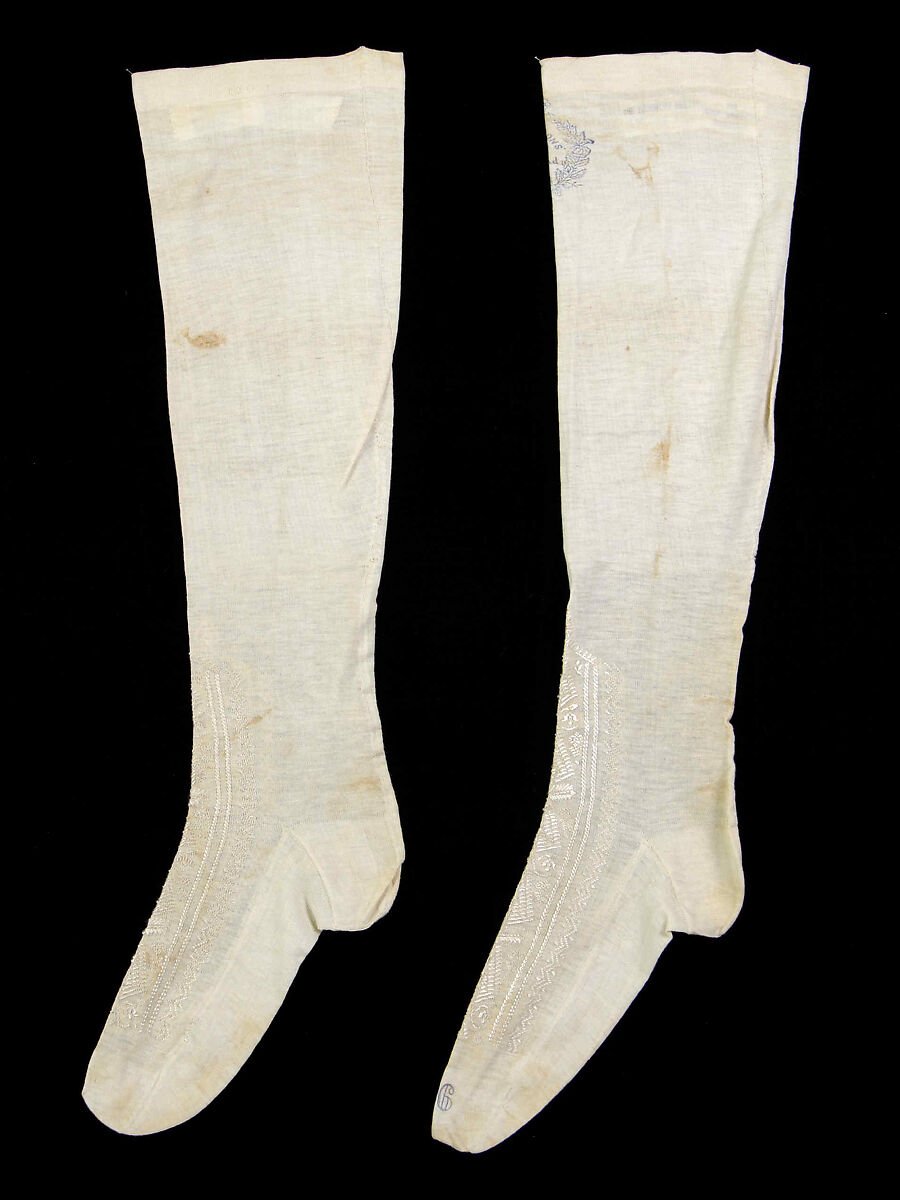
Around 1860: the C. Pecker & Sons stamp
The Met explicitly names C. Pecker & Sons as manufacturer of 2009.300.7728a, b, dated ca. 1860 and catalogued in cotton and silk. A separate markings panel transcribes a stamp in a wreath on one stocking: “C. Pecker & Sons/superior Lisle Thread.” It also records the numeral “6” at the toe. This connects a company name and product language to the object itself. “Superior” is a word in a stamp, not an independent quality assessment by this article. The record does not explain the numeral, so we do not translate it into a modern shoe size. Object and marking record
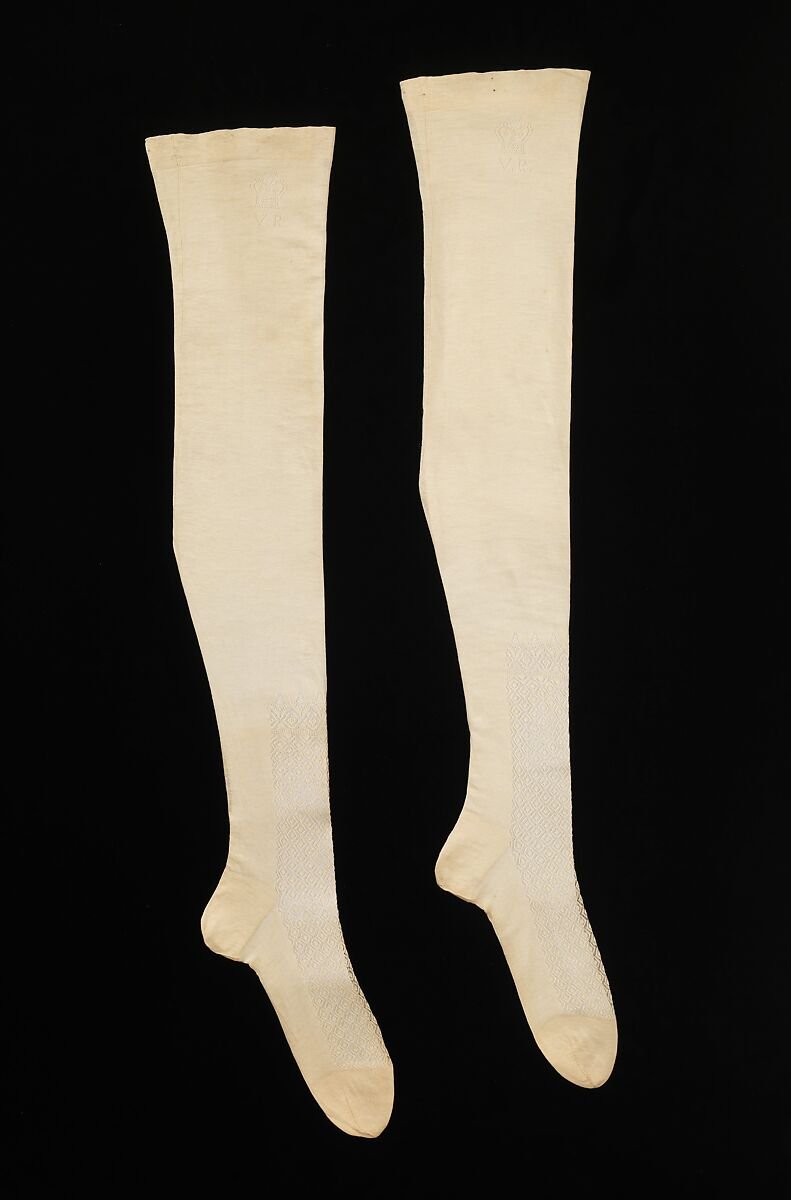
Late 19th century: what V.R. can and cannot prove
Pair 2009.300.1687a, b is a British cotton knit of the fourth quarter of the 19th century. The Met says it probably belonged to Queen Victoria because it bears a royal cipher. Its markings panel describes a crown over the initials “V.R.” in openwork below the band on both stockings. The museum also calls attention to a finely worked back seam that is almost invisible. Yet a cipher is not conclusive evidence of a specific wearer. The museum’s 1927 purchase history does not close that gap either. We retain its qualified “probably” rather than declaring the pair the Queen’s personal property. Object and marking record
1894: a dated silk pair and an open question
The Met dates silk pair C.I.41.15.11a, b to 1894 and records it as British. Miss Valerie J. Dreyfus donated it in 1941. We can place it next to the silk-and-cotton pair dated 1775–1795, but the two surviving objects alone do not demonstrate an unbroken manufacturing lineage. To establish one would require commercial records, maker information and closer comparison of construction. This image is evidence that a dated pair survives, not the inevitable last frame of a neat progress story. Object record

Six records, two useful limits
Across these six Met records, material labels differ: silk and cotton, linen, wool, cotton and silk, cotton, and silk. That is evidence of diversity in the preserved sample, not a chronology of national fashion. Two sets of marks deserve closer attention. The C. Pecker & Sons stamp supplies a manufacturer but leaves the meaning of “6” open. The V.R. cipher supports a royal association but does not prove an individual owner. The museum’s conditional language is part of the evidence and should travel with the photograph.
A pattern researcher would still need to examine backs, heels and toes, measure yarn and gauge, and follow the making direction before claiming a reconstruction. “British” is a collection classification and “Public Domain” is an image reuse condition. Neither is a stitch chart. The six linked primary records provide a starting point for that deeper object study without inserting missing techniques into the catalogue.
Object records and image rights
- 2024.519a, b — 1775–1795; silk, cotton.
- 1988.342.4a, b — ca. 1800; linen.
- 08.187.5a, b — early 19th century; wool.
- 2009.300.7728a, b — ca. 1860; cotton, silk; C. Pecker & Sons.
- 2009.300.1687a, b — fourth quarter 19th century; cotton.
- C.I.41.15.11a, b — 1894; silk.
- The Met Open Access policy
On 15 October 2026 we checked each of the six object records, its Public Domain label and image file. All six are photographs of collection objects; none is AI-generated. The account does not infer making histories beyond the museum’s stated culture, dates, materials and markings.