The Knitted Chook Project: Children’s Drawings after Australia’s 2009 Bushfires
After the 7 February 2009 bushfires destroyed Strathewen Primary School in Victoria, children chose colours and patterns for drawings of hens. Barbara Joyce and volunteer knitters translated those choices into soft knitted cushions. This article follows that chain of decisions and examines one brown chook preserved by Museums Victoria. It distinguishes the school project, a later child’s drawing, and the museum object rather than treating them as a documented matching set.

A borrowed classroom and a place for children’s drawings
Museums Victoria’s account of children and the fires states that Strathewen Primary School reopened four days after the disaster in a borrowed classroom in nearby Wattle Glen. Reopening did not end the losses. The museum describes children’s drawings as both immediate documents of their experience and a form of expression. That context matters here: the colours on a chook drawing were choices made by children, not merely decorative instructions supplied to adults.
The museum’s Recovery & Wellbeing account traces the project’s earlier object to a chook cushion Joyce had knitted in 2004 with fibre from a neighbour’s alpaca. After the 2009 fire, that cushion was taken to the neighbours’ funeral; Joyce subsequently approached the school with a proposal. The institutional account records the sequence, but a knitted object should not turn bereavement into a simple origin story. It shows how an existing handmade form became a way to invite participation.
From one drawing to a different maker’s stitches
In the project described by Museums Victoria, each child coloured a picture of a nesting hen. Volunteer knitters then interpreted the selected colours and patterns in a cushion. Joyce’s own Grailcraft account also describes this exchange and says that working together gave local women a way to connect. The museum records a special assembly in November 2009 at which children received the cushions, followed by provision to other people affected by the fires. The children designed the colour choices; the volunteer knitters made the knitted forms. Saying that the children knitted the cushions would erase that division of work.
The separate museum record for Luella’s drawing, HT 26887, describes a 2010 A4 drawing coloured blue, green, pink, red and yellow. Its date and archive identity make it useful evidence for children’s participation. They do not establish that it was the design for the brown chook photographed below. The drawing’s image is marked All Rights Reserved on the collection page, so this article links to that record without reproducing the image.
One brown chook, five photographic views
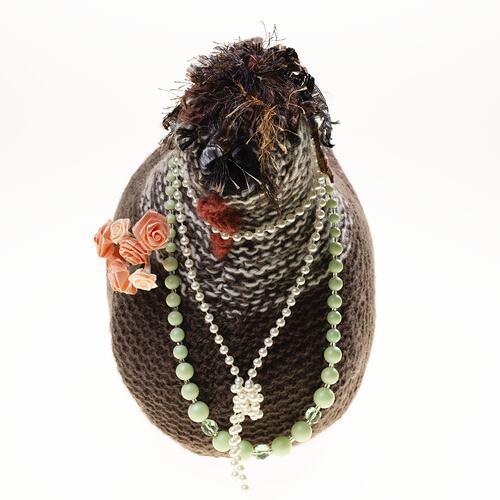
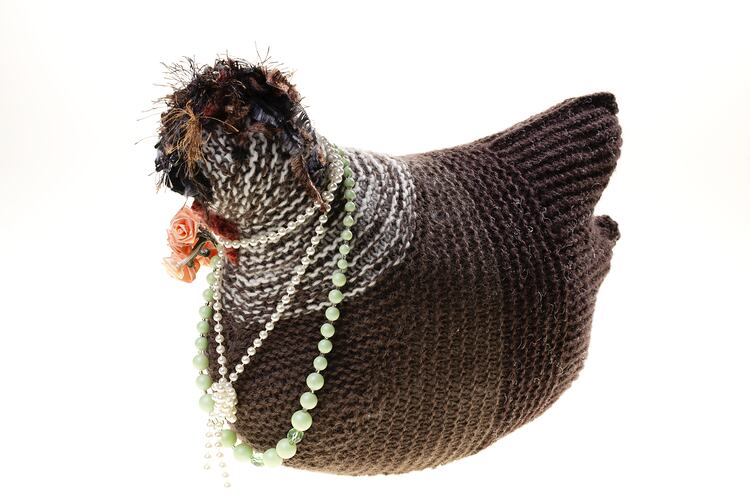
The collection card for HT 33133 identifies it as a hand-knitted chook made by women in the St Andrews area and given to people affected by the Black Saturday bushfires. It was made mostly with brown wool and measures 370 mm long, 170 mm wide and 270 mm high. Stella and Alan Reid donated it to Museums Victoria in August 2012. The record includes Stella Reid’s account of adding flowers and adornments and keeping the chook near her bed. The precise sequence of every embellishment cannot be reconstructed from the catalogue description alone.
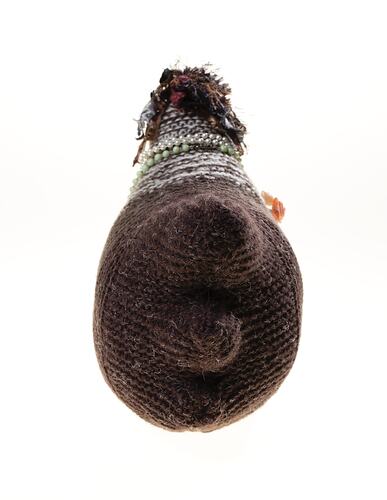
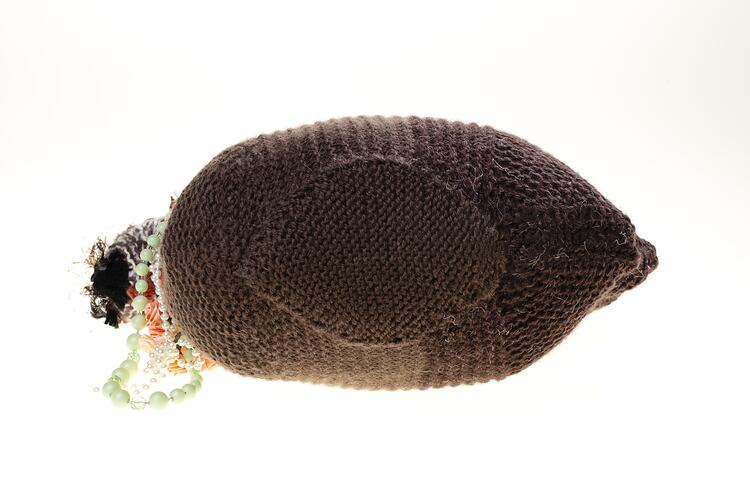
The five images here are five views of the same object, not five separate chooks. The front, another angle, back and top help a reader inspect colour, volume and added decoration. They do not establish the stitch count, needle size, filling material or complete knitting pattern. The museum’s physical description is limited to a hand-knitted chook made mostly of brown wool. We retain that limit.
What the archive can and cannot represent
Museums Victoria’s 2019 recovery exhibition presented creative work as a tangible response within a long, difficult process. HT 33133 documents one recipient’s object and later donation. Luella’s drawing documents a child’s choices in a separate record. Joyce’s account explains how the knitting group worked. None is a complete inventory of every child’s cushion or proof of a measurable therapeutic outcome. Read together, they reveal a small but concrete sequence: drawing, interpretation in yarn, giving, keeping and preserving.
Primary records and image rights
- Museums Victoria, hand-knitted chook HT 33133 and individual CC BY 4.0 image views
- Museums Victoria, Luella’s drawing HT 26887; image All Rights Reserved
- Museums Victoria, Recovery & Wellbeing exhibition account
- Museums Victoria, Children exhibition account
- Barbara Joyce, About the Chook Project
All five reproduced photographs depict HT 33133 from different angles. Each file view credits Rodney Start and Museums Victoria and displays CC BY 4.0. The restricted image of Luella’s drawing and restricted exhibition photographs are linked, not copied.