Mary Walker Phillips: Reading Knitting as Art, Material and Space
DDUJA KNIT JOURNAL · UNITED STATES · ARTISTS AND TEXTILES
Research and writing: DDUJA KNIT
What changes when knitting hangs on a wall? Instead of checking sleeve length, we may begin to notice gaps, shadows and the edge of a textile. Mary Walker Phillips offers a way into that shift. This article follows three documented works and asks how their records can sharpen our looking. One artist’s career is not a complete history of American knitting; it is a specific route into questions about material, scale and artistic choice.
Starting with weaving · Near East · Reading materials · Beads and repetition · Your next swatch · Sources
Image note: All five images are AI-generated reference illustrations. None depicts an actual Phillips artwork or reconstructs her studio. Each caption links to authentic source photographs.
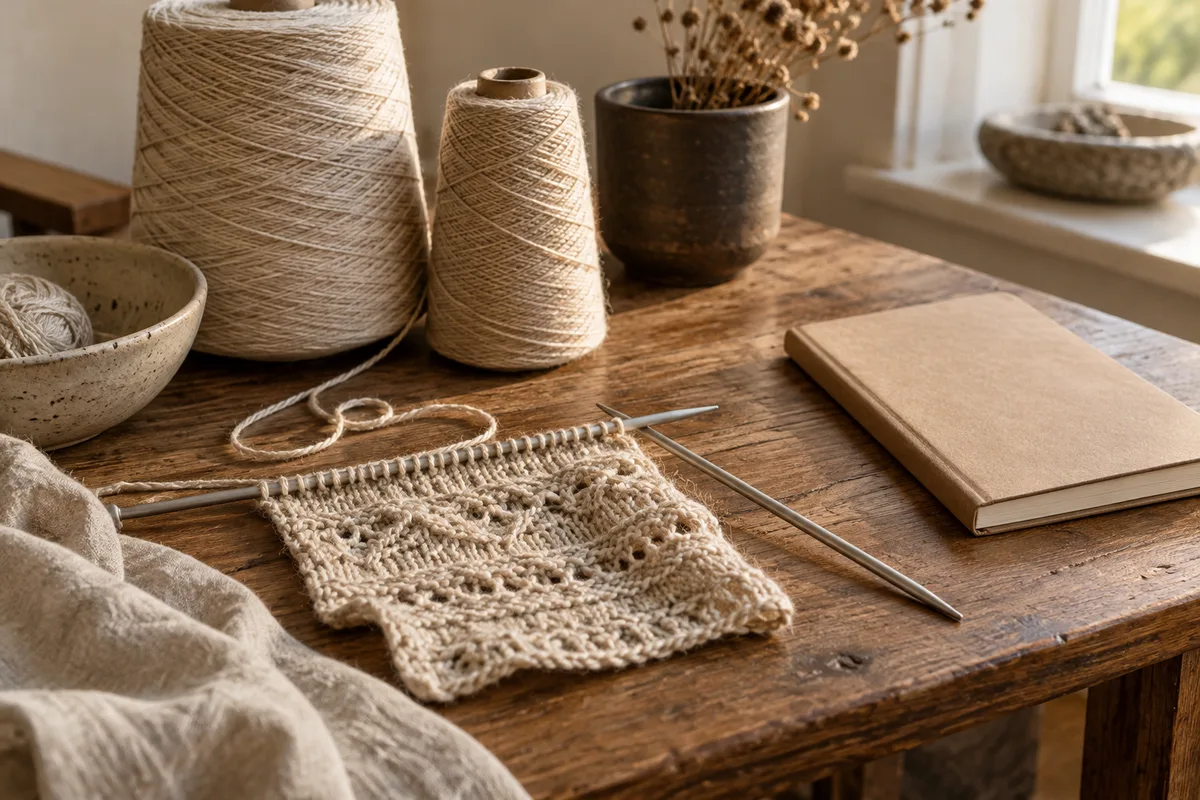
Keep weaving and knitting distinct
Cooper Hewitt records Phillips’s 1947 Cranbrook graduation, work in Dorothy Liebes’s studio and later woven interior commissions for Frank Lloyd Wright. She returned to Cranbrook in 1960 and explored knitting with encouragement from Jack Lenor Larsen. [1]
Those distinctions matter before we even discuss color. Textiles made from yarn are not automatically knitting. A similar surface in a photograph can conceal a different structure, so a maker’s use of several techniques makes the catalogue’s technique field especially useful. Describing a woven commission as an early knitted wall hanging would collapse separate parts of the career into a misleading story.
In her 2012 symposium paper, researcher Jennifer L. Lindsay places Phillips’s 1960s knitting between industrial design and studio craft. She describes an expanding interest from architectural prototypes toward independent wall hangings, and records the artist’s 1978 American Craft Council fellowship. This gives us a documented context without requiring the sweeping claim that one person invented knitting as art. [2]
Near East: begin with 283.2 centimeters
MoMA dates Near East Wall Hanging to 1964 and records wet-spun linen, dimensions of 283.2 × 113cm and object number 336.1969. The date in a collection number must not replace the work’s creation date. Its current online record says that an image is unavailable, so we do not invent a close visual description from that page. [3]

A height of 283.2cm is difficult to register on a small phone screen. Imagine the wall needed to accommodate it and compare that height with your own. A repeated stitch can invite one kind of attention at arm’s length and another from across a room. Close up, we may follow the yarn; farther away, we may read the distribution of light and dark. This is a viewing exercise prompted by the recorded dimensions, not a reconstruction of a particular installation or its lighting.
MoMA’s Wall Hangings exhibition ran from February 25 to May 4, 1969, and its archive includes installation photographs. An advance fact sheet names Phillips among the participating artists and describes a range of fibers and spatial forms. This was not exclusively a knitting exhibition. Its wider textile context is useful precisely because we should not call every exhibited work knitted. [4] [5]
More Variations: a material list begins the discussion
Cooper Hewitt identifies More Variations (1967), accession 1998-38-3, as a knitted hanging in Lurex, linen and handspun silk. It is distinct from the 1960–63 woven sample illustrated on the same page. [1]

Open the authentic photograph and ask three separate questions. Where does the surface catch the light? Where does the spacing between stitches appear to change? How are neighboring areas divided? Three listed materials do not necessarily correspond to three easily isolated colors in a photograph. Exposure and lighting also affect what we see. A material list establishes what the record reports; it does not let us reverse-engineer every yarn combination or needle size.
For your own experiment, test materials separately before combining them. Using one needle and one basic structure can make differences easier to compare. Note the conditions, then view each small sample flat and hanging. Decide whether you want to change sheen, flexibility or drape, rather than simply rank one yarn as better. This is a proposed contemporary study, not Phillips’s documented production method.
Fans And Beads: decisions within a repeat
Lindsay’s 2010 MA thesis studies Fans And Beads (1974) in a dedicated chapter. It records ikat-dyed linen, mahogany beads and approximate dimensions of 26 × 31 inches, and examines a historical stitch repeat. This thesis and the 2012 conference paper are different publications, with different titles and dates. [6]
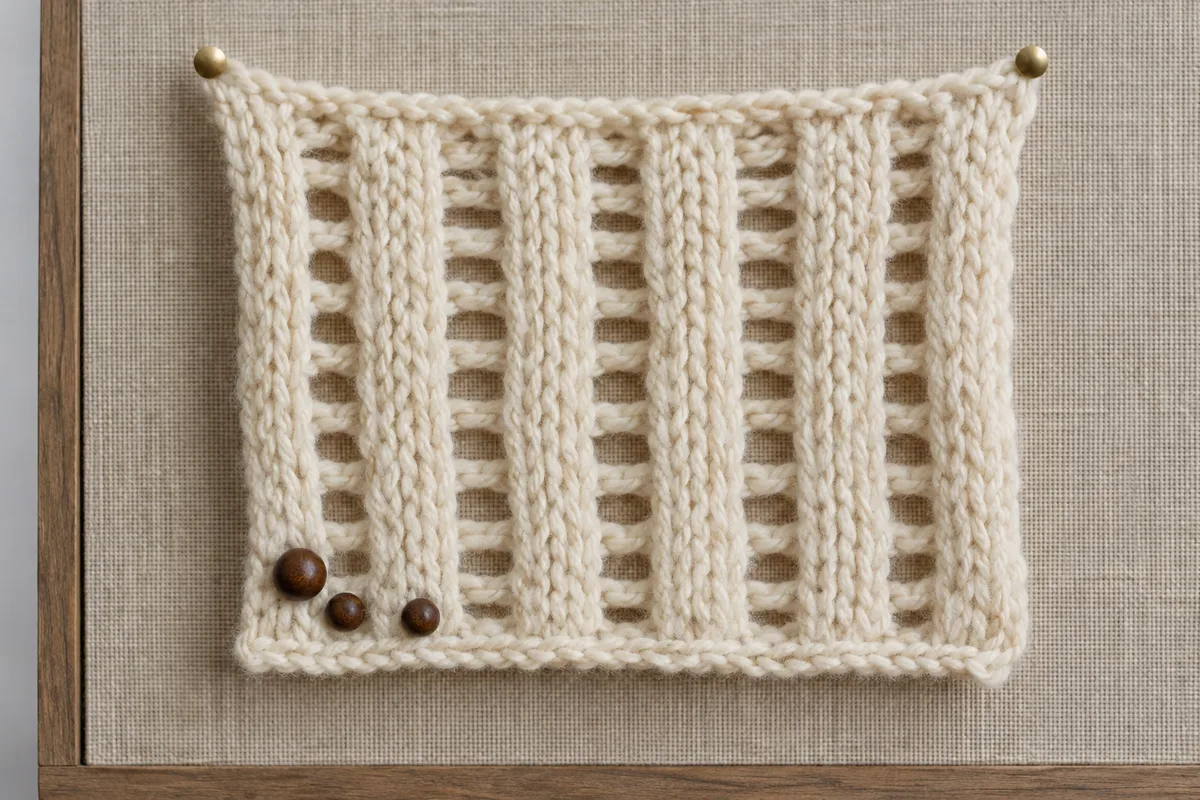
Beads invite us to consider both the surface and the distribution of weight. In the authentic photograph, look at where a bead sits within a repeated unit and how neighboring open space makes it visible. A photograph alone cannot settle every question about attachment or the hidden back. Our invented beaded sample is a separate visual aid: it does not reproduce the actual work’s pattern or arrangement.
Does a new work require a newly invented stitch? An existing structure still leaves choices about material, repetition and placement. Conversely, accumulating difficult stitches does not automatically make a composition persuasive. For a project of your own, write one sentence identifying what will remain constant and what you will change. That simple distinction can help make the experiment legible, both to you and to someone viewing the result.
Turn observation into a useful swatch
Phillips also studied traditional knitted bedspreads. Lindsay discusses her 1989 book Knitting Counterpanes as work concerned with researching and documenting older stitch patterns. Experimental art and attention to inherited structures need not sit at opposite ends of a maker’s practice. [6]
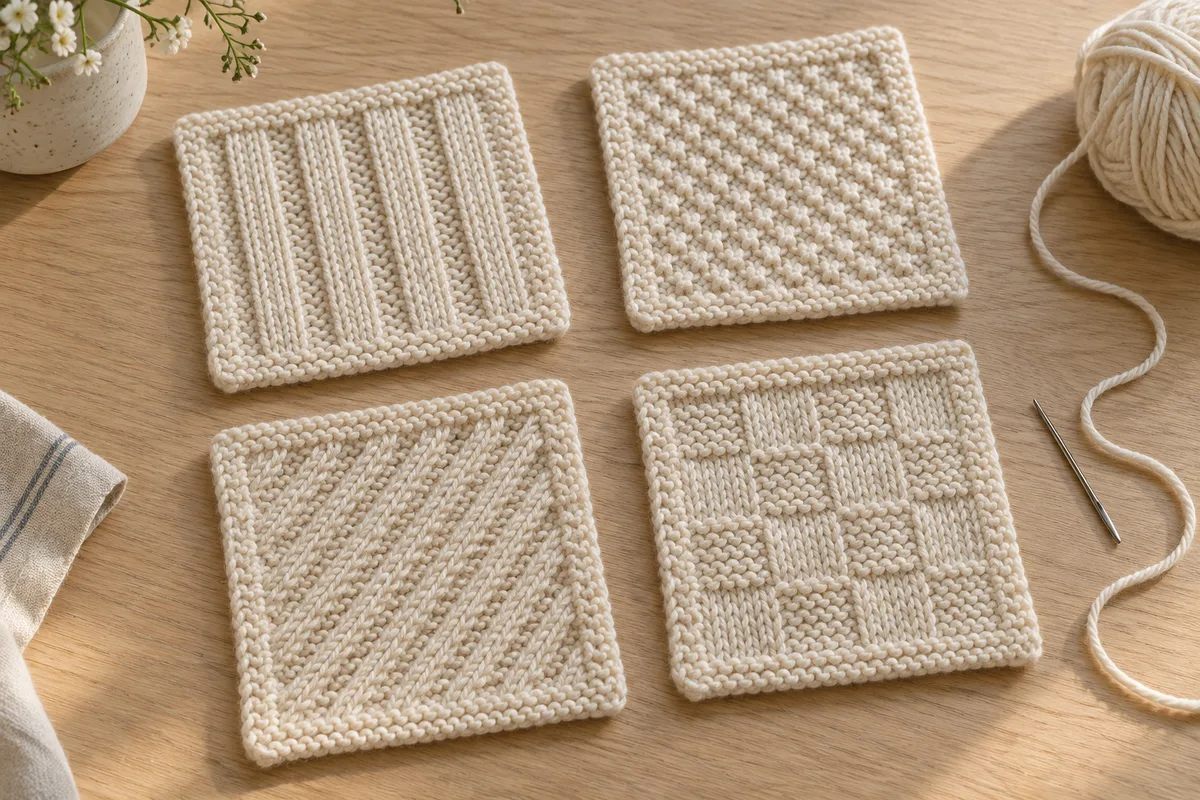
When opening your next pattern, separate looking at the finished form from deciding how to make it. First record the source’s title, date, technique, material and dimensions. Then note what the photograph reveals about repeats, openings and edges. Leave an unseen back or uncertain join marked as unknown. Finally, list the decisions that belong to your yarn, tools and intended use. This creates a small working record in which evidence and your design choices remain distinguishable.
If you plan to assemble modules, join two samples rather than stopping at one. A thick seam or mismatched edge length may become apparent only at the join. Measure before and after finishing. For a hanging, also observe the sample while suspended. These tests will not turn an AI illustration into a reliable chart or reconstruct a museum object. They let you test questions with real material instead of treating an attractive image as a complete set of instructions.
Expand the possibilities; keep the record precise
Phillips’s work offers more than a declaration that knitting can leave clothing behind. It invites separate attention to scale, yarn, repetition and space. Readers who cannot see the objects in person especially need accurate records and clear routes to photographs. The invented illustrations here introduce ideas and atmosphere; the linked sources remain the place to examine the artist’s actual work.
Sources and image note
- Susan Brown, Cooper Hewitt · Mary Walker Phillips
- Jennifer L. Lindsay · Mary Walker Phillips and the Knit Revolution of the 1960s, TSA symposium proceedings (2012)
- MoMA · Near East Wall Hanging (1964), 336.1969
- MoMA · Wall Hangings, 25 February–4 May 1969
- MoMA · Wall Hangings advance fact sheet, 19 December 1968
- Jennifer L. Lindsay · Mary Walker Phillips: Creative Knitting and the Cranbrook Experience, MA thesis (2010), pp.179–183, 297; illustrations
- Surface Design Association · Knitted Wall Hanging (1965), photograph credited to Patricia Abrahamian
The five illustrations were newly generated because reuse rights for the original photographs were not established. Follow the caption links to the collection and research sources. Synthetic illustrations are neither evidence of the actual artworks nor knitting instructions; factual descriptions follow the cited records.