Knitting in American Art: Five National Gallery Works, 1869–1918
Research and writing: DDUJA KNIT
When a figure holds yarn in a painting, what can we actually know about her work? Five primary records from the National Gallery of Art invite different answers: a knitter inside a family portrait, two different kinds of work on a British coast, movement broken into sequential images, a quiet interior near a window, and a black lithograph. This is a close reading of five works in American art, not a sample from which to calculate how many Americans knitted. Winslow Homer’s scene is linked to the English coast despite his American identity. A picture’s maker, setting, date, medium and later collection history must be kept apart.
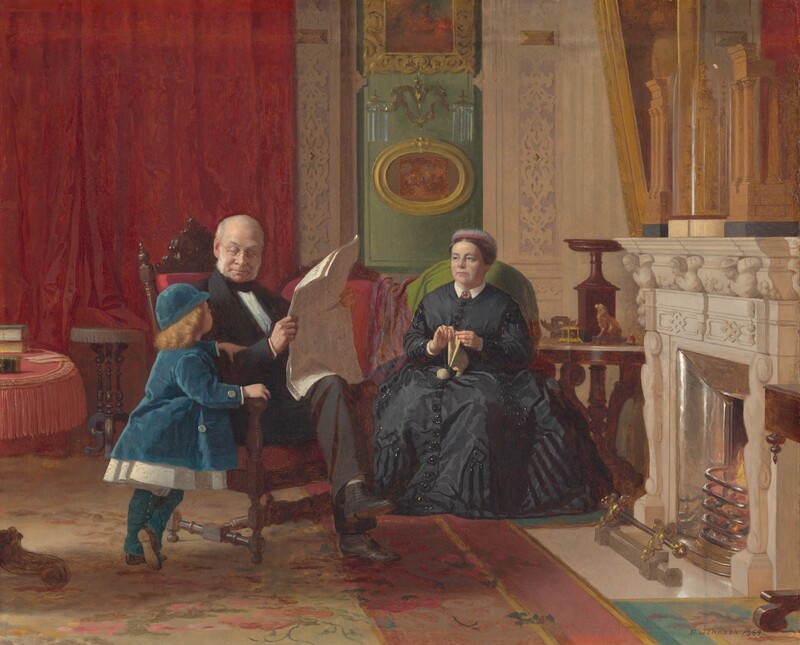
1869: knitting at the edge of a family portrait
Eastman Johnson’s The Brown Family places a woman knitting on the right side of a room occupied by an older man reading a newspaper and a child standing nearby. The NGA dates the work to 1869 and describes its support as oil on paper on canvas. Its image measures 59 by 72.4 cm. The shared interior shows how the painter represented an activity within a family scene. It is not a diary of the woman’s hours or a stitch chart. The NGA visual description identifies knitting; neither a garment name nor the needle size is supplied by the object record.
A viewer can locate the hands without turning every textured area of clothing or furnishing into knitted fabric. The act of knitting and the structure of a particular garment are separate observations. One surviving picture cannot stand for every nineteenth-century American household. It has a specific maker, composition and later provenance, each of which matters when it is used as historical evidence.
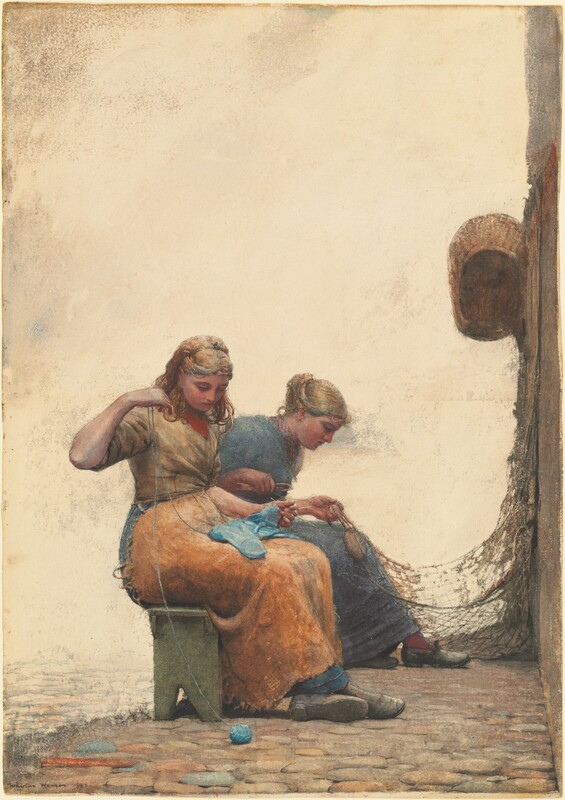
1882: a needle beside a fishing net
In Winslow Homer’s Mending the Nets, two young people sit side by side. The nearer figure holds knitting needles and blue yarn, whose ball rests on the cobbled ground. The other works on a fishing net. Their tasks share a picture but not a textile construction: mending a net is not the same action as forming knitted loops. The NGA identifies the medium as watercolor over graphite, notes a signed date of 1882, and preserves earlier exhibition titles. Those titles connect the scene with an English coast. The artist’s American nationality must not turn this British setting into an American fishing-village record.
The modern title can tempt readers to assume both figures mend nets. The museum description instead directs attention to their different implements and materials. It does not report their actual work hours, where the yarn was spun, or a pattern that could be knitted today. A painted action is evidence of representation, not a complete production log. Asking what the two hands do is more useful than silently replacing the knitter’s activity with the work named in the title.
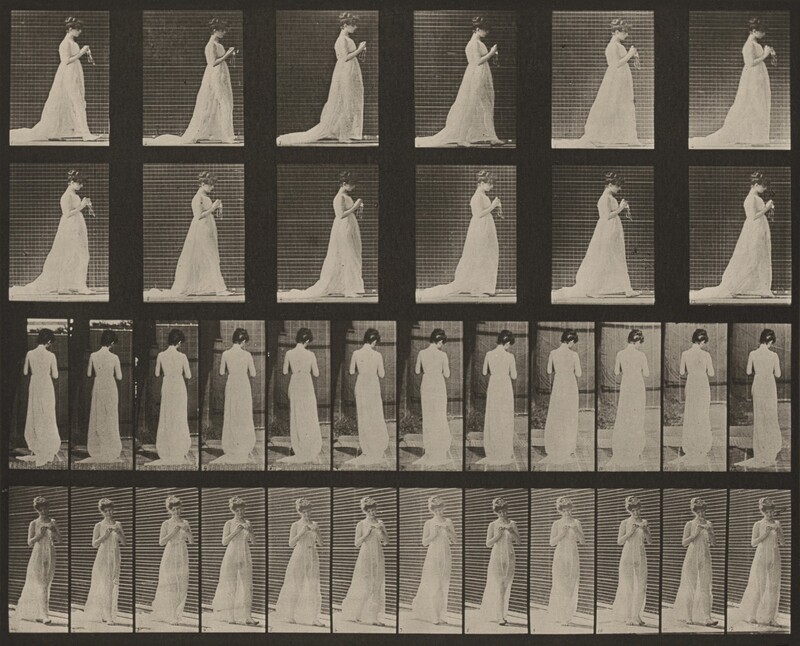
1887: knitting named as movement
Eadweard Muybridge’s plate 39 bears the precise title Walking; hands engaged in knitting. Dated 1887, it belongs to Animal Locomotion and is catalogued as a collotype. Several phases of a moving body occupy a single sheet. The subject is no longer simply a seated figure in an interior: knitting is included in a sequence of bodily movement. According to the NGA record, the Corcoran Gallery purchased the plate from the artist in 1887. Its present NGA accession number reflects a much later transfer, not the moment of exposure.
The sequence is a visual study, not an executable knitting tutorial. At this scale, the needle tips and yarn loops are too small to identify a stitch method. The title tells us the activity under investigation; it does not license invented instructions. A photograph can depict movement and still leave the detailed structure of the work invisible. Reading motion and reading a pattern demand different kinds of evidence.
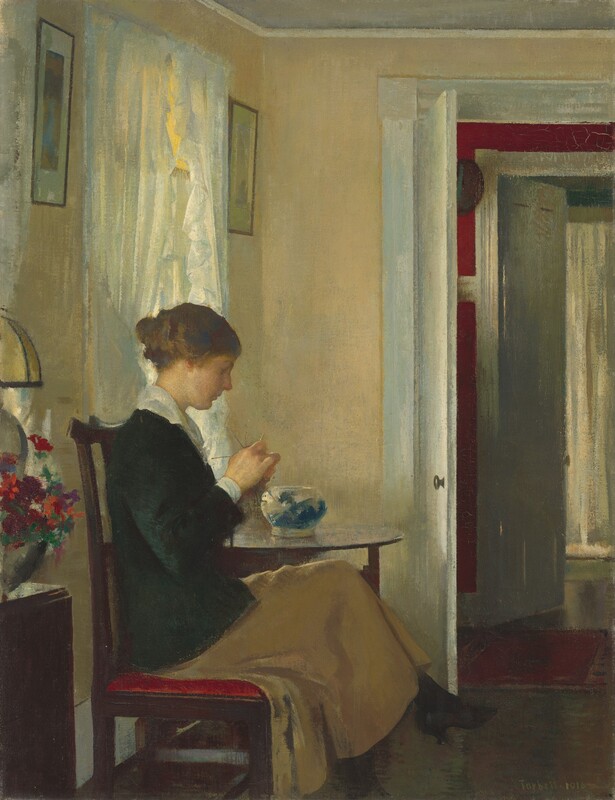
1916: attention concentrated at a window
Edmund Charles Tarbell’s Josephine Knitting shows a seated figure looking down toward thin needles and her work. A window and domestic objects establish the room while her gaze concentrates attention on her hands. The NGA catalogue dates the oil painting to 1916 and gives an image size of 66.68 by 51.44 cm. It distinguishes making from the 1916–17 exhibition and sale to George M. Oyster Jr., a later bequest to the Corcoran, and entry into the NGA collection. Those are distinct events, and a collection date should not be substituted for the date painted.
The title names Josephine, but the object description does not identify a finished garment or usable stitch count. Two needles in a painted scene are not a gauge swatch. Brushwork and color show how the artist constructed an image; they do not reveal every yarn loop. We can observe posture, hand placement and the role of window light without inventing material specifications. The image encourages technical questions but cannot answer them alone.
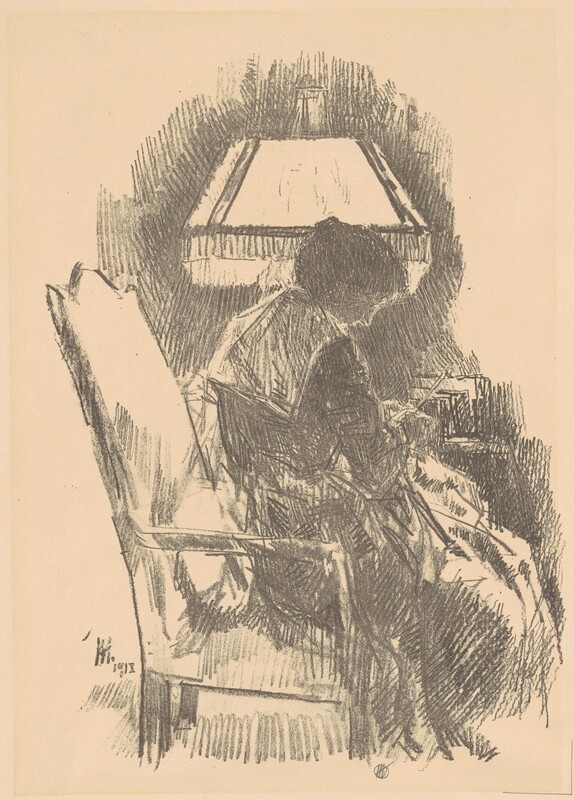
1918: knitting in a black lithograph
Mrs. Hassam Knitting (large) is a 1918 black lithograph on wove paper. The NGA record associates Childe Hassam and George C. Miller with the work, gives the printed image as 31.75 by 21.27 cm, and transcribes marks on the stone and sheet, including a title written along an edge. It traces the print through the artist and Mrs. Hassam to its 1940 Corcoran gift and later NGA accession. Neither the gift date nor the accession date is the date of making.
Black lines compress figure and gesture differently from Tarbell’s oil color or Muybridge’s photographic sequence. They do not prove that the real yarn was black. Nor does the title tell us the sitter’s occupation or how many hours she spent knitting. The medium makes an action legible while limiting what we can infer about material. The printed impression is itself a collected artwork, not a direct technical record of an extant garment.
How to read the next knitting picture
First establish whether the museum record actually identifies knitting. Then look separately for needles, yarn, the workpiece and the position of the hands. Separate the artist’s origin from the depicted place, and the date of making from later collecting. These five primary records show different ways artists pictured knitting across several media. They cannot establish the origin of a regional tradition, the average workday, or the stitch count of a lost garment. A visual record is valuable when its limits are respected.
Original records and image rights
- NGA, Eastman Johnson, The Brown Family (1869), accession 1978.72.1 — date, medium, provenance and description. The object page marks its media Public Domain.
- NGA, Winslow Homer, Mending the Nets (1882), accession 1984.58.3 — date, medium, provenance and description. The object page marks its media Public Domain.
- NGA, Eadweard Muybridge, Plate Number 39. Walking; hands engaged in knitting (1887), accession 2014.79.91 — date, medium, provenance and description. The object page marks its media Public Domain.
- NGA, Edmund Charles Tarbell, Josephine Knitting (1916), accession 2014.136.18 — date, medium, provenance and description. The object page marks its media Public Domain.
- NGA, Childe Hassam / George C. Miller, Mrs. Hassam Knitting (large) (1918), accession 2015.19.470 — date, medium, provenance and description. The object page marks its media Public Domain.
The NGA Open Access guidance was checked alongside each object. Five actual collection images from five separate works appear here; no AI image is used. Every caption links its original record, image file and reuse information. Homer’s British scene is not presented as American coastal labor, and none of these pictures is offered as a knitting pattern.