Aime Metsar’s Knitted Hat and Gloves: Estonian Pattern Across Migration
A knitted hat can prompt a broad question: “Which country’s tradition is this?” Aime Metsar’s hat and gloves at Museums Victoria invite a more precise one. Who made them, when, and why did a regional pattern travel into another life? The museum catalogues the wool set as hand-knitted by an Estonian-born maker in Melbourne in 1991. Its pattern refers to a belt design from the Järva-Jaani district. The museum objects are therefore not the original hats worn in post-war refugee camps. They are later work through which a maker revisited a remembered visual language. [1]
One set, three hand-knitted pieces
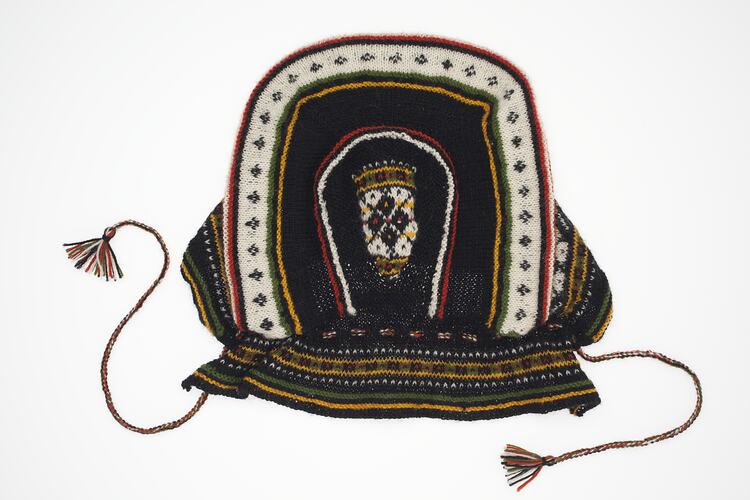
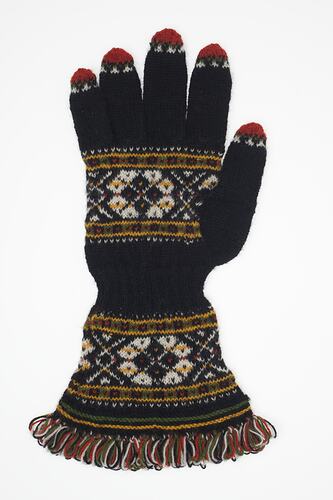
The parent accession SH 911634 covers a hat and a pair of gloves. Black, white, yellow, red and green wool form the pattern. The hat has an upright rim; the gloves have red patterned fingertips and long patterned, fringed cuffs. The catalogue gives 22 cm in length and 26.5 cm in height for the hat, and 32 by 12 cm for the gloves. These are recorded object dimensions, not the stitch count, gauge or instructions for a reproducible pattern. The distinction matters whenever a historical object is offered as inspiration for a modern project. [1]
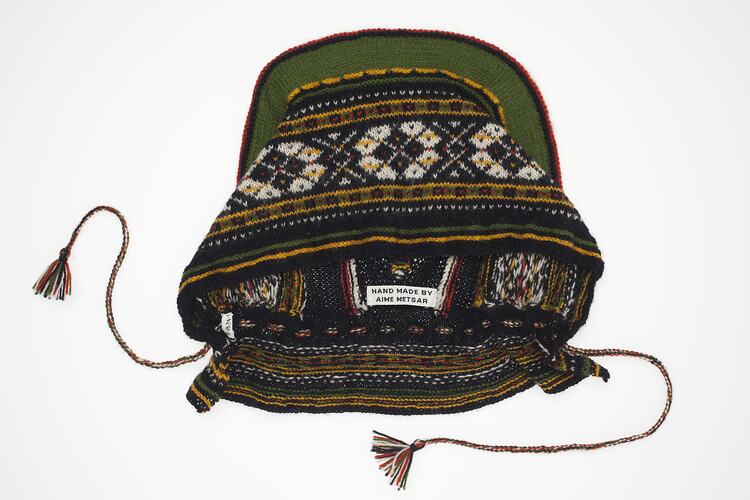
A second view of the hat helps us inspect the raised edge and repeated colors. It is another photograph of the same hat, not a second specimen. Although the two angles clarify its silhouette, they do not reveal every stitch, the needle size or the way the cast-on was made. The museum identifies the materials and hand-knitting but does not supply a complete working chart. [1]
A belt pattern changes shape
The catalogue locates the design in Järva-Jaani rather than describing it as a single timeless pattern shared throughout Estonia. Its specific claim is that an authentic regional belt pattern was used for this 1991 set. A belt and a glove have different widths, directions and requirements for stretch. Without Metsar’s chart or a close technical examination, we cannot reconstruct exactly how the belt motif was converted into glove stitches. We can compare what the records and pictures actually show: colored motifs on the hat and a related arrangement on the gloves. [1][2][3]
The gloves also have structures beyond their colorwork. Red patterned fingertips and extended cuffs change how each part frames the hand. The museum records them separately as SH 911634.2 and .3. Their nearly identical catalogue descriptions do not make them examples from different decades; they remain a matched pair. Reading both child records helps keep the parent accession and its individual pieces straight. [2][3]

The camp hat and the museum hat are not the same object
Museums Victoria describes hats and gloves as popular in Estonia during the 1940s and says Estonians continued to make and wear them in German refugee camps after the Second World War and brought them to Australia. That history offers context, but it does not date the surviving 1991 set to the camps. Metsar’s recollection, recorded in the January–February 2015 issue of PieceWork, adds a personal account: she recalled making her first such hat at age thirteen in a displaced-persons camp in Germany from scraps of wool and cotton, and wearing it on the 1950 journey toward Australia. This is testimony about an earlier hat, distinct from the museum’s later hand-knitted set. [1][5]
Another museum object marks a different chapter. In 1953, after migration, Metsar made a costume associated with Mustjala on Saaremaa for an Estonian folk-dancing group. The museum says she aimed to make it as authentic as circumstances allowed. The costume’s skirt and vest are valuable evidence of her cultural work, but their sewing and decorative construction should not be mislabeled as the knitting of the 1991 hat. A single maker’s archive can include different textile techniques. [6]
A birch-pattern shawl as a comparison
Metsar also made a triangular shawl with a birch pattern in Melbourne around 1989–1990, recorded as SH 901469. A sewn label states “HAND MADE BY AIME METSAR.” The museum describes a fine, one-ply shawl and the birch association with Estonian life, but its object record does not specify the precise textile technique. We therefore use the shawl here as a comparison in subject and maker, not as independent proof of a particular knitting method. The Järva-Jaani belt motif on the 1991 hat and gloves and the birch motif on the earlier shawl are separate choices in separate works. [4]

Questions for a modern pattern reader
Before turning this history into a project, separate four dates and kinds of evidence. The camp hat of about 1950 comes to us through a maker’s later recollection. The 1953 costume is a different museum object. The 1989–1990 shawl is a related textile whose technique is not specified in its record. The 1991 hat and gloves are surviving hand-knitted objects. Their materials, colors, raised rim, fingertips, long cuffs and regional pattern attribution are documented; their stitch counts, row counts, gauge and exact chart are not. A reconstruction should label those missing details as contemporary design decisions. That care preserves the specificity of a person’s migration history while still letting a knitter learn from the objects. [1]–[6]
Primary records
- [1] Museums Victoria, hat and gloves SH 911634.
- [2] Museums Victoria, glove SH 911634.2.
- [3] Museums Victoria, glove SH 911634.3.
- [4] Museums Victoria, birch-pattern shawl SH 901469.
- [5] PieceWork, January–February 2015, Estonian hat recollection.
- [6] Museums Victoria, 1953 national costume SH 911635.
All five photographs here are original Museums Victoria images marked CC BY 4.0 in the linked object records. Real images: 5; AI illustrations: 0. Photographs of the earlier camp hat and of the costume are not reproduced.