Australia’s knitted image: Jenny Kee, Flamingo Park and the hands behind the designs
DDUJA KNIT · World Knitting Journal · Australia
Research and writing: DDUJA KNIT · 한국어판 보기 ↗
A garment can bring together several kinds of work: the person who imagines its colours and motifs, the person who knits it, and the person whose wearing helps it travel. Jenny Kee’s animal knitwear is immediately recognisable, but collection records reveal a fuller story. They distinguish the date of a design from the date of a knitted object, and preserve the names of makers whose work can disappear behind a famous label.
Flamingo Park: a shop, a collaboration and a new knitwear line
The National Gallery of Australia records that Kee opened Flamingo Park in Sydney’s Strand Arcade on 27 August 1973. The shop brought together vintage fashion and designs by Linda Jackson, beginning a creative partnership that shaped Australian fashion. The Powerhouse Collection describes the next step: before the first winter season in 1974, Kee introduced cardigans featuring Australian fauna. Its account says a television callout for knitters led Kee to Jan Ayres, a hand-knitter and pattern maker who made many early designs. The shop’s 1973 opening and the knitwear launch in 1974 are separate milestones, not competing dates.[1][2][3]
The Powerhouse record for the “Koala, Kooka, Kanga” cardigan dates it to 1974–76 and credits Kee as designer and Ayres as hand-knitter. It describes a koala and kangaroo on the front and a kookaburra on the back. Calling it only a “Jenny Kee design” would leave out the skilled knitting that made the garment real; crediting the knitter alone would also erase the design and shop context. The object record shows distinct contributions coming together in one garment.[4]
This is a modern fashion history, not evidence of one ancient or uniform Australian knitting tradition. A koala or kookaburra motif may evoke place, but no single image can stand for the full history of Australia or its First Nations peoples. It is more useful to ask which images were chosen, by whom, and how they moved from an idea into a wearable surface.
Design date, knitting date and the surviving object
The Powerhouse record for a “Koala” jumper lists a 1980 design and a surviving garment made in 2007. Kee is credited as designer and Ann Jones as the knitter of that 2007 version, made from the original pattern. The front shows a koala in a tree; the back continues the composition with a tree, leaves and a map of Australia. The dates describe different things: the design is from 1980, while the object held by the museum was knitted in 2007.[5]
The same collection record notes that a version of the Koala jumper became widely known after Diana, Princess of Wales, wore one in 1982. That episode helps explain how the design circulated beyond the shop. It does not mean the particular garment made by Jones in 2007 is the one worn in 1982. A design can have multiple knitted realisations; the surviving object and the publicly photographed version should not be conflated.
Other objects widen the picture beyond the animal jumper. The Powerhouse lists Kee as designer and Ayres as knitter of the “Lightnin’” knit dress: it dates the design to 1977 and the surviving knitted object to 1979. The record also names journalist Cherry Ripe as the person who selected its colour scheme and describes her wearing it in London from 1980 to 1982. The “Wattle” dress, also designed in 1977, is recorded as mohair knitwear. Each object has its own chain of design, making, commissioning, wearing and collecting.[6][7]
This distinction matters in any craft history. A designer may determine the silhouette, motif and colour arrangement; a knitter interprets instructions, manages yarn and tension, shapes the fabric, and turns a plan into a wearable object. A museum object adds another layer: its materials, dimensions, condition, later history and cataloguing. Where a record does not identify a specific technique, we should not fill the gap with guesswork. Collection descriptions are useful evidence, but they are not complete patterns.
Four questions for reading a knitted garment
- Who designed it? Is the person who chose the silhouette, imagery or colour named?
- Who knitted it? Does the record credit a maker separately from the designer?
- What does the date refer to? Design, knitting, wearing, acquisition or cataloguing?
- What is not documented? If the full pattern, yarn quantity or gauge is absent, do not present a reconstruction as fact.
Look beyond the front motif. The back, sleeves, opening, collar, cuffs and hem all shape how the image works across a garment. Map the motif first, then note the construction details actually described in the record. Only then consider how a chart or colour sequence might have worked, and label that as interpretation. The cited online records do not provide enough information to reproduce every original instruction, yarn quantity or gauge.
Contextual photographs, with their limits made clear
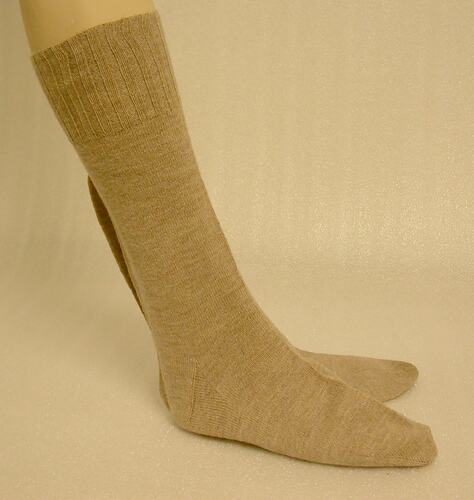
The five images below are contextual sources, not photographs of Flamingo Park garments or their making. The Kee portrait is from 2013; the Australian War Memorial images document separate wartime knitting activity; and the Museums Victoria socks are an unrelated Victorian making story. Images of the actual Kee knitwear are omitted because reuse permission could not be verified. Each caption identifies what the image does—and does not—show, and links to its source and reuse terms.


When you open the next pattern
When you encounter a jumper covered in animals, turn it around. Record the designer, knitter, wearer and dates separately. Read the garment’s construction as well as its image, and distinguish what the catalogue states from your own interpretation. Behind a celebrated motif are design decisions, repeated stitches, skilled hands and a route through which the garment reached an audience. That is where Australian modern knitwear becomes more than a familiar souvenir image.
Primary and collection sources
- National Gallery of Australia, “Linda Jackson and Jenny Kee” — collaboration and Flamingo Park chronology.
- National Gallery of Australia, “Know My Name: Jenny Kee” — biographical and shop context.
- National Gallery of Australia, Jenny Kee story — contextual biography.
- Powerhouse Collection, “Koala, Kooka, Kanga” cardigan — dates, early mohair knitwear and making credit.
- Powerhouse Collection, “Koala” jumper — design and object dates, designer and knitter credits.
- Powerhouse Collection, “Lightnin’” knit dress — design, knitting, commissioning and wearing record.
- Powerhouse Collection, “Wattle” dress — garment description and collection record.
Editorial note: Roles and dates follow the collection records cited above. Unverified pattern details, gauge and techniques have not been inferred.