Read Serbia’s Timok double-stranded socks through its national heritage register, museum records and five licensed exhibition photographs, separating documented technique from what a photograph cannot prove.
Five North Macedonian sock photographs are read alongside five separate British Museum records to distinguish knitting, embroidery, woven soles, and the limits of each source.
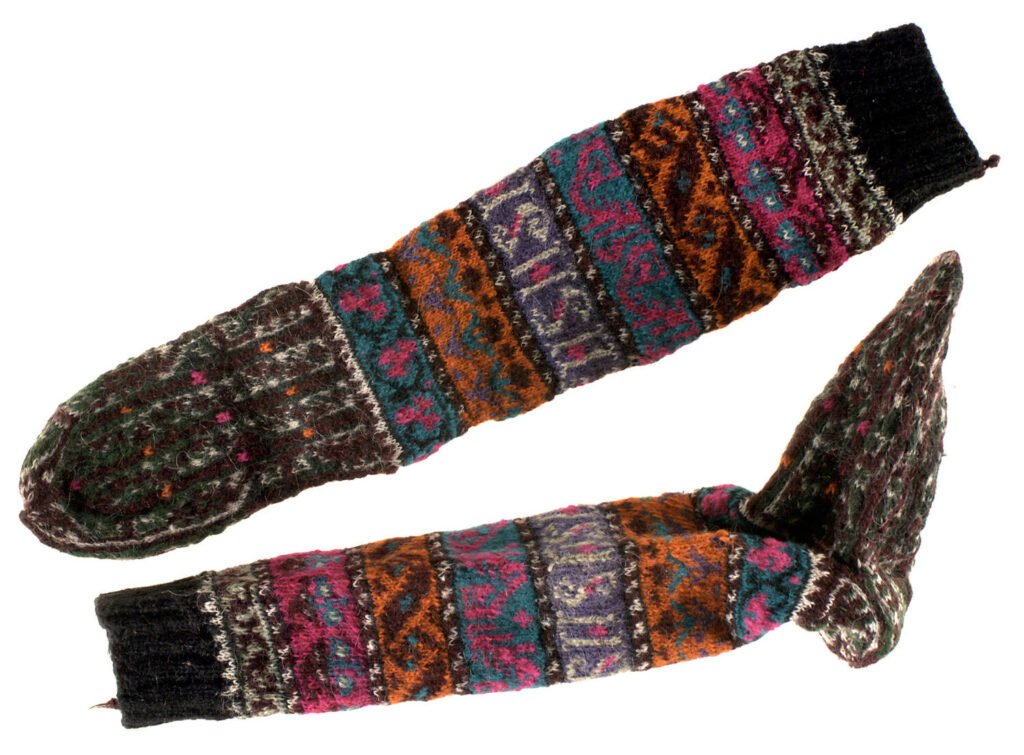
A museum record identifies George Rayner’s striped hand-knitted Antarctic socks, but the surviving boots and field portrait answer different questions. Seven primary records and five licensed images show what is documented—and what remains unknown.
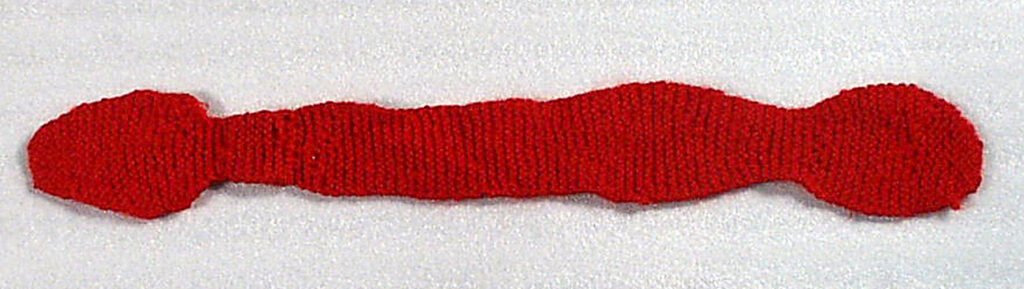
A grandmother’s red knitted scarf reached Marie Pregal after her family’s 1965 move from Argentina to Australia. Five museum objects reveal what travelled and what followed.
Five views and a conservation report reveal how a seventeenth-century Italian silk jacket was pieced, patterned and seamed—and where its making remains uncertain.
Five Australian museum records show how knitting appears in miniature domestic life, football fandom, family craft and occupational therapy—without assuming the same maker, technique or purpose.
Five museum records show why a needle’s length may describe a pin, a case, a trade display or a cotton bundle. Compare the objects, photographs and limits of what they prove.
Five U.S. patents by Isaac W. Lamb, dated 1863–1904, reveal different approaches to tubular knitting, mitten blanks and holding loops on inactive needles.
Five Craft Museum of Finland glove and mitten records reveal distinct cuffs, thumb gussets, yarn and decreases, with clear limits on dates, techniques and visual comparisons.
A pair of red socks sits inside a card box. The record for object 2018.17.1 at Auckland War Memorial Museum Tāmaki Paenga Hira calls it ‘socks, pair’, machine knitted, red with ‘TEAM NEW ZEALAND’ in black and a black fern logo, and notes that the original cardboard packaging survives with it. The packaging carries the […]