Edda Azzola’s Home Knitting Machine: From Friuli to Melbourne
A knitted garment can conceal a complicated chain of work. Museums Victoria’s records for Edda Azzola preserve more than finished clothing: there is a hand-operated knitting machine, an Italian-language design notebook, a trial piece, a cardigan and a bathing costume. Read together, these five objects show how a migrant woman’s skill moved between family use and paid work in Melbourne. They also require care with terms: machine knitting performed by hand is neither a hand-knitted garment made with two needles nor an automatic industrial process.[1–7]
A skill carried from Friuli to Melbourne
Museums Victoria’s biographical article says that Azzola was born in 1927 in Pontebba, in Italy’s Friuli region. Several object records instead give Moggio Udinese as her birthplace and say that her family moved to Pontebba when she was four. The records do not justify collapsing those two wordings into a single certain birthplace. They agree, however, that Edda and her sisters worked on a family knitting machine before she migrated: neighbours supplied yarn to be made into clothes, and the earnings helped their mother assemble the daughters’ trousseaux.[1,4]
Edda married Angelo Azzola in 1953. He travelled to Australia in 1954; she followed in 1955. Her first Melbourne work described by the museum included a quiltmaking factory and cleaning laboratory equipment at the University of Melbourne. She left the latter job before the birth of her son in 1958. Later that year she bought a knitting machine from another Italian migrant woman. It was a way to turn a familiar household skill into paid work rather than an instant entry into ownership of a fashion house.[1]
The machine was a workplace inside the home
Object HT 18348 is a Swiss Dubied hand-powered double-bed knitting machine, made around 1950. Another Italian migrant had brought it to Australia before selling it to Edda. The museum records her use of it in Fitzroy North and then in the family home at Reservoir. Its needle beds, moving carriage, yarn-feeding arms, weights and other accessories make the mechanism visible. A worker still had to move the carriage, manage yarn and needles and decide how a shaped piece would be produced.[3]

Two changes recorded for this particular machine are especially telling. Angelo placed wooden blocks beneath its iron frame so that Edda did not have to bend over constantly. After a moving arm nearly trapped their son’s leg, he replaced it with a carriage operated with two hands. These details show posture and child safety as part of the history of work at home. They describe the Azzola family’s alterations, not a standard feature of every Dubied machine.[3]
From notes to samples and garments
In notebook HT 18380, Edda sketched clothing and recorded design, style, size and execution notes in Italian while consulting a clothing designer. The museum’s separate history of Richard Charlupski’s Ricardo Knitwear explains the division of labour: a designer sketched models, Richard supplied wool and the proposed design, and skilled knitters such as Edda decided how to shape pieces on a machine. Finished sections returned to the factory for assembly. Ricardo described its garments as “fully fashioned”: shaped during knitting rather than cut from a sheet of knitted fabric. The notebook documents planning and decisions, but it is not evidence that every pictured garment matches one particular surviving note or that a full public pattern can be reconstructed from it.[2,5]

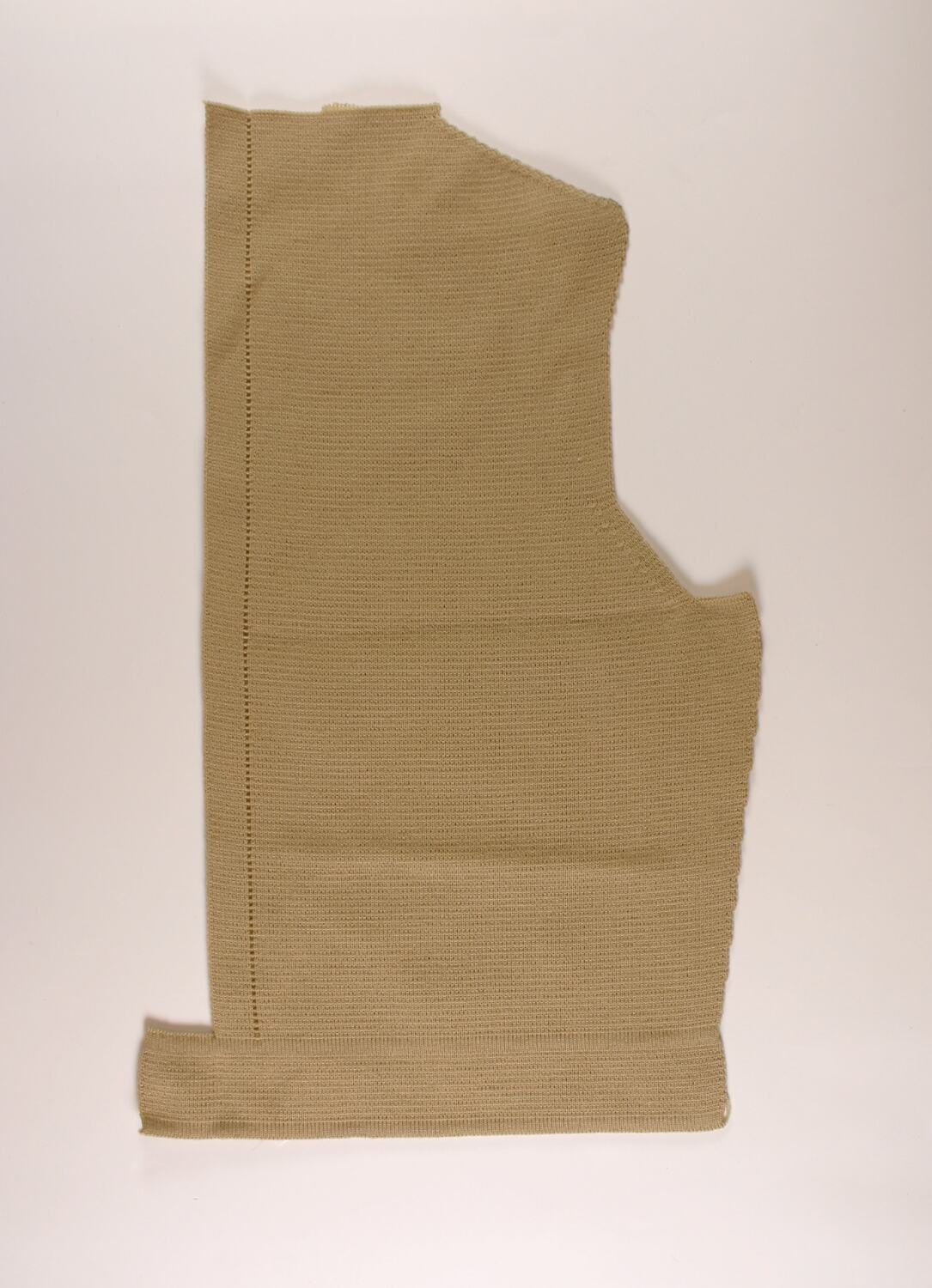
The beige left-front piece HT 18503 is catalogued as one of Edda’s trials for a cardigan. It is a sample, not an entire cardigan sold in a store. The object record identifies its position in a garment but gives no stitch count, gauge or secure match to a particular finished piece. The modest conclusion is valuable: shaping and appearance were tested before a garment was made.[6]
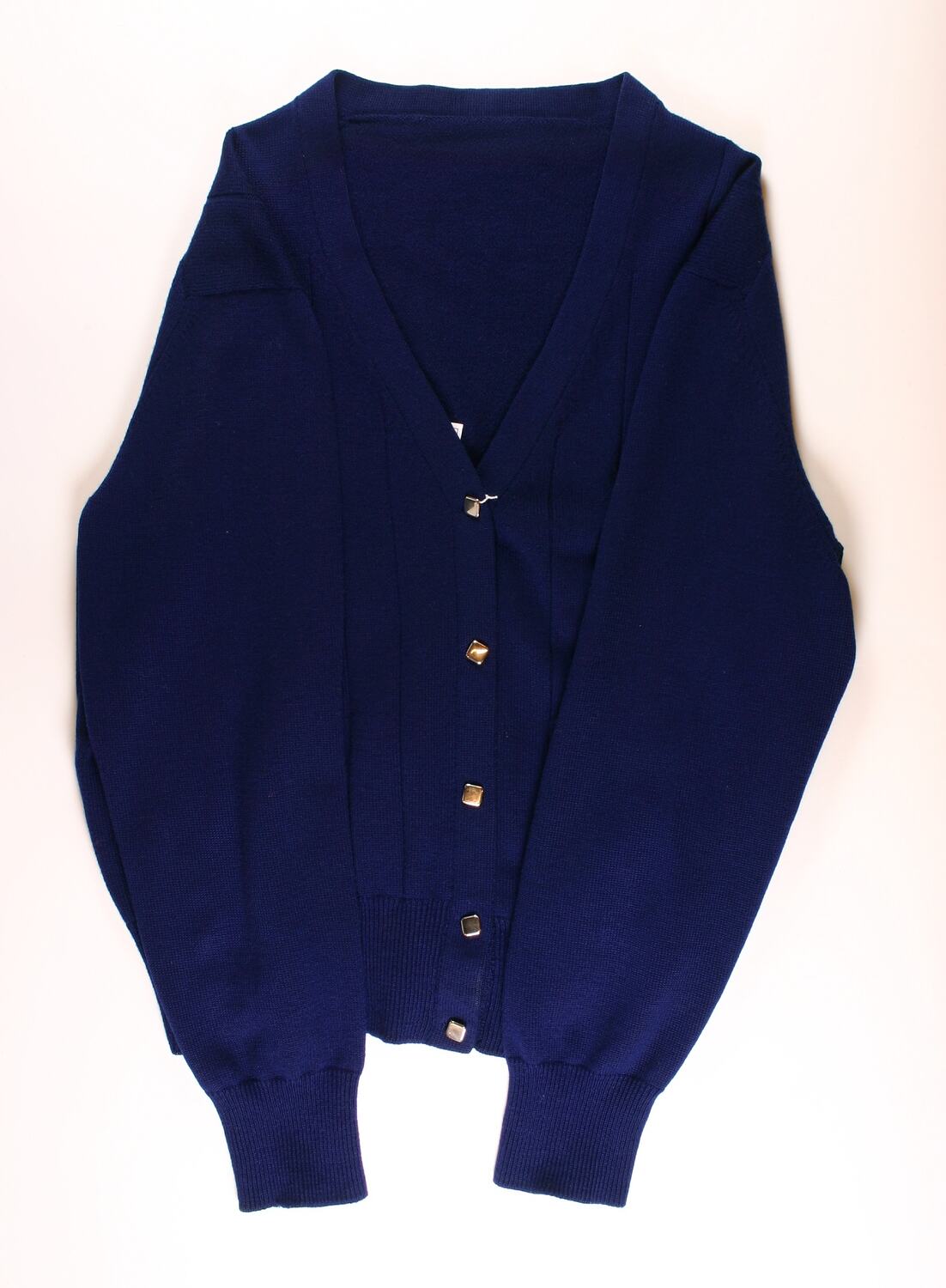
Navy cardigan HT 18424 presents a different boundary. Museums Victoria says it was made for a commercial purpose but was not sold to the factory. The surviving garment has a V-neck and silver buttons. Ricardo Knitwear as a business supplied Myer, David Jones and Georges; that general distribution history does not establish that this specific cardigan was sold by any of them. A photographed finished object is not automatically a record of its retail destination.[2,7]
Personal clothing before migration is not Ricardo stock
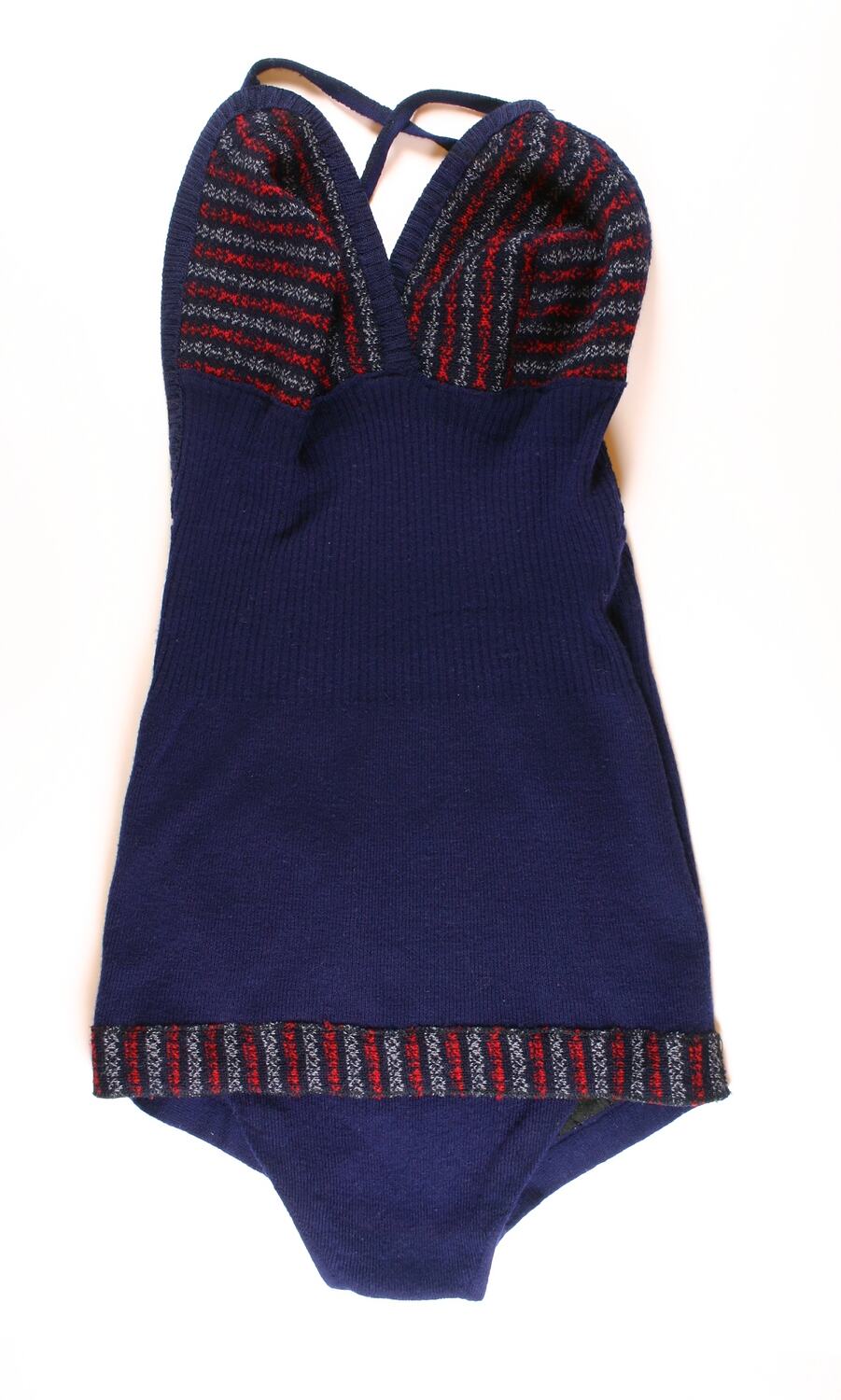
Bathing costume HT 18437 was made on the family’s knitting machine in Italy in the 1950s. It is dark blue wool with red and grey striped detail. The museum says Edda made it for herself and wore it only a few times. It documents her machine-knitting skill before migration and a later life in Australia, but it should not be relabelled as a Ricardo garment made for a Melbourne department store. Place and purpose matter as much as stitch structure.[4]
In Melbourne, Edda worked with Polish-born factory owner Richard Charlupski. He supplied wool to outworkers, whose shaped pieces and hand finishing became coats, jackets, skirts, jumpers and cardigans under the Ricardo label. The museum biography describes Edda working five or six hours a day according to demand and deadlines and earning about $70 a week by 1974. That figure is a statement about one worker in one record, not an industry-wide wage average. Working at home offered flexibility around family needs, while leaving the labour and its pay visible in the account.[1,2]
The museum sources disagree over an ending date. Edda’s biography and several object descriptions say that the factory for which she worked closed in 1974. The separate Ricardo company history dates the closure of Ricardo Knitwear to 1978 and says Edda retired three or four years earlier. This article treats 1974 as the point at which Edda’s commercial work is said to have ended and 1978 as the company-history date for the label’s closure. The sources do not make it safe to assert that both statements refer to the very same closure event.[1–3]
What five surviving things let us ask
The machine records a tool and its modifications; the notebook records design language; the beige front records testing; the navy cardigan records an unsold completed garment; the bathing costume records personal making before migration. Together they illuminate the decisions hidden behind the phrase “knitwear,” without making every object the same commission or product. After her commercial work, the museum records Edda continuing to make clothes for family and friends. Her skill did not vanish when her relationship with the factory ended.[1]
These objects invite concrete questions when we look at another vintage knit. Who supplied the yarn and design? Who decided how to shape the fabric? Which stages were made on a hand-powered machine and which were finished by hand? What does the record actually say about the garment’s maker, date, use and sale? Leaving an unanswered question open is more faithful to both the worker and the object than inventing a tidy story.
Primary collection records
- [1] Museums Victoria, Edda Azzola, Italian Migrant & Textile Worker.
- [2] Museums Victoria, Richard Charlupski’s Ricardo Knitwear Melbourne.
- [3] HT 18348, Dubied knitting machine.
- [4] HT 18437, wool bathing costume.
- [5] HT 18380, design notebook.
- [6] HT 18503, cardigan left-front trial piece.
- [7] HT 18424, navy cardigan.
All five illustrations above are actual Museums Victoria collection photographs marked CC BY 4.0. Each caption links its object, image file and reuse terms. No AI-generated illustration is used.