Sirkka Könönen: Painting the Forest in Wool—and Naming the Makers
Sirkka Könönen: Painting the Forest in Wool—and Naming the Makers

Can a sweater hold a forest? Open one of Sirkka Könönen’s knits and animals pass across the chest: a black grouse, a raven, a capercaillie or a moose. Flowers and foliage are not simply colored in; they help build the ground beneath the creature, the dusky sky around it, the whole scene. Yet the museum records reveal a second story that is just as important as the imagery. Several garments carry Könönen’s name as designer and a different person’s name as maker. Some were hand-knitted; others were machine-knitted. The four sweaters examined here are therefore not evidence of one artist working alone. They show how a textile artist translated Finnish nature into wearable color while a network of skilled makers turned detailed designs into finished garments. [1][2][3][4][5]
A designer develops a visual language
Könönen qualified as a textile artist from the University of Art and Design Helsinki in 1979. She went on to build a practice across textile design, craft entrepreneurship and art. The Craft Museum of Finland’s retrospective, The Colourer of the World, traced her development from the first knits she made herself to a body of animal- and plant-themed garments known for their saturated color. Foxes, moose, reindeer, birds and progressively more detailed botanical forms appear across her work. The museum describes this as a continuation of Finnish knitting heritage as well as a reworking of it: the motifs remained connected to place and nature, while the color combinations and scale made the garments distinctly contemporary. [1]
That distinction helps us avoid an easy but misleading story about “folk motifs.” Könönen’s sweaters are not simply old regional patterns repeated unchanged. They are authored designs, built from close observation, color memory and a sophisticated understanding of how a knitted garment is made. The museum says she understood the process from draft to finished product and its maintenance. Her designs used the repeat and structure of knitting to carry an image over a body that bends, stretches and moves. The result is not a flat picture transferred onto clothing; it is a scene made to live within the proportions and material behavior of a sweater. [1]
The artist also valued Finnish wool and wanted garments to be worn and passed on, rather than treated as disposable fashion. The retrospective connects her work to environmental responsibility and describes her interest in making sweaters into heirlooms. This context does not mean every animal motif has one fixed political or symbolic meaning. It does suggest that nature was more than a convenient decorative theme. Könönen’s museum profile recounts that she sent a fox sweater to Prince Charles with a note asking him to oppose fox hunting. The episode is reported by the museum as part of her practice; it should not be inflated into an independently verified royal correspondence. It nevertheless makes clear that she could use clothing to make a public appeal. [1]
In 1992 Könönen received the Finnish Art Industry Award, followed in 1993 by the title of Textile Artist of the Year, according to the museum’s exhibition account. Recognition brought more commissions, but it also made the work more collaborative. The name on the design could reach a broad audience because other people knew how to realize it in yarn and fabric. [1][6]
The network behind the name
Könönen made the earliest garments herself. As demand grew, she built a network of home knitters and weavers across Finland. The museum describes a practical system: Könönen sent out detailed patterns, yarn and color samples; makers returned completed garments to Helsinki. The network extended from Rovaniemi and Ostrobothnia to Tampere, Kainuu and South Karelia. After the awards of 1992 and 1993, she recruited additional makers through newspaper advertisements. Her designs could be technically demanding, and the museum notes that she treated the home workers as trusted collaborators who made “art you can wear.” The phrase captures the ambition, but the catalog records make the labor more concrete: names, places and methods can be attached to particular sweaters. [1][6]
Consider the four garments in this feature. The record for Varis names Liisa Paananen; Tähtikukka is credited to Maaretta Narumo of Rovaniemi; Metso to Riitta Nenonen; and Hirvi to Outi Jokinen in the Tampere region. Add Könönen as designer and at least five named people appear across four sweaters. That is a richer account than attributing every stitch to the best-known name. It also lets us ask what design authorship means in a production model that separates sketch, color planning, knitting and finishing without making any of those stages incidental. [2][3][4][5]
Nor should “home knitting” automatically be read as hand knitting. The museum records distinguish methods. Tähtikukka is described as hand-knitted by a professional maker; Varis, Metso and Hirvi are classified as machine-knitted. A home-based maker could be working with a machine. The distinction matters because hand and machine production demand different kinds of planning, equipment and skill. Museum cataloging preserves that information instead of flattening all knitwear into the same romantic category of handmade craft. [2][3][4][5]
The network also complicates the idea that a designer’s “signature” is visible only in a distinctive motif. Könönen coordinated colors and supplied samples, while makers realized difficult patterns with their own technical judgment. A tension that stays even, a shape that hangs properly, a sleeve that fits the wearer: these are not automatic outcomes of a drawing. They belong to the craft knowledge of the person making the garment. The retrospective’s account of detailed instructions and close contact with the workers suggests an exchange between design direction and making, rather than a one-way handoff to anonymous labor. [1]
Reading four museum sweaters
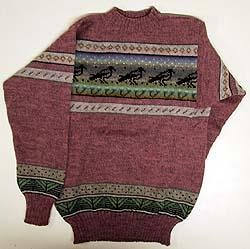
Varis (Raven), E1492/006, is a wool sweater dated to the 1990s. The museum record names Paananen as maker and Könönen as designer, and identifies the technique as machine knitting. Against a pink ground, a dark bird and plant forms occupy the body. The image is not a bird emblem pasted onto a blank garment: the color ground, repeated pattern and central scene work together. The left-shoulder buttons are also part of the garment’s structure, making it easier to put on and take off. The record supplies useful facts about material and production; reading the visual composition alongside those facts is an interpretation, not a claim made verbatim by the catalog. [2]
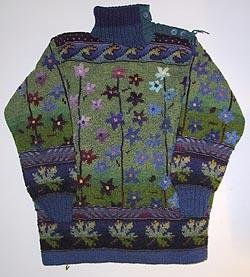
Tähtikukka (Starflower), E1590/049, is a wool sweater catalogued as made between 1995 and 2003. Narumo knitted it by hand in Rovaniemi. The record notes a green ground, flowers across the body, a leaf-like border, blue sleeve cuffs and a collar that folds diagonally. Its listed length is 75 centimetres and its chest measurement is 114 centimetres. The floral design does not resolve into one large flower. Instead, the body, cuffs and collar create separate rhythms of color. These details are useful for studying the garment, but they do not give us a complete knitting pattern. A photograph cannot tell us exact stitch counts or gauge, and a museum object record is not a free pattern for reproducing the sweater. [3]
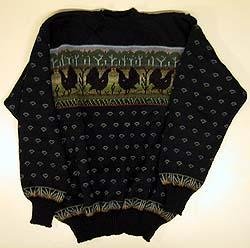
Metso (Capercaillie), E1492/008, is dated 2002 and credited to Nenonen. The museum classifies it as professionally machine-knitted wool. A pair of birds faces inward across a band of multicolored plants on a deep blue ground. Six red buttons close the left shoulder; the neckline uses a two-knit, two-purl rib. The museum lists the sweater at 75 centimetres long and 126 centimetres around. Those measurements remind us that this is wearable clothing, not merely a decorative panel. In comparison with the black grouse scene on Teeri, another Könönen design in the collection, Metso spreads its birds across a wider band. [4][7]
Hirvi (Moose), E2130/001, was made in 2007 by Jokinen in the Tampere region. Dark moose and trees stand against layers of green, blue and violet; a crescent moon appears above one animal. The catalog identifies it as machine-knitted wool and notes that it was an unsold garment rather than a worn example. It measures 72 centimetres in length and 60 centimetres across the body. Beside Metso, it shows another way of placing an animal at chest height: one sweater builds a horizontal, almost symmetrical bird band; the other suggests a layered night landscape. [5]
The four garments are a small sample, not a complete survey of Könönen’s work. The collection also includes Teeri (Black Grouse), E1492/001, dated to the 1990s and recorded as a machine-knitted wool sweater designed by Könönen. Its bird and plant motif sits in a horizontal chest band above smaller repeats across the body and sleeves. The black grouse painting shown in image 1 offers a reference for the species, but it is not an image source for the sweater’s design. The distinction matters: the museum records the garment; the Finnish National Gallery records the painting. Their proximity here supports comparison without confusing one object for another. [7]
The four sweater photographs below are collection images released by the Craft Museum of Finland through Finna under CC BY 4.0. Each caption identifies the object and the designer/maker distinction recorded by the museum, with a link to the catalog and image file. The reproduction license for a photograph does not grant permission to copy the sweater design or distribute a pattern. The catalog images are also small; enlarging them beyond their resolution would not reveal construction details that the file does not contain. [2][3][4][5]
Timeline
- 1947. Sirkka Könönen is born. [1]
- 1979. She qualifies as a textile artist from the University of Art and Design Helsinki. [1]
- 1992–93. Könönen receives the Finnish Art Industry Award and is named Textile Artist of the Year; the museum connects the recognition to rising demand for her designs. [1][6]
- 1990s. Museum records preserve garments including Varis and Teeri; where the catalog gives a decade rather than a year, the broader date is retained. [2][7]
- 1995–2003. Narumo hand-knits Tähtikukka in Rovaniemi, within the date range recorded by the museum. [3]
- 2002. Nenonen makes Metso. [4]
- 2007. Jokinen makes Hirvi. [5]
- 2018. Könönen dies. 2019–20. The Craft Museum presents a retrospective of her work. [1]

Look beyond the animal
When you meet a Könönen sweater, do not stop at the animal’s name. Find the object number. Ask who designed the garment and who made it, whether the catalog calls it hand- or machine-knitted, and how the scene sits against the ground of the body. A single sweater can be at once an artist’s view of the forest and a record of skilled work carried out across several Finnish regions.
That is why the maker’s name belongs beside the designer’s. The story of a knit is not finished when a motif has been drawn. It continues through yarn selection, repeat, tension, shaping, finishing and the judgment of the person who turns a plan into a garment that can be worn. Könönen’s work makes this process visible: color carries the landscape, while the catalog records the people who helped it take shape.
Sources and image credits
Numbered citations refer to the museum, collection and artwork records below. Each image caption identifies the photographer or institution where the record provides that information and links to the object/file record and license.
- The Colourer of the World – Textile Artist Sirkka Könönen, 2019–20 · Craft Museum of Finland
- Varis, E1492/006 · Craft Museum of Finland collection record, Finna
- Tähtikukka, E1590/049 · Craft Museum of Finland collection record, Finna
- Metso, E1492/008 · Craft Museum of Finland collection record, Finna
- Hirvi, E2130/001 · Craft Museum of Finland collection record, Finna
- Craft Museum of Finland, Annual Report 2020
- Teeri, E1492/001 · Craft Museum of Finland collection record, Finna
- Ferdinand von Wright, Black Grouse, Cock and Hen, 1885, A-2002-624 · Finnish National Gallery image record and CC0 1.0 file