A Child’s Knitted Wardrobe in Postwar Australia: Reading the William Boyd Collection
What survives when a family keeps a child’s clothes for decades? The childhood collection of William “Bill” Boyd, raised in Maryborough, Victoria, contains a bonnet, booties, a cardigan, a romper and layette pants alongside toys, books and everyday scraps. Its knitted garments are especially revealing because the museum records name other techniques on the same objects: embroidery, ribbon and crochet. This article reads five objects and the Museums Victoria collection account as evidence of one family’s wardrobe, not as a survey of all postwar Australian households.[1]
The family and the archive
Bill was born in 1947. His mother Lillian preserved many of his childhood possessions, and the collection ultimately passed through the Museum of Childhood at Edith Cowan University to Museums Victoria. The museum says the collection holds more than 700 items, including ephemeral material that most families would not retain.[1] That unusual survival makes the garments valuable for comparison across one wardrobe. It does not establish who knitted each garment. Lillian is documented as the person who kept the objects; the individual garment records do not name her as their maker.
The records also distinguish an estimated object date from a date of use. One bonnet carries a title date of about 1945–46, while its summary says Bill wore it as an infant in the late 1940s.[2] Since he was born in 1947, the apparent discrepancy should remain visible. Perhaps it was made in advance, perhaps the catalogue date is approximate; these records do not decide the matter. Treating “circa” as an exact birthday would erase an important limit of the evidence.
Bonnet and booties: knit is not the whole construction
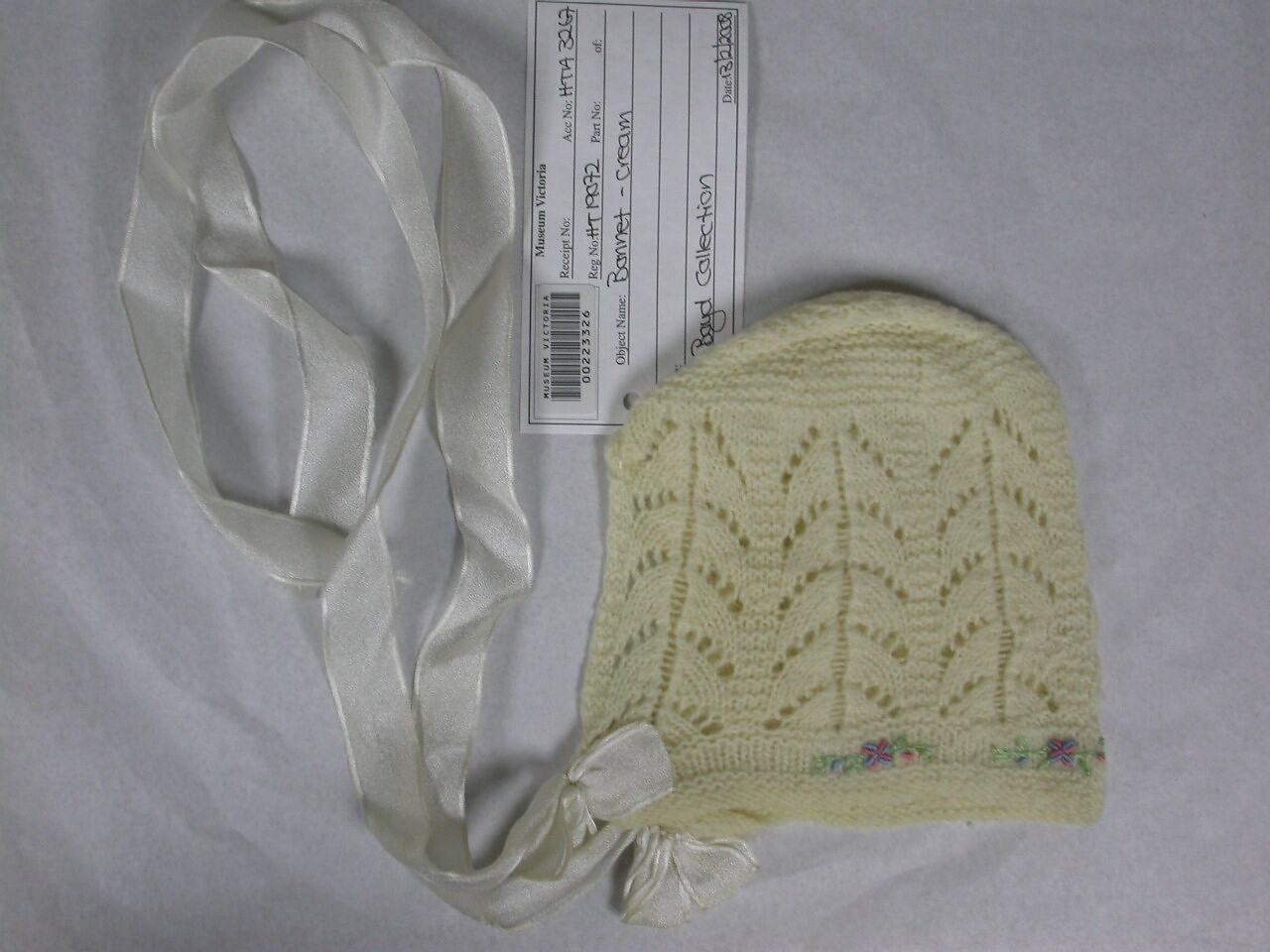
The cream bonnet, HT 19072, is described as knitted, with an embroidered edge, pink and blue embroidered flowers and a cream ribbon. Its recorded width is 150 mm and height 120 mm.[2] A viewer might mistake the flower decoration for stitches worked into the knitted fabric. The object record instead identifies embroidery. When reading a historical pattern or a museum photograph, separating the fabric that shapes an item from its applied ornament is the first useful step.
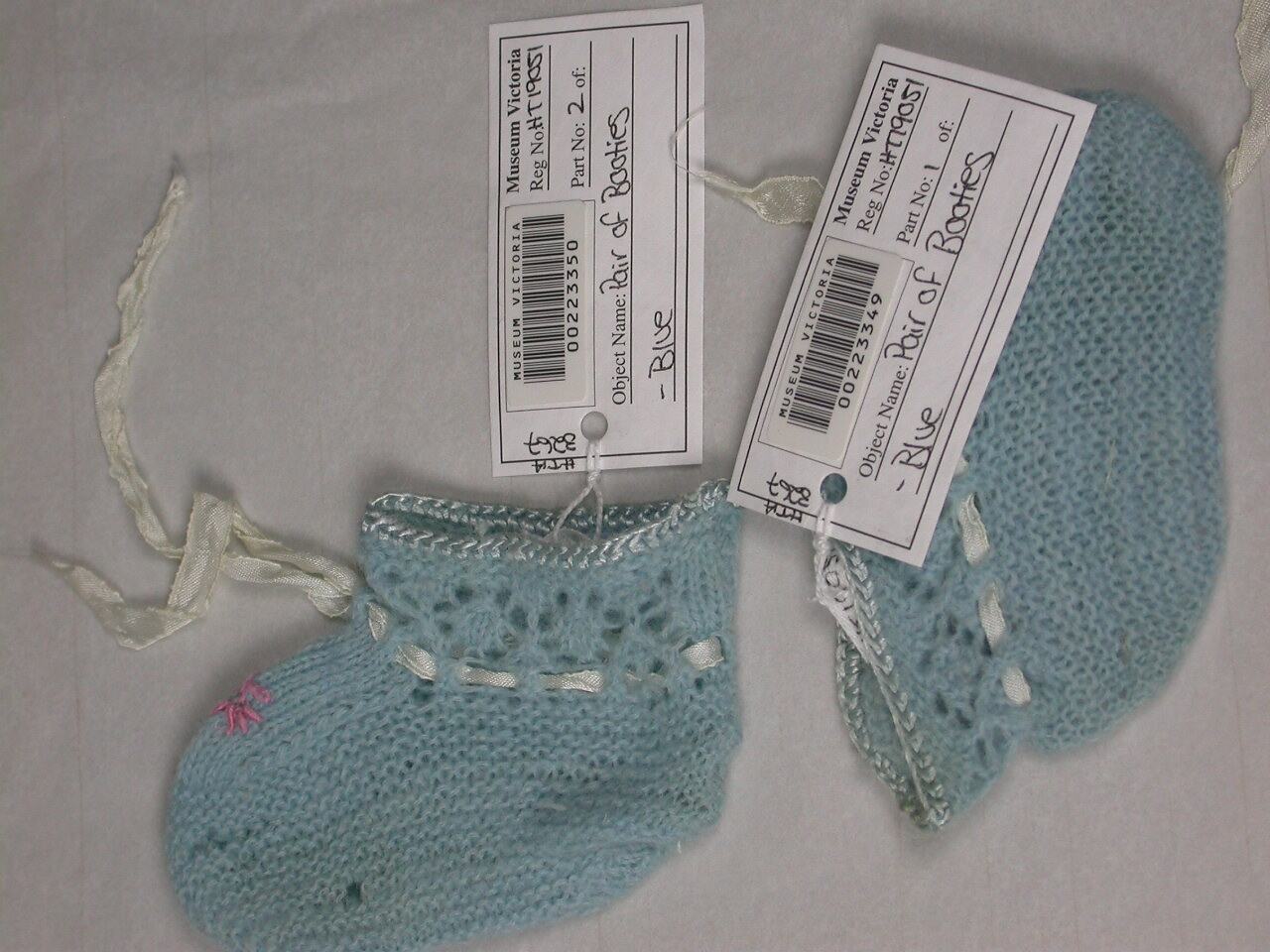
The blue booties, HT 19051, make that distinction still clearer. Museums Victoria identifies a knitted pair with a lace-like ankle, embroidered flowers on the foot, a white ribbon and a rayon crochet edge. The pair is recorded as 110 mm wide and 70 mm high. The summary says Bill wore them about 1947.[3] A heading that simply says “knitted booties” cannot tell us how the entire edge was made. Compare the knitted body with the crochet trim; do not invent a stitch count, needle size or full pattern from a catalogue photo.
Blue diamonds on cream wool
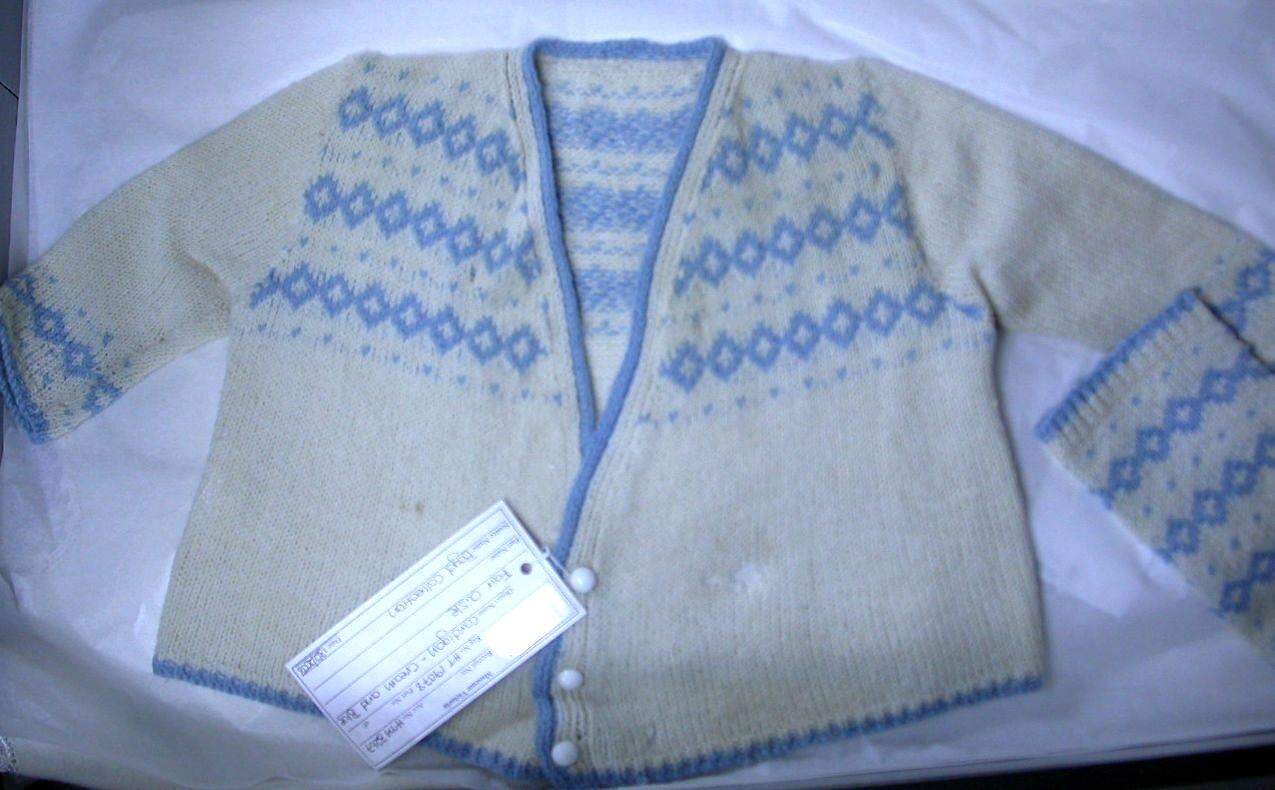
The cardigan HT 19078 has a cream wool ground and a blue design of diamonds and dots. The museum lists it as worn in the late 1940s and records a width of 620 mm and height of 340 mm.[4] “Fair Isle” appears in the catalogue title, but the title alone does not prove exactly how the yarns travelled across the reverse, how the pieces were assembled or how many colours were used in a row. Those are questions for closer structural examination. The photograph supports description of the visible motif, while the record supports identification of the material and use.
A second cream-and-blue jumper, HT 19079.1, is also catalogued in the collection.[7] Its similar diamonds and dots invite comparison with the cardigan. Similar colours are not proof of a common maker or a single pattern lineage. The comparison is a question to investigate, rather than a conclusion to print as fact.
What the romper and layette records actually specify
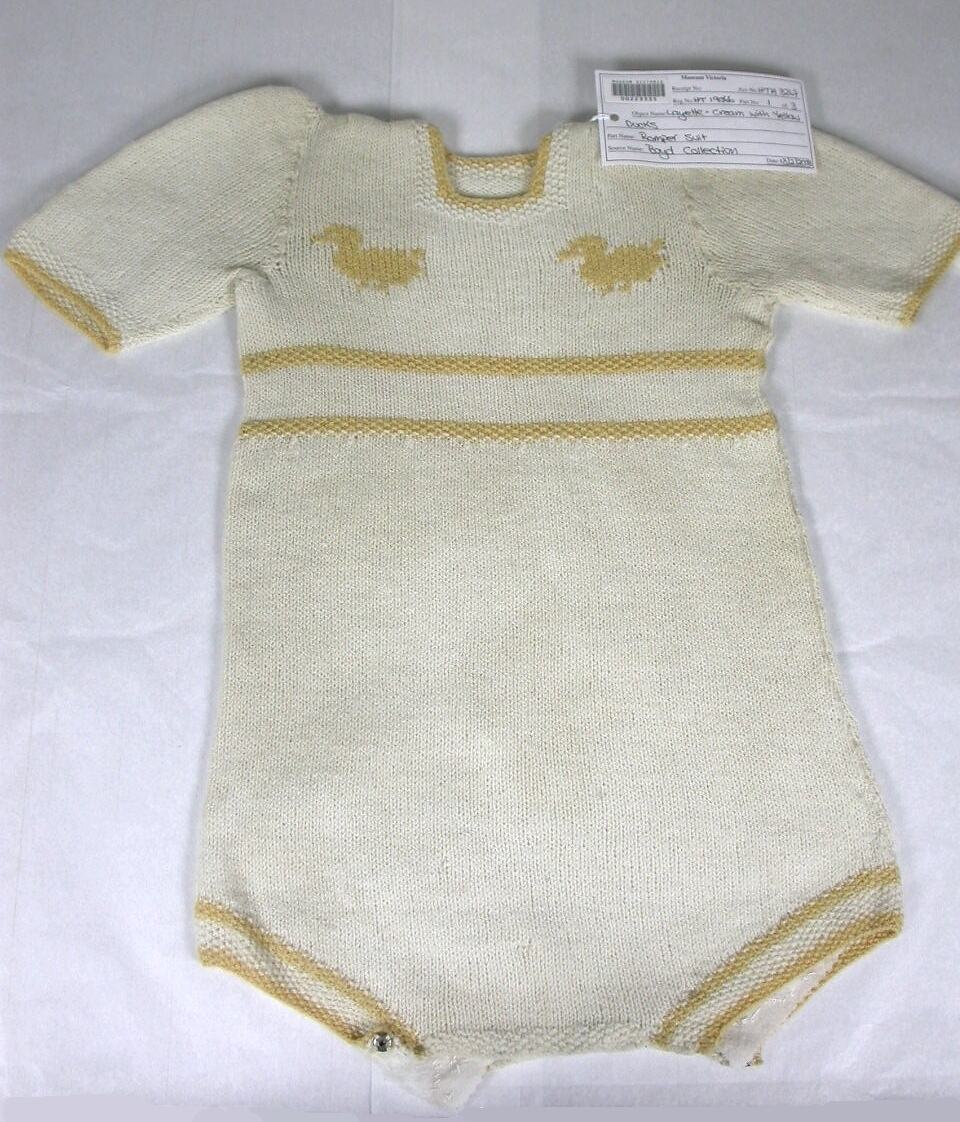
The cream-and-yellow romper HT 19066.1 is recorded as an item Bill used in the 1950s. Its physical description places it in a hand-knitted set with a cardigan and beret. The museum names cream wool rib stitch, yellow moss-stitch edgings and yellow duck motifs. The romper is listed at 520 mm wide and 490 mm high.[5] Those details help a knitter locate stretch, texture and decoration as separate design decisions. They do not provide row counts, the placement of every motif or a tested sequence for constructing a new garment.
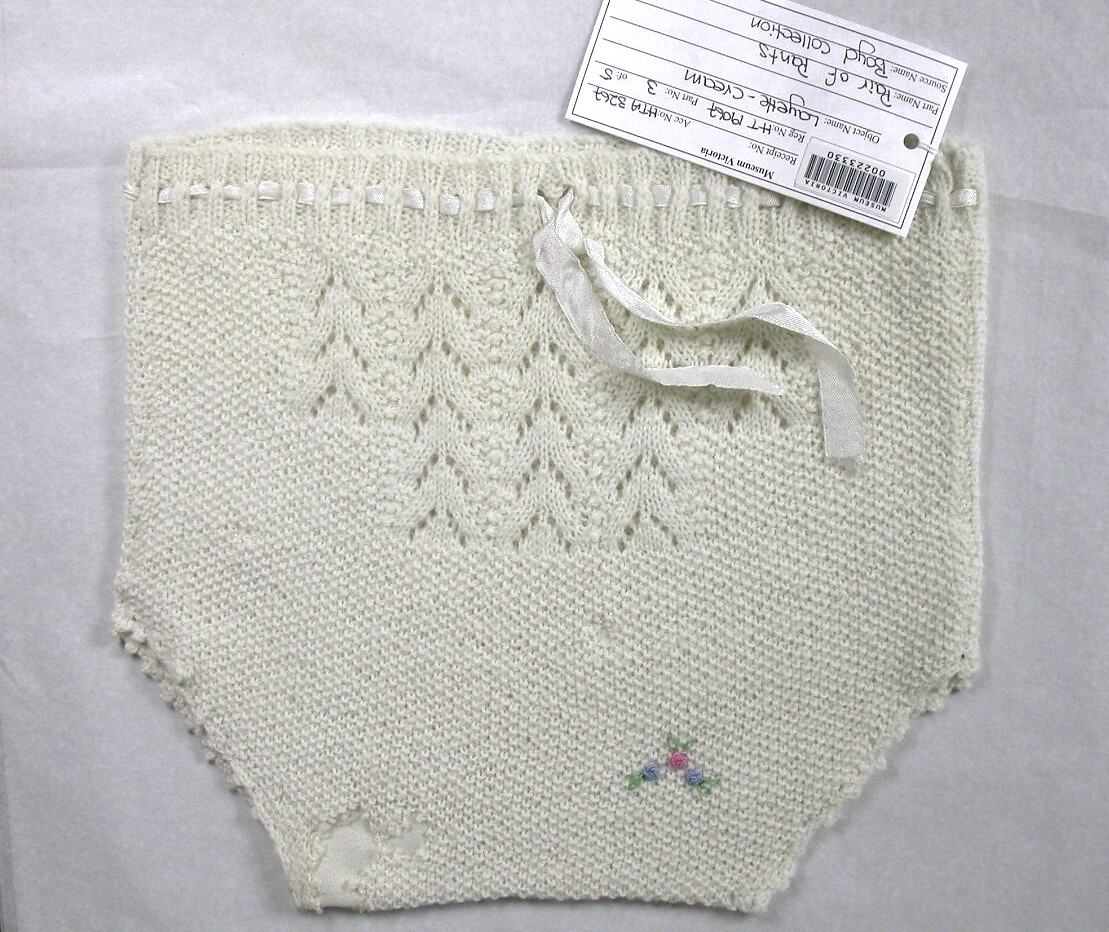
The cream layette pants HT 19067.3 belong to a described group of a dress, matinee jacket, pants and bonnets. The physical description mentions hand-knitted cream wool, lace stitch and rosebud motifs.[6] It describes the ensemble, so we cannot place every rosebud on the pants from this sentence alone. Nor should “lace” be treated automatically as crochet. The collection includes both knit and separately identified crochet elsewhere; the wording attached to each object matters.
Read the household, but keep its scale
Museums Victoria uses the wider childhood collection to explore making do in postwar Victoria, changing toy materials, gender expectations and the influence of Britain and American popular culture.[1] That is a curatorial interpretation of hundreds of objects, not proof that every Australian infant wore a hand-knitted layette or that Lillian made these five garments. Here, the strongest evidence is more modest and more concrete: one family retained objects that show how knitted fabric could be combined with embroidery, ribbon and crochet; how colour motifs could recur; and how catalogues separate an object’s estimate of age from its documented use.
When opening another vintage knitting pattern, ask four questions before borrowing its story. Is the making date separate from the wearing date? Which features are knitted, and which are added later? What material, dimensions and stitch names are actually recorded? Is the maker identified? The unanswered questions belong in the account too. They keep a beautiful object from turning into an invented history.
Primary records
- [1] Museums Victoria, William Boyd Childhood Collection.
- [2] HT 19072, Bonnet.
- [3] HT 19051, Blue Booties.
- [4] HT 19078, Cardigan.
- [5] HT 19066.1, Romper Suit.
- [6] HT 19067.3, Layette Pants.
- [7] HT 19079.1, Jumper.
The five photographs are actual collection images, each marked CC BY 4.0 by Museums Victoria. No AI-generated illustration is used. Each caption links the object, image file and reuse licence.