Eight pairs of knitted doll socks and three berets with conflicting knitting and crochet labels reveal how to read an Auckland Museum wardrobe through original records and five licensed photographs.
Auckland Museum’s circa-1945 New Zealand cot blanket combines a knitted ground with embroidered victory messages. Five licensed photos and primary records reveal what the object can and cannot prove.
Museums Victoria’s knitted wool jumper HT 31972 shows how Nicky Winmar’s 1993 garment became historical evidence. Five licensed museum views, the object record, and official testimony distinguish what the textile proves from later interpretation.
Auckland Museum’s 1853 Harsant shawl reveals a named migrant, a hand-knitted wool textile and the limits of royal tradition. Compare five rights-cleared views and six primary records.
Five Smithsonian NMAI chullo records from Peru’s Cusco region distinguish place, fibre, knitting and crochet. Five separately licensed comparison photographs are clearly identified as different objects, while restricted museum images are not reproduced.
Fifteen primary and institutional records trace the Monarch Knitting Company from a St. Thomas factory incentive to home-knitting yarn and two wartime pattern books. Two licensed modern Buffalo photographs and three clearly marked AI illustrations distinguish evidence from interpretation.
Anne Trotter’s 1840 Irish specimen book preserves four knitted exercises beside sewing and embroidery. Five credited museum photographs reveal both the work and its limits.
Five Norwegian collection records show knitting in a reading group, a painted market, press photographs and a family home—while their catalogues set clear limits on what can be claimed. Five individually credited, reusable images.
Violet May Wilson’s seamless hand-knitted socks reveal making habits and the limits of exhibition prize records. Five museum object cards and five credited CC BY photographs distinguish knitting from tapestry and embroidery.
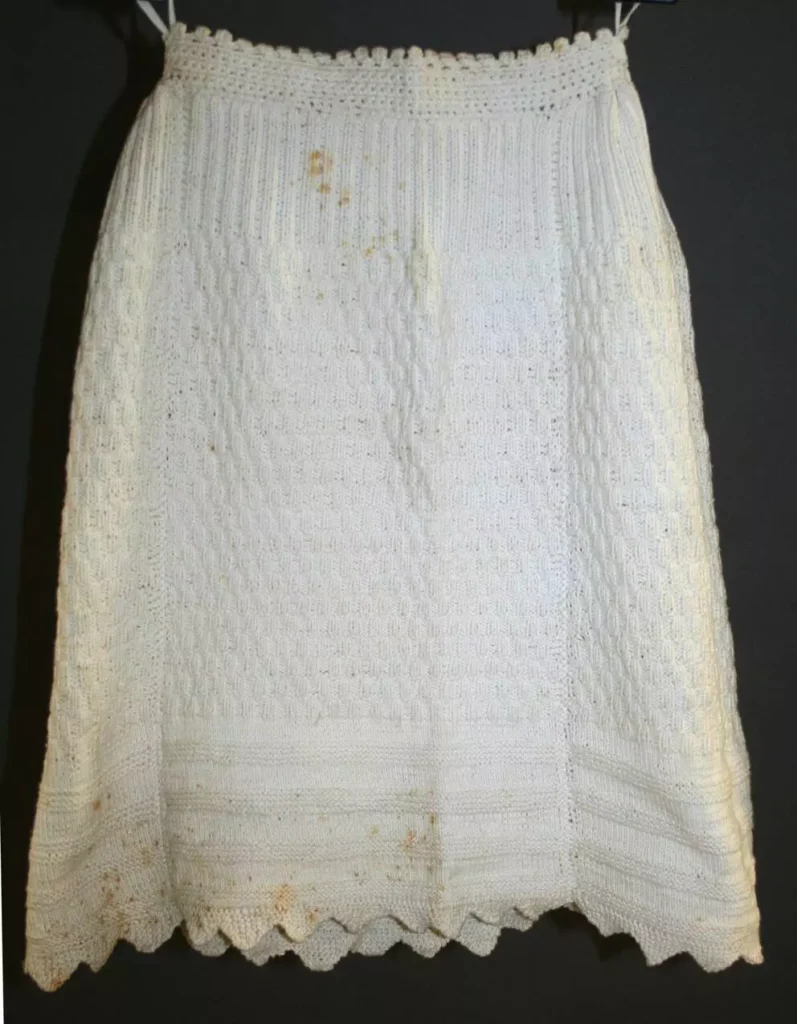
Five Wien Museum garments dated from about 1890 to about 1965 reveal how knitting, crochet, embroidery and sewing appear together in the records. Explore five original cards and five CC BY 4.0 photographs.