Violet May Wilson’s Seamless Socks: Making, Shows, and More Than Knitting
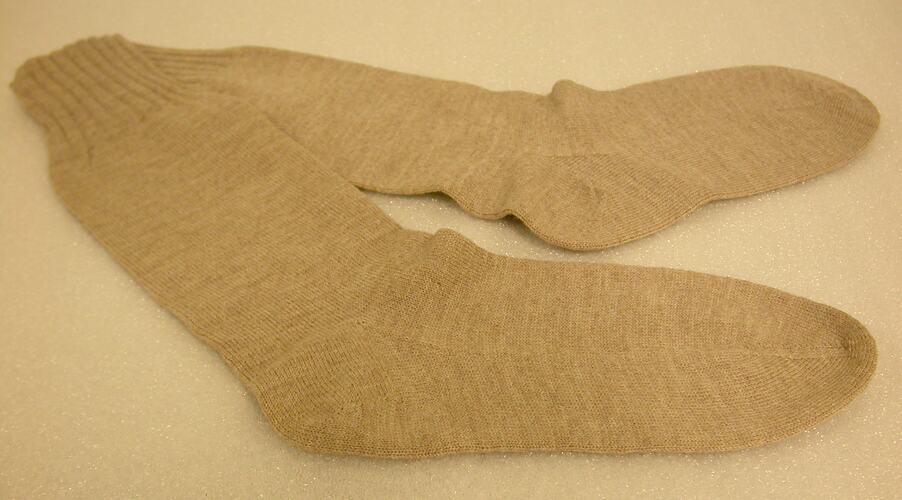
A pair of fawn socks offers a more precise starting point for Violet May Wilson than a tally of prizes. Museums Victoria records that she knitted the wool pair on four needles without seams. The ribbed tops continue into stocking stitch on the calves and feet. The catalogue dimensions are 15 by 51 cm; they are not a modern shoe size. The card identifies the maker as Mrs Violet Wilson and the donor in 2001 as Miss Myrtle Wilson, without stating their relationship.
The same record describes Wilson setting aside 2–4 p.m. for handcraft on days other than Sunday and knitting or making wool tapestries by an Aladdin lamp in the evening. These are details preserved through one collection record, not a general timetable for Australian women. It also reports three very fine pairs of men’s socks that reportedly needed a hand-knitted label for show judges in the 1960s. That passage does not give the needle size or gauge of the surviving fawn pair.

What the prizes can and cannot tell us
The museum says this pair received 50 first and 15 second prizes before the Second World War, while warning that details of individual awards no longer survive. Those numbers are the institution’s account, not a recoverable list of shows or judges. It would be wrong to attach the fine-gauge description of Wilson’s other socks to this exact pair.
Another knitted object by Wilson, the bird tea cosy SH 890220, shows a different construction: its sides are joined only halfway down, leaving room for a teapot’s handle and spout. The museum dates it to around 1933. Its show and prize history belongs to that cosy, not to the socks; the two totals cannot establish a lifetime count. The cosy and two other Australian makers are discussed in the existing tea-cosies article.

Her work was more than knitting
Wilson also made a tapestry bag SH 890361 dated 1932 and a pansy table centre SH 890338 dated 1943. The bag is tapestry; the linen table piece uses embroidery and cutwork. Calling either knitting would erase the different work involved. The table-centre card preserves the donor daughter’s memories of flowers brought indoors as models and of parcels sent to shows, later returning with certificates. This is family recollection recorded by the museum, not a description of every exhibitor.


Powerhouse object 91/2061 preserves another Wilson tea cosy, made of embroidered linen, and six prize certificates. Its photographs require a separate licensing enquiry, so none are reproduced here. Those six surviving certificates do not verify every prize attributed to the knitted cosy in another collection. Read together, the socks, cosy and non-knitted work show how technique, use, exhibition and later collecting must be kept distinct.
Primary object records: HT 659; SH 890220; SH 890361; SH 890338; Powerhouse 91/2061.