Which Sweaters Were Made with Needles? Reading Chiconcuac’s Market and Its 2025 Artisan Catalogue
Published · Updated

A sweater in the market is a question, not a technique label
A row of wool garments at the Chiconcuac market invites a quick conclusion: these must all be knitted by hand. Their appearance alone cannot tell us whether a particular garment was made with knitting needles, a crochet hook or a knitting machine. Haakon S. Krohn's 2010 photograph of wool garments shows the commercial setting, but it does not identify the maker or construction of any individual sweater. His photograph of the market is likewise a view of trade, not a photograph of an item in the municipality's 2025 artisan catalogue. The useful question is narrower than whether Chiconcuac is a “hand-knitting village”: which specific records actually identify work made with needles?


A 2010 market-context photograph; it does not establish an individual garment's technique or maker. Haakon S. Krohn, original file and credit, published image file, CC BY-SA 3.0. Original unmodified.

A 2010 scene of clothing trade, not a photograph of a 2025 catalogue item. Haakon S. Krohn, original file and credit, published image file, CC BY-SA 3.0. Original unmodified.
The municipality's account of attractions and traditions distinguishes blankets woven on a treadle loom from sweaters made with needles or a crochet hook. It also describes pre-Hispanic local textile practice, including reed mats. That older practice does not date the origin of modern needle-knitted sweaters. In the municipality's explanation of its coat of arms, a pair of needles appears among the symbols selected in 1974. The emblem tells us how textile work was represented in the community; it cannot establish the stitch structure of a garment hanging in the market.
Two accounts of changing production
The municipality's local history describes a market and textile trade in the late nineteenth century, then places synthetic fibres for handmade sweaters and the first knitting machines in the 1960s. A field account in CIESAS's Ichan Tecolotl discusses the adoption and spread of machinery in the 1970s and 1980s. These are accounts with different emphases, not a single precisely dated switch after which handwork vanished. The market brought manual and machine production into the same setting. When Sergio Gómez recalls production rising from roughly one garment a day to about thirty with machinery, that is his reported experience, not a measured average for the whole municipality.
In the CIESAS article, artisan Reyes Pérez Delgado recalls learning wool work from his family as a child. His account moves through washing, drying, carding, spinning and dyeing wool. After a period working with machines, he returned to the needles to make a sweater for himself; he says wearing it at a local festival brought orders. Returning to needles does not mean he had been untouched by machine production. His account is more revealing because one maker could know and choose among several ways of working. The article's relative phrase “six years ago” must not become a calendar year without establishing the article's date and its reference point.
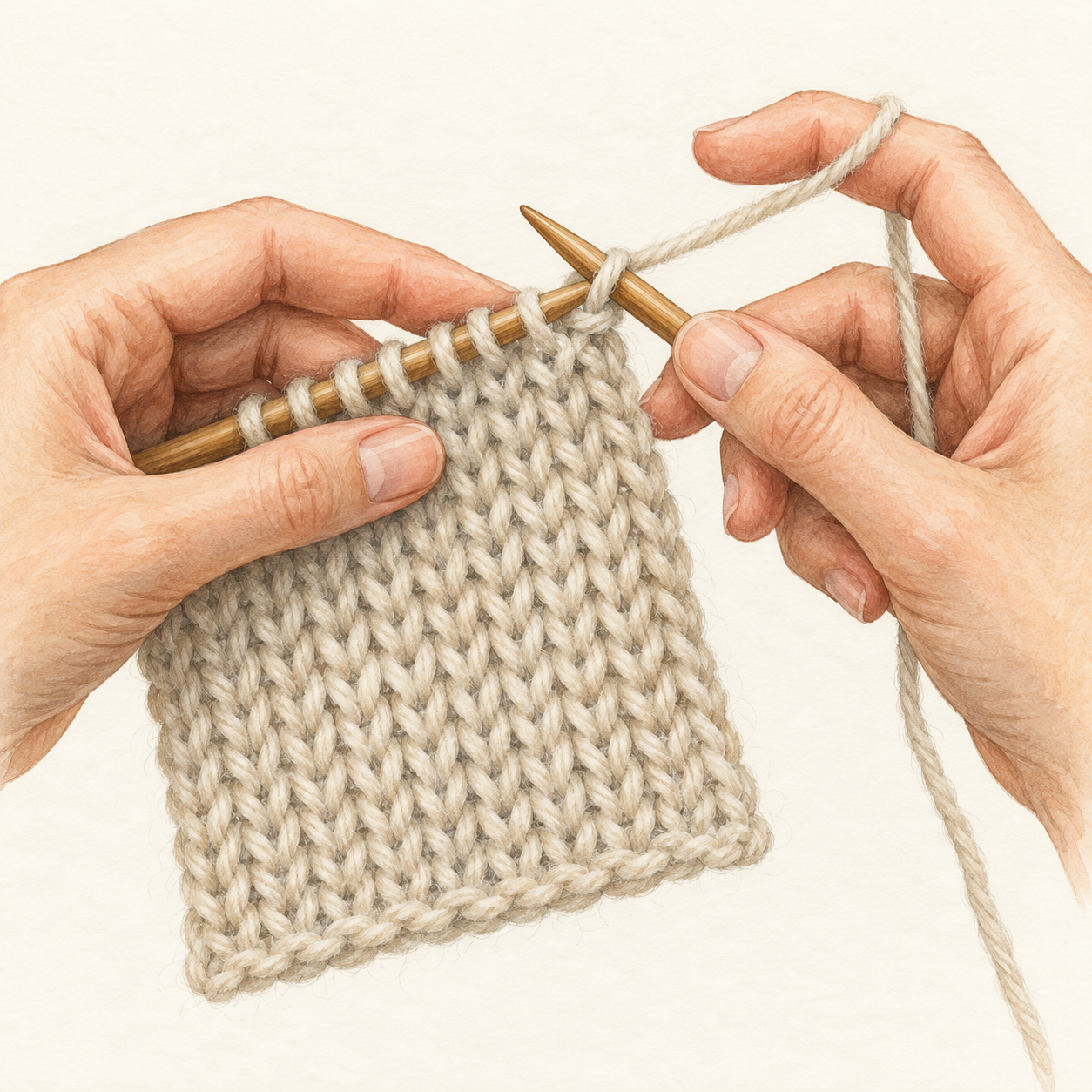
AI-generated reference illustration. These are not Reyes's hands or a photograph of a Chiconcuac garment, and this is not an executable pattern. Published image file. The interview and its documentary photographs are in the CIESAS field article.
The same article presents Sergio Gómez as someone who learned needle knitting from his mother and was learning to incorporate letters, geometric forms, plants and animals from Pérez. It says he had worked with acrylic and mixed yarns and was trying wool. A change in yarn can change the feel and dimensions of a motif, but the article supplies neither needle size, gauge nor stitch counts. It would be misleading to turn this description into an executable pattern. Reyes Pérez Delgado in this article and J. Reyes Pérez López in the municipal catalogue have different surnames. The available records do not establish that they are the same person; they must be read as separate people.
The item label matters more than the catalogue section
The cover of Chiconcuac municipality's 2025 artisan product catalogue names treadle loom, needles and crochet separately. Its pages are therefore a reminder that even products listed under one maker need not share one technique. On Julia Flores Ceballos's page, the purple V-neck vest JULIA/006 is labelled “TEJIDA A GANCHO.” Immediately below it, the pale infant sweater JULIA/007 is labelled “TEJIDO CON AGUJAS · CUELLO REDONDO.” The red infant sweater JULIA/008 is also labelled as needle knitting, with the description “ABIERTO CON PALMAS.” The vest is crochet while both sweaters are needle-knitted, despite their shared maker. This distinction follows the technique printed beside each object, not a guess about stitches from a photograph.
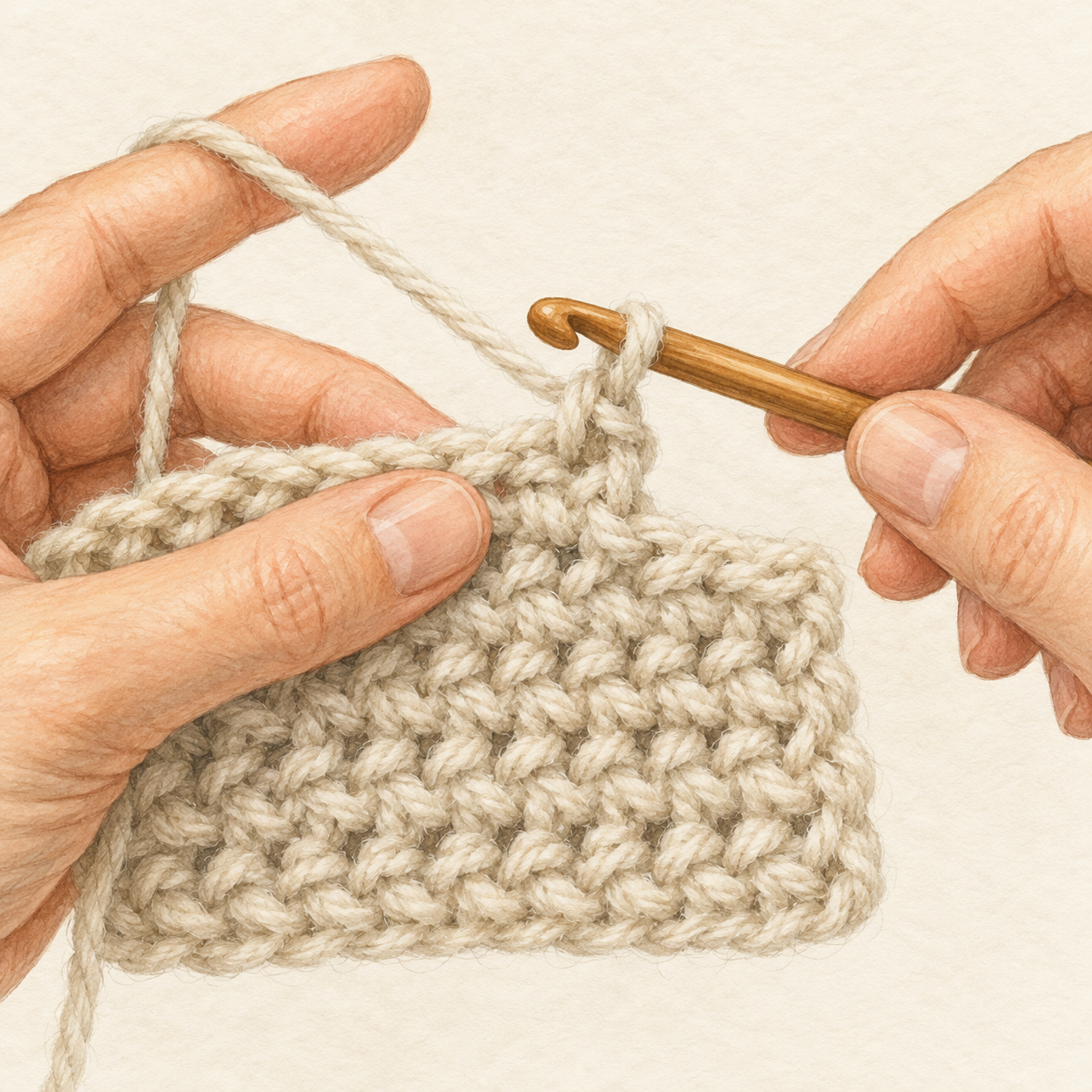
AI-generated reference illustration. This is neither a photograph nor a reconstruction of Julia Flores Ceballos's vest. Published image file. See the actual object photographs and technique labels in the municipal 2025 artisan catalogue.
Later, the catalogue's “Taller de Tejido de Agujas” section gives Tuesday, Thursday and Friday as class days and presents children's sweaters and vests. On the inspected pages, the red-and-black round-neck sweater is attributed to student Rocio Ramos, and the pale cable-style round-neck sweater to Eloisa Velasco. The following page shows Maria Luisa Guzmán's pink striped, front-opening sweater. The descriptions and photographs distinguish necklines, openings and surface details, but they do not supply stitch counts, gauge or assembly instructions for these garments. The catalogue also uses a phrase about the “world's largest sweater”; without independent verification, it cannot be adopted as a verified world record.
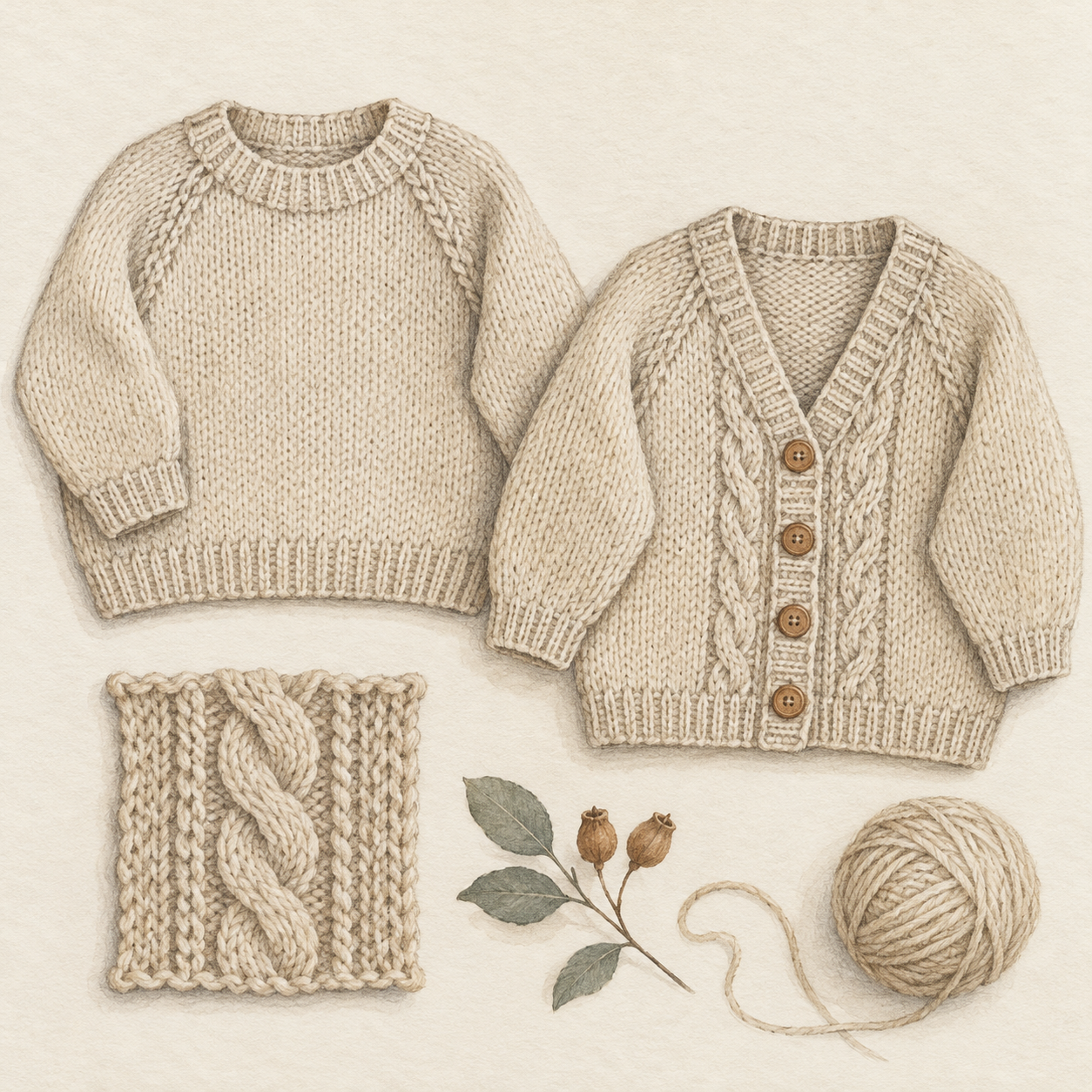
AI-generated reference illustration. It does not reproduce students' actual work, measurements or assembly. Published image file. The municipal 2025 artisan catalogue contains the documentary photographs and descriptions.
The catalogue can guide a reader through three practical checks. First, read the item's technique label: needles, crochet and loom are different processes. Second, check which construction details belong to that item, rather than to its neighbour on the page. Third, look for measurements, gauge, assembly and stitch counts. The catalogue introduces artisans and products; it is not a complete pattern for every garment. Filling in absent numbers would silently replace a maker's documented work with our own invention.
The two market photographs can answer where garments were sold. The CIESAS interviews can tell us who learned and reconsidered particular methods. The municipal catalogue can identify which listed objects are explicitly described as needle-knitted. Next time a sweater or a pattern catches your eye, look past the garment's name and ask what the record says about its technique, construction and missing measurements. That small separation respects the range of textile work in Chiconcuac and makes the makers' choices easier to see.
If you enjoyed this story, please leave a warm greeting.
No name or email is needed. Greetings are published immediately, and your country and a masked IP address may be shown. The original IP address and browser information are stored with your greeting for comment management, spam prevention and security. Privacy policy and deletion requests
This product includes GeoLite Data created by MaxMind, available from https://www.maxmind.com.