What Can a Name on a Stocking Tell Us? Five Knitted Pairs from Nineteenth-Century Wales
Published
A name at the top of a stocking invites a story. Who put it there, and whom was the stocking meant to serve? The name alone cannot answer the second question. Five pairs held by Museum Wales offer a more careful way to read a knitted object: compare the record of its maker and use with what the catalogue says about the stitches. Two pairs carry an explicit association with death. The other three make useful comparisons because letters and decorative patterns appear without a documented funeral use. The point is to keep each pair’s evidence in its own place.
A traveller’s observation and five object records
John Evans’s 1804 account of a tour through South Wales describes domestic clothing production and skill at knitting in a particular area. His report of a rapid stocking-making pace combines observation and information he received. It is neither a measured output for all Wales nor an eyewitness account of any of the five pairs below. The passage does not mention funeral stockings or names worked into the fabric. It does, however, give a contemporary context for knitting as household work. John Evans, Letters written during a tour through South Wales (1804), printed page 357
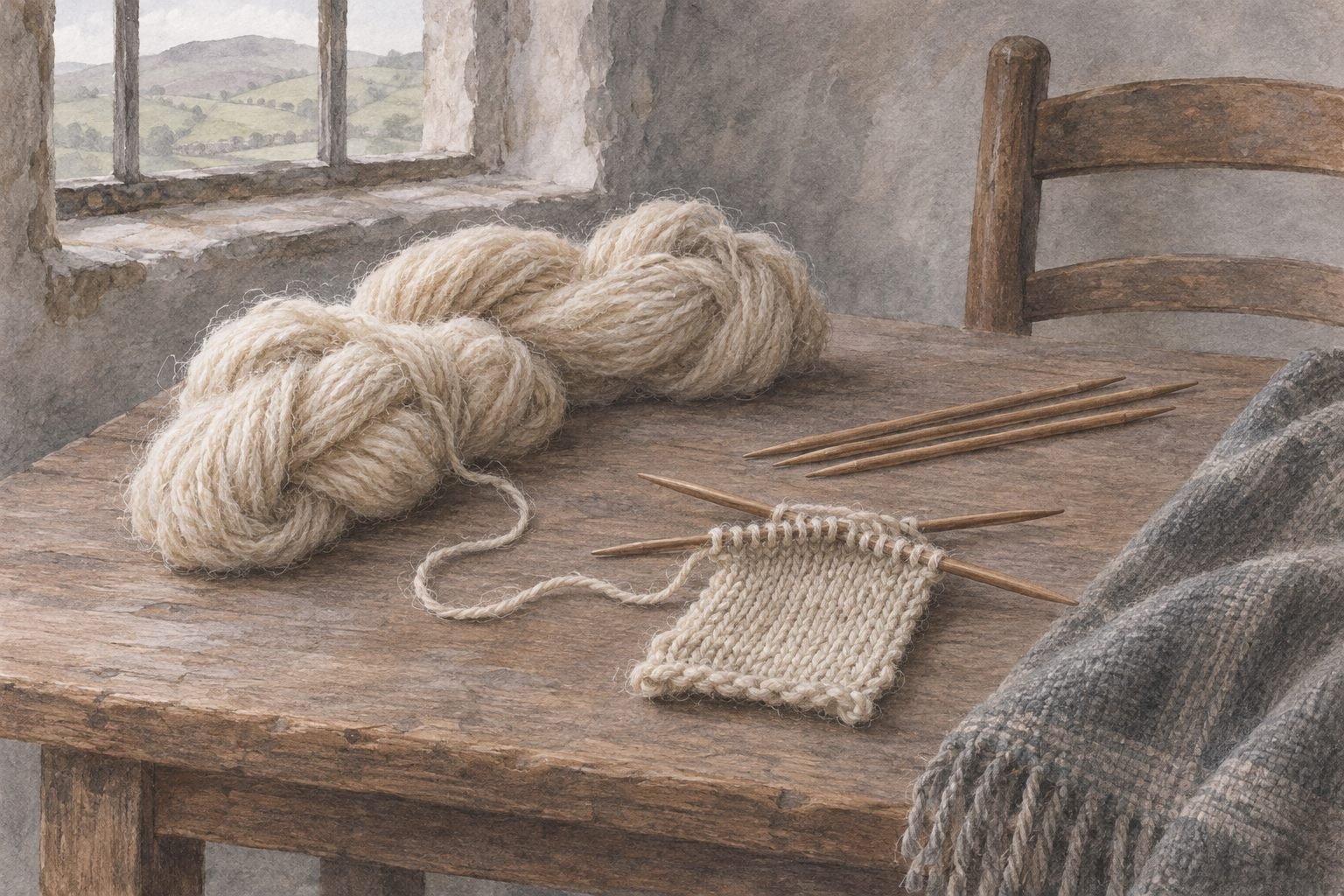
AI-generated illustration. An imagined materials scene, not a documented nineteenth-century interior or named person. Image file · Contextual source: Evans’s 1804 printed page. The source image was not copied.
The museum cards are a different kind of source. They describe surviving objects, measurements, materials, techniques and reported associations. All five cards belong to the same institution, although each records a different pair. They cannot be turned into five independent testimonies to one national custom. What they can do is show where a name, a stitch pattern and an account of use coincide—and where they do not.
Two pairs associated with death, in different ways
The stockings of Eliza Lewis, 41.51.1–2, were made at Esgair-onnen Farm near Llanarth around 1850. Museum Wales says Lewis knitted the knee-length white pair from wool hand-spun on the farm, intending them to be worn on her body after her death. Her full name is knitted at the upper part in reddish-brown wool. The record gives dimensions of 600 by 220 mm. The farm origin of the yarn does not tell us who spun it; it would be an extra claim to say Lewis carried out that work herself.
The Capel Bangor stockings, F78.4.12–13, have a different association. The museum says a donor’s family used them when laying out a deceased relative in the late nineteenth century. Their maker is not named on the card. The black-and-white chevron pattern sits below a roughly 2.5 cm band of knit-one, purl-one ribbing and a 7 cm plain section. The record lists wool and cotton and measurements of about 560 by 210 mm for each stocking. Lewis’s own intention and the reported use of the Capel Bangor pair are distinct pieces of evidence. Neither warrants a rule that all Welsh funeral stockings carried the maker’s name.
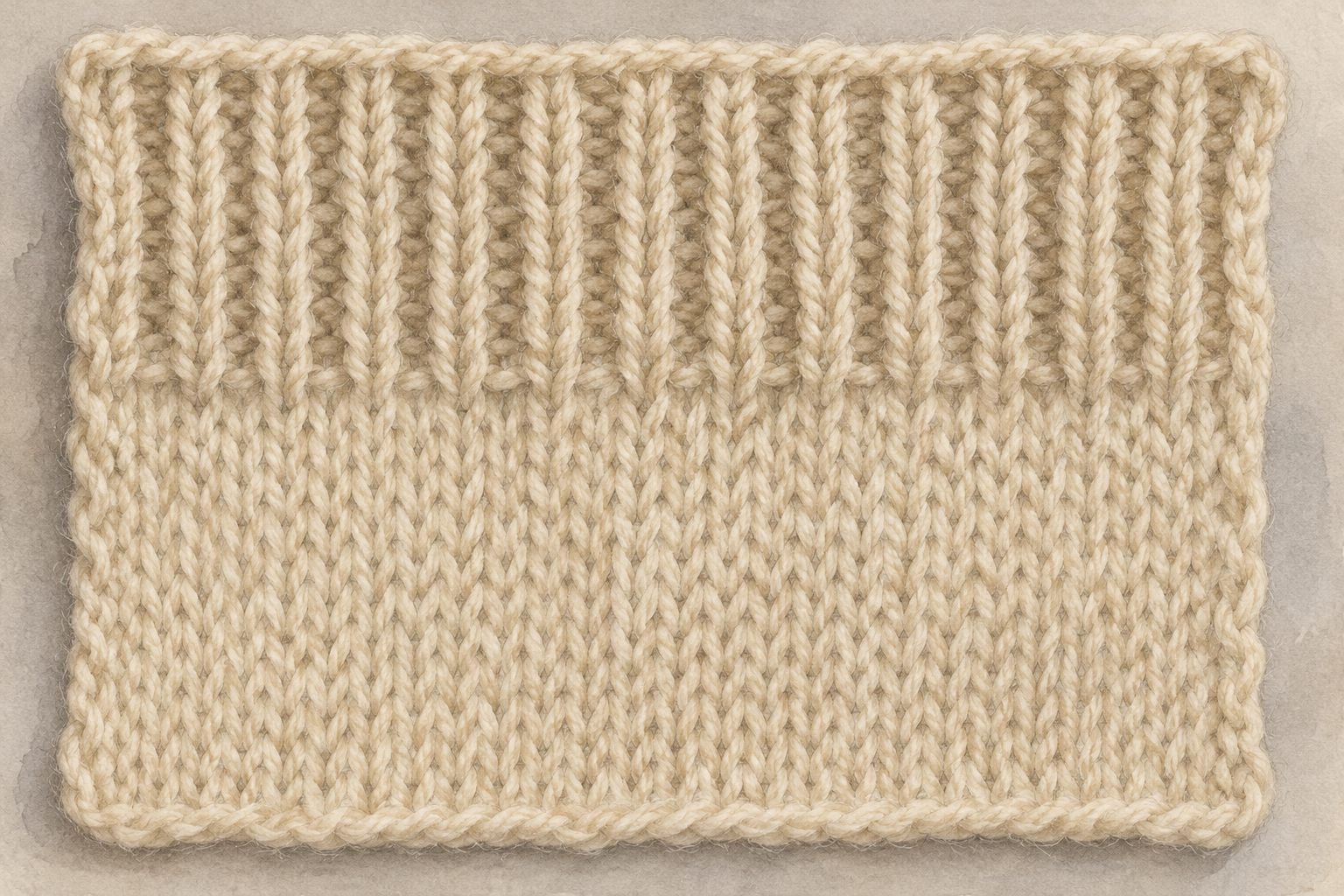
AI-generated illustration. A general texture comparison, not a reconstruction of the Capel Bangor pair, its dimensions or exact stitch layout. Image file · Object record for comparison. The object photograph was not copied.
Letters do not all mean the same operation
The pair knitted by Elizabeth Thomas, 67.526.6–7, is dated 1874 and placed at Gwynfe. Two purl rows at the top are followed by twelve rows of three knit stitches to one purl stitch. Blue wool marks the initials ET five times around the stocking. Further down, four-stitch cables, each only a little over a centimetre wide, cover much of the leg and foot. The catalogue distinguishes sections of plain knitting at the heel, sole and toe. It does not classify the pair as funeral wear. The initials are only one part of a much more detailed account of construction.
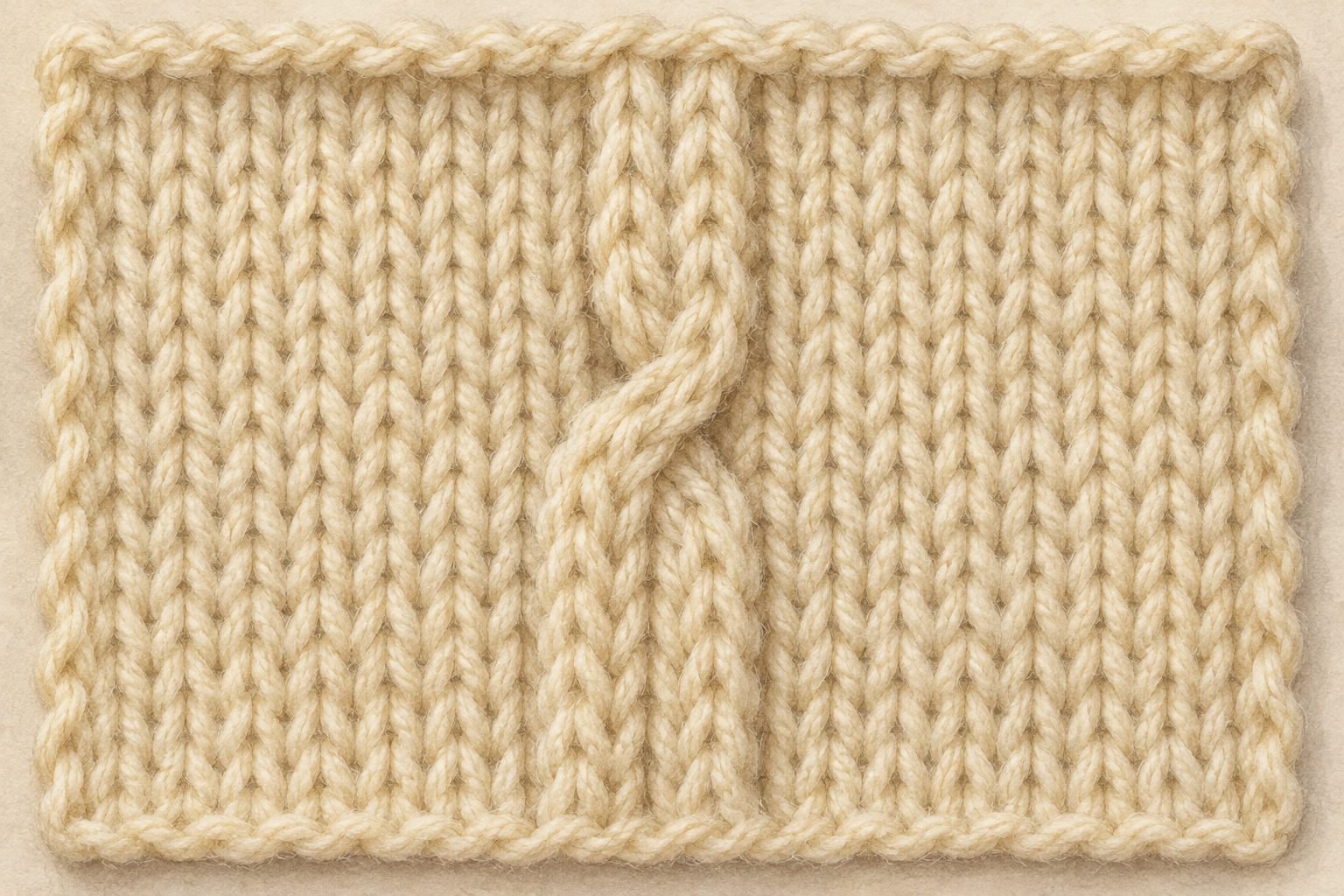
AI-generated illustration. A general raised cable texture, not a chart or proof of the Thomas pair’s four-stitch crossing, width or direction. It is not an executable pattern. Image file · Object record for comparison. The object photograph was not copied.
The Ann Jones pair, 45.338.1–2, was made around 1870 at Rhydcymerau. The museum’s Welsh-language card describes the pair as having cross-stitched letters. Its current English card does not specify the letters, colour or stitch layout, so this article does not identify them as AJ or assign them a colour. Thomas’s English card says ET is picked out in blue wool; Lewis’s says her complete name is knitted into the upper part. Those descriptions should not be collapsed into one assumed sequence of stitch-making. The Jones card does not document a funeral or a particular wedding use.
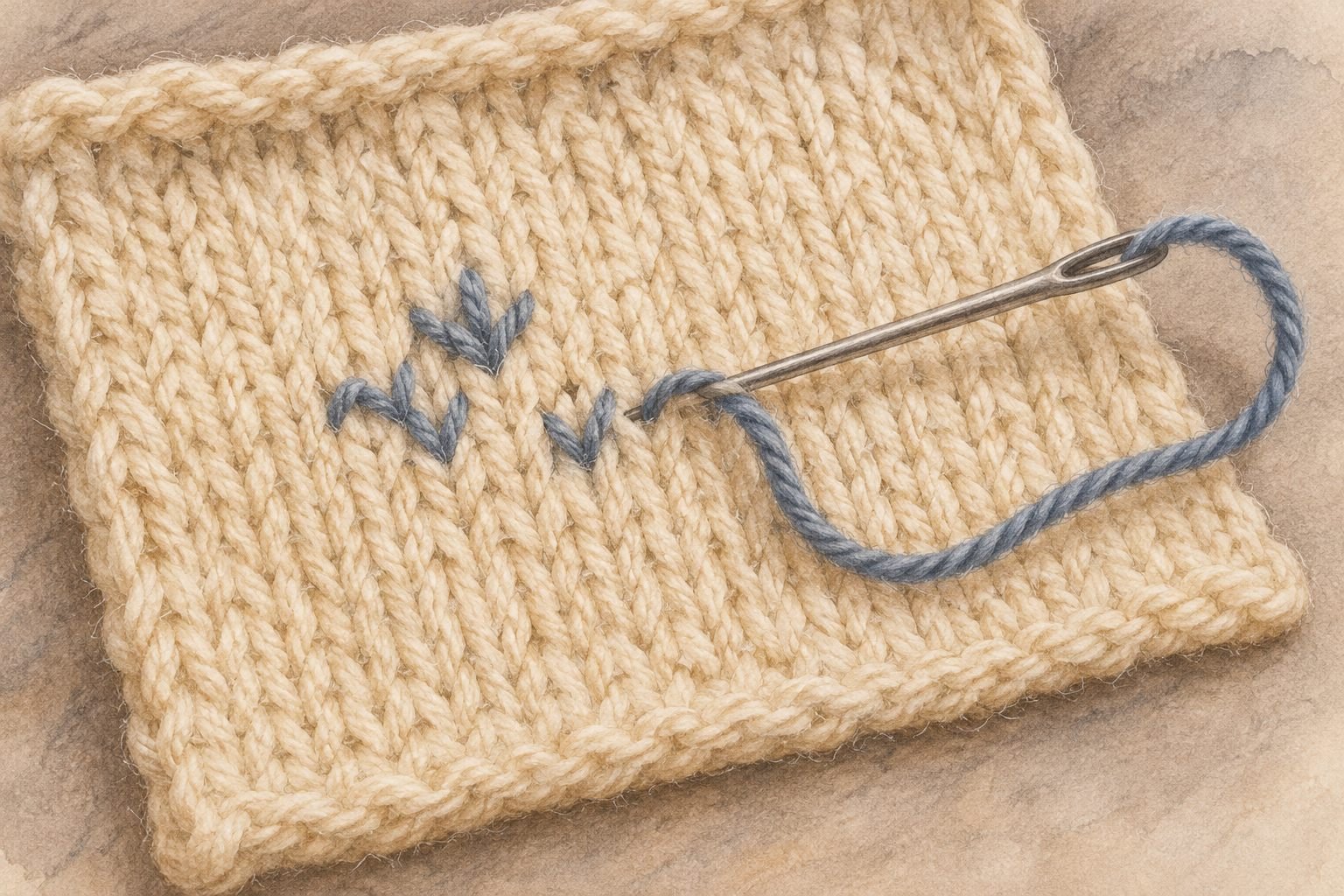
AI-generated illustration. A general concept of adding separate yarn to a knitted surface, not the Jones pair’s lettering or cross-stitch method. Image file · Museum’s Welsh-language object record for comparison. The object photograph was not copied.
A maker’s name can live in the record rather than on the fabric
The stockings owned and made by Esther David, 56.494.12–13, are recorded under the name of a maker who lived from 1821 to 1898. Their cream wool has decorative motifs at either side of the ankle and a band about 2 cm wide at the upper edge, formed by contrasting knitted stitches. The card does not say that David’s name was written on the stockings, or that they were used at a funeral. Her identity comes through the object record; the surface offers information about its decorative placement and stitch contrast.

AI-generated illustration. Only a general placement example, not the David pair’s actual motifs or shape, or a mourning garment. Image file · Object record for comparison. The object photograph was not copied.
The practical reading sequence is simple, though its answers are not. Begin at the upper edge: is the band ribbed, plain, or built from contrasting stitches? Check whether a letter is described as embroidery, picked out in another colour, or knitted as part of a name. Follow a motif down the leg and foot, or locate it at the ankle only. Then return to the record before making a claim about the wearer’s life. Lewis and the Capel Bangor pair support two different death-related stories. Thomas, Jones and David show how letters and patterns also occur where no funeral use is documented. A surviving stocking can preserve a set of loops and letters without telling us an entire biography or the practice of every Welsh household.
If you enjoyed this story, please leave a warm greeting.
No name or email is needed. Greetings are published immediately, and your country and a masked IP address may be shown. The original IP address and browser information are stored with your greeting for comment management, spam prevention and security. Privacy policy and deletion requests
This product includes GeoLite Data created by MaxMind, available from https://www.maxmind.com.